

Western Bronze-naped Pigeon vs Lemon Dove
Columba iriditorques versus Aplopelia larvata
Play a quiz with Western Bronze-naped Pigeon and Lemon Dove
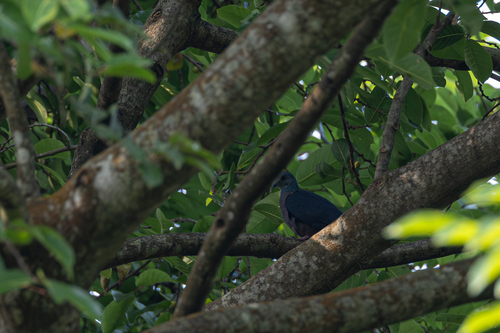 Western Bronze-naped Pigeon
 Lemon Dove
In short
The most reliable field mark to separate Western Bronze-naped Pigeon from Lemon Dove is the broad, pale terminal tail band of the Bronze-naped, which is especially obvious when the bird lands or fans its tail—Lemon Dove lacks this. In perched views, focus on head and underpart color: adult male Bronze-naped Pigeon shows a dark bluish-grey head and vinous breast, while Lemon Dove is more uniformly brownish-grey with a cinnamon breast and a pale whitish face. Juvenile Lemon Doves have barred, pale-fringed wing coverts, a feature not described for Bronze-naped. Both species can look similar in size and general shape, but the Lemon Dove is slightly heavier and has a more subdued, ground-dove jizz. Habitat can help: Lemon Dove is tied to montane forests, often on the ground, while Bronze-naped Pigeon is more generalist.
Identification tips
- Pale terminal tail band (Bronze-naped only): Look for a broad, pale band at the tip of the tail, especially visible as the bird lands or fans its tail—diagnostic for all ages and sexes of Western Bronze-naped Pigeon, never present on Lemon Dove.
- Head color (adult males): Adult male Bronze-naped Pigeon has a dark bluish-grey head, contrasting with the body; Lemon Dove is brownish-grey with a pale whitish face and lacks any blue-grey tones.
- Underparts (adults): Bronze-naped Pigeon males show a dark vinous (wine-red) breast and belly; Lemon Dove is cinnamon brown below, usually paler and warmer-toned, with a more gradual transition from the brown upperparts.
- Crown and underparts (adult females): Female Bronze-naped has a cinnamon-reddish brown crown and greyish-chestnut underparts, but still shows the pale tail band. Female Lemon Dove is duller than male but otherwise similar, with a cinnamon breast and pale face.
- Juvenile/immature plumage: Juvenile Lemon Dove has pale fringes on wing coverts and body feathers, giving a barred look, and greyer facial markings. Juvenile Bronze-naped Pigeon is not described as barred or fringed, likely appearing plainer.
- Neck gloss: Lemon Dove adults have a greenish or bronze gloss on the neck sides in good light; Bronze-naped Pigeon does not show this feature.
- Facial markings: Lemon Dove has a pale whitish face grading into the brown body, sometimes with white marks on the head; Bronze-naped Pigeon lacks this pale face and is more uniform-headed.
- Bill and bare parts: Lemon Dove has red feet, red iris and orbital skin, and a black bill; these features are not described for Bronze-naped, but are not likely to be as obvious at distance.
- Flight style: Lemon Dove flushes low and fast, usually disappearing into dense cover; Bronze-naped Pigeon may fly higher and is more likely to show the tail band in flight.
- Jizz: Lemon Dove is compact, ground-dwelling, and horizontal in posture; Bronze-naped is more upright and 'classic pigeon' in silhouette.
- Habitat: Lemon Dove is almost always in dense montane or evergreen forest, often on the ground; Bronze-naped Pigeon is more generalist, often in more open or edge woodland, and more arboreal.
- Size: Lemon Dove is slightly heavier, but size overlap is extensive and not reliable for field separation.
- Sex differences: Both species show subtle sexual dimorphism, but the tail band (Bronze-naped) and face color (Lemon Dove) are more useful than sex-based differences.
- Season: No strong seasonal plumage changes are described for either species; use structural and plumage marks year-round.
- Pitfalls: In poor light, both can look brownish and similar in size. Always try to see the tail pattern and face color for confirmation.
Size
Both species are medium-sized pigeons, but Lemon Dove averages slightly heavier (body mass ~148g vs. ~126g for Bronze-naped [wikidata]). Lemon Dove's length range (24–30 cm) overlaps with Bronze-naped's (about 25 cm), so size alone is unreliable in the field. Structurally, Lemon Dove is compact and ground-dwelling, often appearing shorter-legged and more horizontal when walking; Bronze-naped Pigeon is a bit more upright and 'classic pigeon' in jizz.
Plumage
- Juvenile/immature: Juvenile Lemon Doves are brown overall with pale fringes on wing coverts and body feathers, creating a barred appearance, and have greyer facial markings. No such barring or pale fringes are described for juvenile Bronze-naped Pigeon, which likely appears plainer.
- Adult males: Bronze-naped Pigeon males have a dark bluish-grey head and a dark vinous (wine-red) breast and belly, with a broad, pale terminal tail band. Lemon Dove adults are brownish-grey above, cinnamon brown below, with a greenish-glossed neck and a pale whitish face; the tail is plain, without a pale terminal band.
- Adult females: Female Bronze-naped Pigeon has a cinnamon-reddish brown crown and greyish-chestnut underparts, but still shows the pale tail band. Female Lemon Dove is similar to male but duller, with the same cinnamon breast and pale face.
- Flight/upperwing: The only clear flight mark is the Bronze-naped's pale terminal tail band, visible when landing or fanning tail; Lemon Dove lacks this, and its flight is less showy, with no strong tail pattern.
Behaviour
Lemon Dove is shy, unobtrusive, and spends much time on the ground in dense montane or evergreen forest, often walking with a bobbing motion. It is more likely to flush low and quickly vanish into cover. Western Bronze-naped Pigeon is more arboreal and often perches higher, sometimes seen flying between trees or landing in more open forest edges, where its pale tail band flashes. Lemon Dove's behavior is more typical of a ground-dove, while Bronze-naped fits the pattern of a tree-pigeon.
Habitat
Lemon Dove is strongly tied to montane and evergreen forests in sub-Saharan Africa, usually above 1000 m, and is rarely found far from dense, moist woodland. It is most often seen in the undergrowth or on the forest floor. Western Bronze-naped Pigeon is more widespread across Africa and less habitat-restricted, found in a variety of wooded habitats, including lowland forests and edges. If you see a pigeon on the ground in dense montane forest, Lemon Dove is much more likely; in more open or varied woodland, especially if perched or flying, consider Bronze-naped.