

Western Bluebird vs Mountain Bluebird
Sialia mexicana versus Sialia currucoides
Play a quiz with Western Bluebird and Mountain Bluebird
 Western Bluebird
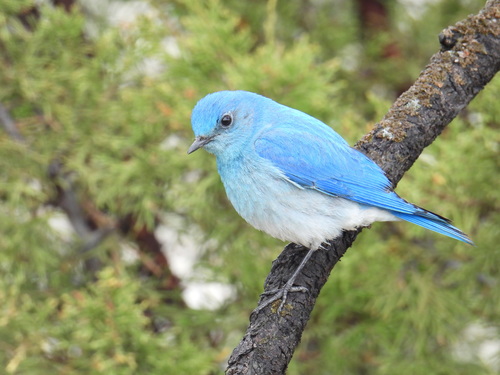 Mountain Bluebird
In short
The most reliable field mark between Western Bluebird and Mountain Bluebird is the presence or absence of orange coloration: Western Bluebird (all ages) shows orange on the breast and flanks, while Mountain Bluebird completely lacks orange and is instead all blue above with a pale or white belly. Adult male Mountain Bluebirds are a brighter, more uniform sky-blue, especially below, compared to the darker blue and orange combination of Western males. Females and immatures of both species are duller, but Western Bluebird females show at least a hint of orange on the breast, while Mountain Bluebird females are grayish with blue wings and tail and may show only a faint brownish wash in fall. Both species are similar in size and shape, but subtle differences in structure and habitat can help. Immature birds can be tricky, but the presence of orange or brownish-orange on the underparts is a strong clue for Western Bluebird.
Identification tips
- Orange or Rusty Breast (All Ages): Western Bluebird always shows orange or rusty on the breast and sides, even in immatures and females. Mountain Bluebird never shows orange; any warm color on the underparts is brownish in fall females, not orange.
- Male Plumage: Adult male Mountain Bluebird is bright, sky-blue above and below, with a white belly and no orange. Western Bluebird male is darker blue above, blue on the throat, orange on the breast and sides, and grayish below.
- Female Plumage: Female Western Bluebird has a dull orange breast and sides, gray throat, and blue wings/tail. Female Mountain Bluebird is gray overall with blue wings and tail, gray throat, and may have a brownish (not orange) wash in fall.
- Immature/Juvenile Markings: Western Bluebird immatures have spots on the chest and back and show some orange on the underparts. Mountain Bluebird immatures lack orange and are generally dull grayish with pale underparts.
- Throat Color: Western Bluebird has a blue (male) or gray (female) throat. Mountain Bluebird always has a gray throat in females and blue in males, but never orange.
- Belly Color: Mountain Bluebird has a white or very pale blue belly, contrasting with the blue upperparts. Western Bluebird's belly is gray, not white, and the orange of the breast often extends onto the sides.
- Back Patch: Western Bluebird males have a brownish patch on the back, which is lacking in Mountain Bluebird.
- Bill Shape: Both have thin, straight bills, but Mountain Bluebird's may appear slightly finer and more pointed.
- Flight Style: Mountain Bluebird is more likely to hover or sally out in open areas, while Western Bluebird often perches and drops to the ground.
- Habitat Context: In open, treeless or high-elevation areas, Mountain Bluebird is more likely. In wooded or edge habitats, especially with nest boxes, expect Western Bluebird.
- Vocalizations: Mountain Bluebird's calls are higher-pitched and thinner than Western Bluebird's softer, more varied calls, but this is subtle and not always reliable.
- Seasonal Variation: In fall, female Mountain Bluebirds may show a brownish tinge on the breast, but it is never orange as in Western Bluebird.
- Flock Composition: Mixed flocks can occur, but look for the orange-breasted birds (Western) among all-blue birds (Mountain) for quick separation.
- Tail and Wing Color: Both species have blue wings and tail, but Mountain Bluebird's are a brighter, more uniform blue, while Western Bluebird's are darker and contrast more with the orange sides.
- Common Pitfall: Do not rely on overall blueness alone—always check for orange on the underparts for Western Bluebird, and remember that Mountain Bluebird never shows orange at any age or season.
Size
Both species are very similar in size, with Western Bluebird measuring 15–18 cm and Mountain Bluebird 15.5–18 cm in length [wikipedia]. Their weights and wingspans overlap, so size alone is not a reliable separator in the field.
Plumage
-
Juvenile/Immature birds: Western Bluebird immatures have spots on the chest and back, and even young birds show some orange on the breast and sides. Mountain Bluebird immatures are generally duller, with a pale underbelly and lack any orange; their underparts can be washed brownish in fall but not orange.
-
Adult males: Western Bluebird males are deep blue above, with a blue throat, orange breast and sides, brownish patch on the back, and gray belly/undertail. Mountain Bluebird males are bright turquoise-blue above and below, with a paler (almost white) belly and no orange or brown anywhere.
-
Adult females: Western Bluebird females are grayish with dull blue wings and tail, a gray throat, and a dull orange breast and sides. Mountain Bluebird females are gray overall with blue wings and tail, gray crown, throat, and back, and in fresh fall plumage may show a brownish (not orange) tinge on the breast and flanks, with white under the tail.
-
Key contrast: Orange or rusty coloration on the breast and sides is present in all ages and sexes of Western Bluebird, but completely absent in Mountain Bluebird.
Behaviour
Both species are cavity nesters and may use nest boxes. Western Bluebirds are often seen in more wooded or edge habitats, sometimes perching lower or in denser trees. Mountain Bluebirds are more likely to be found in open country, such as meadows or sagebrush, and are more likely to hover or sally for insects in open areas. Both species may be seen in loose flocks outside the breeding season.
Habitat
Western Bluebird prefers open woodlands, forest edges, and areas with scattered trees, often at lower elevations. Mountain Bluebird is more typical of open, often higher-elevation habitats such as mountain meadows, grasslands, and sagebrush flats. Overlap can occur, but context can help: a bluebird in a wide-open, treeless area is more likely Mountain; in a wooded area, Western is more likely.
Voice
Western Bluebird gives soft calls described as "cheer," "chur-chur," and "chup." Mountain Bluebird's call is a thin "few," and its song is a high, warbled "chur chur." Both are soft and may be difficult to separate by ear in the field, but Mountain Bluebird's calls are higher-pitched and thinner.