

Western Black-headed Oriole vs Black-winged Oriole
Oriolus brachyrynchus versus Oriolus nigripennis
Play a quiz with Western Black-headed Oriole and Black-winged Oriole
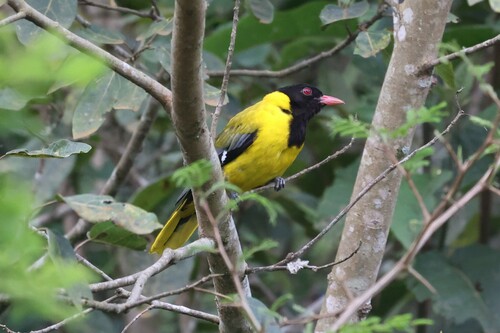 Western Black-headed Oriole
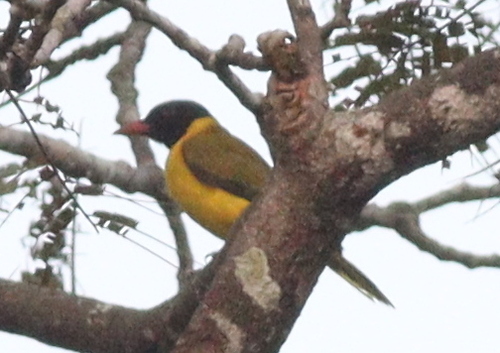 Black-winged Oriole
In short
The most reliable field mark to separate Western Black-headed Oriole from Black-winged Oriole is the head and upper breast coloration in adults: Western Black-headed Oriole shows a striking black head and upper breast, sharply set off from yellow-olive upperparts and bright yellow underparts, while Black-winged Oriole lacks detailed description here but is implied to differ in these features. Juvenile Western Black-headed Orioles are olive above with an olive head and yellow-streaked throat, lacking the adult's black head. Both species are similar in size and structure, so plumage—especially head and underpart color—is key. Be aware that immature birds can be confusing, and wing pattern in flight is not described for Black-winged Oriole, so focus on perched views and head/underpart contrast.
Identification tips
- Adult head and breast color: Western Black-headed Oriole adults have a sharply defined black head and upper breast, which is the most reliable field mark. If you see a bird with a black head and bright yellow underparts, it is almost certainly this species.
- Upperparts and underparts: Western Black-headed Oriole shows yellow-olive upperparts and bright yellow underparts, contrasting with the black head. If the head is not black, check for other features and age.
- Juvenile confusion: Juvenile Western Black-headed Orioles lack the black head; instead, they are olive above, with an olive head and yellow-streaked throat. The breast is streaked with black, and the beak is dusky. These features can cause confusion with Black-winged Oriole, but the yellow-streaked throat is a helpful clue.
- Wing pattern: Western Black-headed Oriole has a small white patch at the periphery of the wings and black tail feathers with broad yellow tips. These details may be visible in good perched views but are not described as unique in flight for either species.
- Bill color: Adult Western Black-headed Oriole has a brownish-pink beak, while juveniles have a dusky beak. Bill color may help in close views, but is not a primary separator.
- Voice: Western Black-headed Oriole's calls are lower-pitched and more fluty than Black-winged Oriole, with detached notes. If you hear a series of fluty, low-pitched notes, consider this species, but do not rely on voice alone.
- Habitat and range: Both species occur in African forests, including moist lowland and mangrove habitats. Unless you are familiar with local distribution, do not use habitat as a primary separator.
- Perched vs. flight views: Since no distinctive flight or wing pattern is described for either species, focus on perched birds and head/underpart contrast for ID.
- Tail pattern: Western Black-headed Oriole has black tail feathers with broad yellow tips, which may be visible when the tail is spread.
- No sexual dimorphism noted: Both species are not described as sexually dimorphic, so these marks apply to both sexes.
- No seasonal variation described: There is no mention of seasonal plumage change, so these marks are reliable year-round.
- Pitfall—immature birds: Immature Western Black-headed Orioles can be confusing due to their lack of a black head; look for the yellow-streaked throat and overall olive tone to separate from adults.
- Pitfall—similar size and structure: Do not attempt to separate these species by size, structure, or jizz, as they are very similar in these respects.
- Pitfall—white wing patch: The small white patch at the wing periphery in Western Black-headed Oriole is subtle and may be missed; do not rely on this alone.
- Use multiple marks: For the most reliable identification, combine head/breast color, underpart tone, and age-related features, especially when dealing with juveniles or birds in poor light.
Size
Both species are similar in size, with Western Black-headed Oriole measuring about 21 cm in length and weighing 42–57 g [wikipedia]. No direct measurements are available for Black-winged Oriole, but there is no indication of a significant size difference in the literature. Structure, such as bill and tail, is not described as distinctive between these two species.
Plumage
For adults, Western Black-headed Oriole is distinctive with its black head and upper breast, sharply contrasting with yellow-olive upperparts and bright yellow underparts. The wings have a small white patch at the periphery, and the tail is black with broad yellow tips. The beak is brownish-pink. In juveniles, Western Black-headed Oriole lacks the black head; instead, it has olive upperparts and head, a yellow-streaked throat, a dusky beak, and a breast streaked with black. For Black-winged Oriole, detailed plumage description is not provided in the sources, but the implication is that it does not show the same black-headed pattern as Western Black-headed Oriole. No age-specific wing pattern or flight marks are described for either species, so separation relies on head and underpart coloration, especially in perched birds. Juvenile Western Black-headed Orioles may be especially confusing, but the yellow-streaked throat and lack of a full black head are clues.
Behaviour
No behavioral differences are described in the available sources for these two species. Both are typical orioles in habits and likely to be seen in similar forested environments.
Habitat
Both species inhabit African forests, but Black-winged Oriole is specifically noted in moist lowland and mangrove forests from Sierra Leone and Liberia to southern South Sudan, western Uganda, central DRC, and north-western Angola [wikipedia]. Western Black-headed Oriole is also native to Africa, but the precise range overlap is not detailed here. In practice, both may occur in similar habitats, so habitat alone is not a reliable separator unless local distribution is well known.
Voice
Western Black-headed Oriole is noted for a variety of fluty vocalizations with detached notes, generally lower-pitched than Black-winged Oriole, and also gives a harsh 'whit-cheeew-cheeew' [wikipedia]. No detailed description of Black-winged Oriole's voice is provided, but the pitch difference may help if both species are present. However, voice is not a primary separator based on available information.
Western Black-headed Oriole · Black-winged Oriole · My Tricky Birds