

Wedge-tailed Shearwater vs Sooty Shearwater
Ardenna pacifica versus Ardenna grisea
Play a quiz with Wedge-tailed Shearwater and Sooty Shearwater
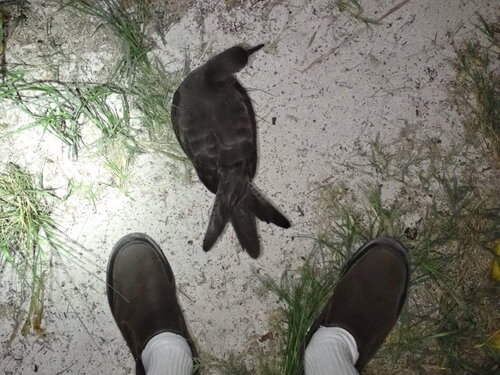 Wedge-tailed Shearwater
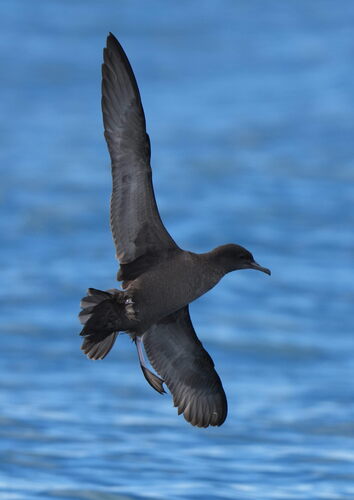 Sooty Shearwater
In short
The most reliable separation between Wedge-tailed Shearwater and Sooty Shearwater is the tail shape and underwing pattern in good light. Sooty Shearwater always shows a silvery central panel on the underwing, while Wedge-tailed Shearwater lacks this feature in all morphs. Wedge-tailed Shearwater also has a distinctly wedge-shaped tail, most obvious in flight, whereas Sooty Shearwater’s tail is more squared-off. Both species can appear all-dark at a distance, especially the dark morph Wedge-tailed, so careful attention to underwing and tail is crucial. Structural differences and subtle plumage cues help in close or prolonged views.
Identification tips
- Underwing pattern is key: Sooty Shearwater always shows a silvery central panel on the underwing in good light, which Wedge-tailed Shearwater (both morphs) lacks. This is the most reliable field mark in flight.
- Tail shape: Wedge-tailed Shearwater has a long, wedge-shaped tail that is often obvious in flight, especially when fanned or gliding. Sooty Shearwater’s tail is more squared-off and less pointed.
- Overall coloration: Sooty Shearwater is uniformly dark chocolate-brown, appearing almost black in poor light. Wedge-tailed Shearwater dark morph is also all-dark, but pale morph birds have grey-brown upperparts and white underparts, which can be distinctive.
- Plumage pitfalls: Dark morph Wedge-tailed Shearwater can look very similar to Sooty Shearwater at a distance or in poor light. Use underwing and tail shape for confirmation.
- Bill and leg color: Both have dark bills, but Wedge-tailed Shearwater has salmon-pink legs (often tucked and hard to see at sea). Not a primary field mark.
- Flight style: Sooty Shearwater’s flight is powerful and direct, with stiff, straight wings, sometimes recalling a small albatross. Wedge-tailed Shearwater also glides but may appear less forceful.
- Habitat and range: If seen in tropical waters, especially around breeding colonies, Wedge-tailed Shearwater is more likely. In cooler waters or during migration, especially in large flocks, Sooty Shearwater is more probable.
- Colony behavior: Wedge-tailed Shearwaters are often seen on the surface during the day at colonies; Sooty Shearwaters are more nocturnal.
- Vocalizations: At colonies, Wedge-tailed’s moaning calls differ from Sooty’s coos and croaks, but this is rarely useful at sea.
- Seasonal context: Sooty Shearwaters are long-distance migrants and may be seen far from breeding grounds, including in the northern hemisphere summer. Wedge-tailed Shearwaters are more resident in the tropics year-round.
- Group size: Sooty Shearwaters can form massive migratory flocks (hundreds of thousands), while Wedge-taileds are usually in smaller groups.
- Confusion with other species: Both can be confused with Short-tailed Shearwater, but that species is not covered here.
- Sex and age: No reliable sex or age differences for field separation; both species lack strong sexual dimorphism and age-specific upperwing marks.
- Lighting conditions: In poor light, both species can appear all-dark; prioritize underwing and tail shape when conditions improve.
- Summary tip: Always try to see the underwing in good light and the tail shape in flight for the safest identification.
Size
Wedge-tailed Shearwater is a medium-large shearwater with a body mass around 465 g [wikidata], making it similar in bulk to Sooty Shearwater, though direct size comparison is difficult without side-by-side views. Both are robust, long-winged seabirds, and size alone is not a reliable field mark between them.
Plumage
- Juvenile/Immature/First-winter: No age-specific upperwing patterns are noted for either species that would allow a quick separation of young birds in flight. Both can appear uniformly dark above and below when seen poorly.
- Adult (all seasons): Sooty Shearwater is always dark chocolate-brown overall, with a distinctive silvery strip running along the center of the underwing, visible in good light. Wedge-tailed Shearwater comes in two morphs: pale morph (grey-brown above, white below) and dark morph (dark grey-brown all over). Both morphs lack the silvery underwing panel. The wedge-shaped tail of Wedge-tailed is a structural plumage feature visible in flight, while Sooty’s tail is more squared. Bill color is dark in both, but Wedge-tailed has salmon-pink legs (often hard to see at sea).
Behaviour
Both species exhibit the typical stiff-winged, gliding flight of large shearwaters, but Sooty Shearwater is especially noted for its powerful, direct flight with wings held stiff and straight, sometimes resembling a small albatross. Wedge-tailed Shearwater also glides but may appear slightly less direct. Both species shear low over the waves, often with wingtips nearly touching the water. At colonies, Wedge-tailed Shearwaters are more likely to be seen on the surface during the day, while Sooty Shearwaters are more nocturnal at breeding sites.
Habitat
Wedge-tailed Shearwater is a tropical species, found throughout the tropical Pacific and Indian Oceans, generally between 35°N and 35°S. Sooty Shearwater breeds in the southern hemisphere (New Zealand, Australia, South Atlantic islands) and migrates widely into both hemispheres, reaching subarctic waters in the non-breeding season. While both can occur together in the Pacific, Sooty Shearwater is more likely in cooler waters and during migration, whereas Wedge-tailed is resident in warmer, tropical seas.
Voice
Wedge-tailed Shearwater is known for its long, moaning calls at colonies, with a distinctive inhaling and exhaling pattern ("OOO-err"). Sooty Shearwater is also vocal at breeding sites, producing loud coos and croaks, but is usually silent at sea except when competing for food. Vocalizations are rarely useful for separation at sea, but can help at colonies.
Wedge-tailed Shearwater · Sooty Shearwater · My Tricky Birds