

Wedge-tailed Grass-Finch vs Lesser Grass-Finch
Emberizoides herbicola versus Emberizoides ypiranganus
Play a quiz with Wedge-tailed Grass-Finch and Lesser Grass-Finch
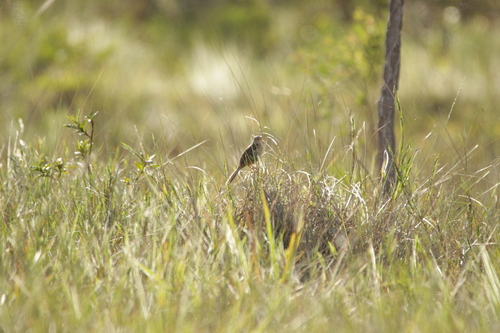 Wedge-tailed Grass-Finch
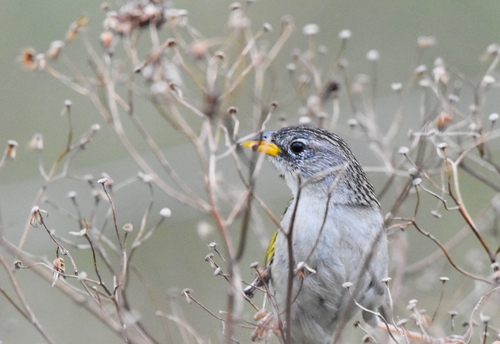 Lesser Grass-Finch
In short
The most reliable field mark to separate Wedge-tailed Grass-Finch from Lesser Grass-Finch is the face and nape color: Wedge-tailed shows a pale brownish face and nape, while Lesser Grass-Finch has a distinctly grayish face and nape. Both species are long-tailed, streaky grassland birds with similar structure and overlapping ranges in southern Brazil, Paraguay, Uruguay, and northern Argentina, but careful attention to facial color and upperpart tones is key. Juvenile birds of both species are similar, but Lesser Grass-Finch juveniles have a more pronounced yellow cast to the face and underparts. Bill color and flank streaking offer supporting clues, but can be subtle. Habitat and behavior are very similar and not reliable for separation.
Identification tips
- Face and Nape Color (all ages): Wedge-tailed Grass-Finch has a pale brownish face and nape, while Lesser Grass-Finch shows a distinctly grayish face and nape. This is the most consistent field mark for adults.
- Supercilium and Eye-ring: Both species have a pale supercilium and thin whitish eye-ring, but these are not reliable for separation.
- Crown and Upperparts: Wedge-tailed has a pale brownish crown with thin blackish streaks; Lesser Grass-Finch's crown is greenish to brownish with similar streaking. The upperparts of Wedge-tailed are boldly streaked brown and blackish, while Lesser is streaked greenish brown and black.
- Rump and Uppertail Coverts: Wedge-tailed's rump is unstreaked, with thin black streaks on the uppertail coverts; Lesser's rump and uppertail coverts have thinner black streaks but are not as clean as Wedge-tailed.
- Wing Edges: Both species have wide, bright edges to the wings, but Wedge-tailed's are olive-green, while Lesser's are bright green. This difference is subtle and best seen in good light.
- Tail Structure: Both have long, pointed tails with similar patterning; tail shape is not a reliable separator.
- Underparts: Wedge-tailed has creamy white underparts with buff flanks and vent, while Lesser is pale grayish white below with buff flanks and darker streaks on the flanks and vent.
- Throat: Wedge-tailed's throat is grayish white; Lesser's is white. This is subtle and best used in combination with other marks.
- Bill Color: Both have yellow to yellow-orange bills with a blackish culmen, but Lesser's is described as yellow-orange. This is not a strong separator.
- Juvenile Plumage: Juvenile Lesser Grass-Finch has a more pronounced buffy yellow cast to the face and underparts, while juvenile Wedge-tailed is rusty yellow above and yellowish below. Both have streaked breasts when young.
- Flank Streaking: Lesser Grass-Finch has darker streaks on the flanks and vent, which can help in close views; Wedge-tailed's flanks are buff without strong streaking.
- Leg Color: Both species have brownish yellow to dull pinkish legs and feet; not useful for separation.
- Habitat and Range: Only use range if you are outside the overlap zone: Wedge-tailed occurs north to Panama and Colombia, Lesser is absent from those areas. In southern Brazil, Paraguay, Uruguay, and northern Argentina, both occur together.
- Behavior: Both species behave similarly in grassland and are not reliably separated by jizz or foraging style.
- Size: Wedge-tailed averages slightly heavier, but this is not useful in the field.
In summary, focus on the face and nape color (brownish in Wedge-tailed, grayish in Lesser), upperpart tones (olive-brown vs greenish brown), and flank streaking (stronger in Lesser). Juveniles are best separated by the intensity of yellow/buff on the face and underparts.
Size
Wedge-tailed Grass-Finch is slightly heavier (mean body mass 25 g [wikidata]) and can reach up to 20 cm in length, but Lesser Grass-Finch is nearly the same length (18–20 cm) and only slightly lighter (18.5–22 g). In the field, size difference is minimal and not a safe mark for separation.
Plumage
- Juveniles: Both species' juveniles resemble adults but with a yellow or buffy wash to the face and underparts, and streaks on the breast. Lesser Grass-Finch juveniles are noted for a stronger buffy yellow cast, especially on the face and underparts, while Wedge-tailed juveniles are more rusty yellow above and yellowish below but less strongly so.
- Adults: Wedge-tailed Grass-Finch has a pale brownish crown and face, with a pale brownish nape and upperparts boldly streaked brown and blackish. The rump is unstreaked, and the uppertail coverts have thin black streaks. The wings have wide olive-green edges. The underparts are creamy white with buff flanks and vent, and the throat is grayish white.
Lesser Grass-Finch adults have a greenish to brownish crown, a grayish face and nape, and upperparts streaked greenish brown and black. The wings have wide bright green edges. The underparts are pale grayish white, flanks are buff with darker streaks, and the throat is white. The face is distinctly gray, contrasting with the crown and nape, which is a key difference from the paler, browner face of Wedge-tailed. - Tail: Both species have long, pointed tails with dark centers and grayish brown edges.
Behaviour
Both species behave similarly, favoring tall grass in grasslands and savannas, often perching conspicuously on grass stems or low shrubs. They are typically seen singly or in pairs, moving through dense grass and occasionally flying low with a bounding flight. Behavior is not a reliable separator.
Habitat
Habitat is not diagnostic: both species inhabit damp to dry grasslands with tall grass and scattered shrubs. Wedge-tailed Grass-Finch has a broader range (including Colombia, Panama, and much of South America except Chile), while Lesser Grass-Finch is restricted to Argentina, Brazil, Paraguay, and Uruguay. In areas of overlap (southern Brazil, Paraguay, Uruguay, northern Argentina), habitat preferences are essentially identical.
Wedge-tailed Grass-Finch · Lesser Grass-Finch · My Tricky Birds