

Water Rail vs Eurasian Coot
Rallus aquaticus versus Fulica atra
Play a quiz with Water Rail and Eurasian Coot
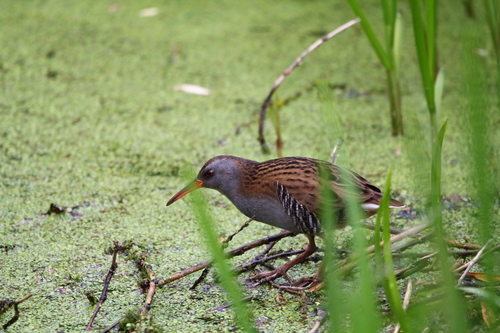 Water Rail
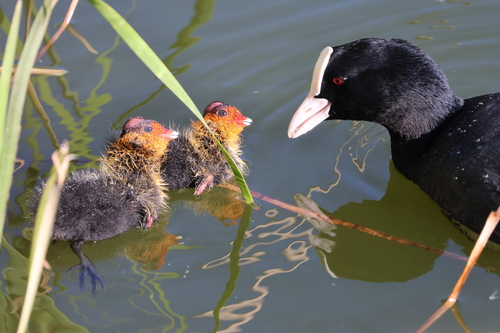 Eurasian Coot
In short
The most reliable way to separate Water Rail from Eurasian Coot is by overall structure and bill color: Water Rail is a slender, laterally compressed rail with a long, downcurved red bill, while Eurasian Coot is a much larger, chunkier waterbird with a short, thick white bill and a prominent white facial shield. In flight or at rest, Water Rail shows brown upperparts with black streaks and a distinctive white undertail, whereas Coot is uniformly slaty-black with no streaking and lacks any white in the undertail. Juvenile Water Rails have buffy underparts and a duller bill, but still never show the white facial shield of even young coots. Size difference is dramatic: Coot is nearly seven times heavier and much longer. Both may be seen in wetlands, but Coot is often out in the open water, while Water Rail keeps to dense reedbeds.
Identification tips
- Bill color and shape: Water Rail has a long, slender, slightly downcurved red bill (adults), while Coot has a short, thick, straight white bill with a large white shield above it. Even in juveniles, Coot never shows a long red bill.
- Facial shield: Only Coot has a prominent white facial shield above the bill; Water Rail lacks any shield, further emphasizing its pointed bill.
- Body shape: Water Rail is slim, laterally compressed, and has a hunched, low-slung posture. Coot is bulky, rounded, and sits high in the water or stands upright on land.
- Plumage pattern: Water Rail shows brown, black-streaked upperparts and blue-grey underparts with black and white barred flanks (adults). Coot is uniformly slaty-black with no streaking or barring.
- Undertail: Water Rail flashes a white undertail with some dark streaks, especially when flicking its tail. Coot's undertail is dark and never white.
- Juvenile differences: Juvenile Water Rail has buffy underparts and brown/buff flank markings, but never a white facial shield or all-black plumage. Juvenile Coot is pale with a whitish breast and lacks the shield, but still appears more uniformly dusky and never streaked or barred.
- Legs and feet: Water Rail has flesh-brown legs and long toes, but not webbed. Coot has strong, partially webbed toes adapted for swimming.
- Flight style: Water Rail flies weakly, low over the reeds, often dropping quickly. Coot takes off with much splashing, but can fly strongly over longer distances.
- Habitat context: Water Rail is almost always near dense cover, rarely in open water. Coot is often in the open, swimming or walking on floating vegetation.
- Size: Coot is dramatically larger and heavier than Water Rail. If you see a rail-like bird that looks goose-sized, it's a Coot.
- Behavior: Water Rail is shy and secretive, quickly disappearing into cover. Coot is bold, often aggressive, and visible.
- Vocalizations: Water Rail's pig-like squeals are distinctive but rarely heard in the open. Coot's sharp, explosive calls are common and loud.
- Tail: Water Rail has a short tail often flicked up to show the white undertail. Coot's tail is very short and not usually flicked.
- Seasonal variation: Both sexes are similar year-round; Water Rail's blue-grey underparts are replaced by buff in juveniles, but the bill and undertail remain distinctive. Coot's shield develops fully only after the first year, but even young birds never have a long red bill or streaked plumage.
- Pitfalls: In poor light, Water Rail's brown and grey tones may look darker, but the long red bill and white undertail are still good clues. Juvenile Coots may seem paler, but lack any streaking or barring and never show a red bill.
Size
Eurasian Coot is vastly larger than Water Rail: Coot averages 775 g (males up to 890 g), while Water Rail is only about 111.5 g. In length, Coot is 36–38 cm versus Water Rail's 23–28 cm. Coot also has a much greater wingspan (70–80 cm vs. 38–45 cm). Even at a distance, Coot's bulk, long neck, and robust body are obvious, while Water Rail is slim, laterally flattened, and much smaller overall. If you see both together, the size gap is unmistakable.
Plumage
- Juvenile/immature birds: Juvenile Water Rail has a blackish crown, white chin/throat, buff or white underparts with dark bars, and brown/buff flank markings (not black and white). Its undertail is buff, and the bill/eye/legs are duller than adults. Juvenile Coot is paler than adult, with a whitish breast, dusky upperparts, and lacks the white facial shield. The adult black plumage and white shield only develop at 3–12 months.
- Adults: Adult Water Rail shows brown, black-streaked upperparts, blue-grey underparts, black and white barred flanks, and a white undertail with some dark streaks. The long, red, slightly downcurved bill is diagnostic. Adult Coot is slaty-black overall, with a glossy black head, a short thick white bill, and a prominent white shield above the bill. Coot never shows brown, streaks, or barring, and its undertail is dark, not white.
- In flight: Water Rail shows a white undertail and brown streaked upperparts; Coot appears all dark with no white in the tail or wings, and its white bill/shield stand out.
Behaviour
Water Rail is secretive, skulking through dense reeds or vegetation, rarely venturing into the open except when flushed or feeding at the edge. It moves with a hunched posture, often flicking its short tail to reveal the white undertail. In flight, it is weak and reluctant, usually flying only short distances low over the reeds. Eurasian Coot is much bolder, often swimming in the open on lakes and ponds, diving for food, and walking on floating vegetation. Coots are aggressive, especially in breeding season, and may be seen chasing each other or other species. Their flight is labored but stronger than Water Rail, with longer, broader wings.
Habitat
Both species occur in wetlands, but Water Rail is tied to dense, well-vegetated reedbeds, marshes, and wet thickets, rarely venturing into open water. Eurasian Coot prefers open freshwater lakes, ponds, and reservoirs, often in urban parks, and is frequently seen swimming far from cover. If you see a rail-like bird out in the open water, it is almost certainly a Coot; Water Rail is typically glimpsed at the edge of reeds or running for cover.
Voice
Water Rail gives a distinctive pig-like squeal or grunting call, often heard at dawn or dusk from deep cover. Eurasian Coot is noisy, with a repertoire of sharp, explosive 'kew' or 'kow' calls, and various cackles and croaks, especially when alarmed or during territorial disputes. If you hear loud, repeated, harsh calls from open water, it's likely Coot; Water Rail's calls are more secretive and less likely to be heard in the open.