
Water Rail vs Baillon's Crake
Rallus aquaticus versus Zapornia pusilla
Play a quiz with Water Rail and Baillon's Crake
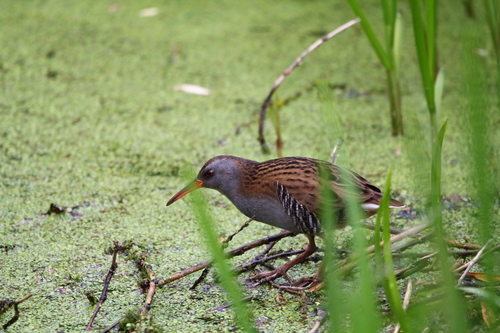 Water Rail
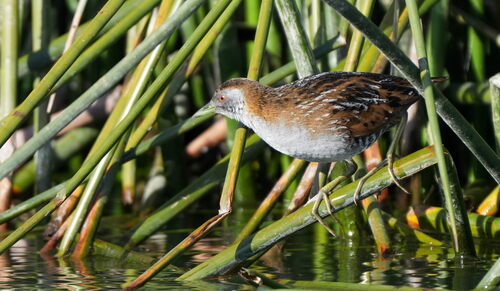 Baillon's Crake
In short
The most reliable field mark to separate Water Rail from Baillon's Crake is overall size and structure: Water Rail is much larger, with a long, downcurved red bill and a laterally flattened body, while Baillon's Crake is tiny, compact, and has a short, straight yellowish or greenish bill. Both species can show blue-grey underparts and barred flanks, but Water Rail adults have a distinctive white undertail and extensive slate-blue on the face and breast, whereas Baillon's Crake is paler below and lacks the Water Rail's long bill and white undertail. Juvenile Water Rails have buffy underparts and a duller bill, which can be confused with Baillon's Crake, but size and bill shape remain reliable. In flight or when flushed, Water Rail appears much bulkier and longer-tailed than the daintier Baillon's Crake.
Identification tips
- Size is the first check: Water Rail is much larger and bulkier than Baillon's Crake. If the bird looks tiny and compact, it is almost certainly Baillon's Crake.
- Bill shape and color: Water Rail has a long, slender, slightly downcurved red bill (adults), while Baillon's Crake has a short, straight, yellowish or greenish bill with no red at the base. This is reliable for all ages except very young juveniles.
- Undertail pattern: Adult Water Rail shows a broad, white undertail with some dark streaks, especially visible when the tail is cocked or in flight. Baillon's Crake has black and white barring on the undertail, but never the bold white patch of Water Rail.
- Face and underparts: Water Rail adults have extensive slate-blue on the face, throat, and breast, contrasting with brown upperparts. Baillon's Crake is paler blue-grey below, with less contrast and no strong blue on the face.
- Flank barring: Both species have black and white barred flanks, but Water Rail's are more sharply defined and contrast with the blue-grey underparts; Baillon's Crake's barring can appear finer and less bold.
- Juvenile confusion: Juvenile Water Rails lack the blue-grey and have buffy underparts with brown and buff flank markings, which can resemble Baillon's Crake. However, size and bill shape remain diagnostic. Juvenile Baillon's Crake is still much smaller, with a short, straight bill.
- Leg color: Water Rail has flesh-brown legs; Baillon's Crake has olive-green legs. This is subtle and best used in good light.
- Upperparts: Water Rail's upperparts are olive-brown with black streaks, especially on the shoulders. Baillon's Crake's upperparts are ochre-brown with some black and white streaks, but less contrasting overall.
- Tail length and carriage: Water Rail has a short but obvious tail, often cocked to show the white undertail. Baillon's Crake's tail is shorter and less likely to be cocked.
- Flight jizz: Water Rail appears heavy, long-bodied, and strong-winged in flight, with a broad white undertail. Baillon's Crake is quick, fluttery, and compact, with no obvious white undertail flash.
- Voice: Water Rail gives a loud, pig-like squeal; Baillon's Crake gives a rapid, rattling trill. If you hear the call, this is diagnostic.
- Habitat context: Water Rail is more likely in large, permanent reedbeds; Baillon's Crake favors small, temporary, or marginal wetlands. If you see a rail in a tiny, overgrown pool, consider Baillon's Crake.
- Seasonal context: Water Rail can be resident year-round in milder areas; Baillon's Crake is more likely to be found during migration or in winter, and is generally less common.
- Sex differences: Both species are sexually similar in plumage; size and bill thickness are not reliable for sexing in the field.
- Chick plumage: Both species' chicks are black and downy, so not separable at this stage.
Size
Water Rail is significantly larger, with adults weighing around 111.5 g and measuring 23–28 cm in length, compared to Baillon's Crake at only 35 g and 15–18 cm long ([wikidata]). Water Rail's wingspan (38–45 cm) is also much greater than Baillon's Crake. In the field, Water Rail looks elongated and laterally compressed, while Baillon's Crake is noticeably tiny, short-necked, and compact, even at a distance. This size difference is often the easiest way to separate them, especially when seen together or with familiar species for scale.
Plumage
-
Juvenile/immature birds: Juvenile Water Rails have buff or white underparts with darker bars, brown and buff flank markings (not black and white), and a buff undertail. Their bill and legs are duller than adults. Baillon's Crake immatures are similar to adults but with more extensive barring and overall duller underparts. Both can appear less contrasting than adults, but Water Rail juveniles are still much larger and have a longer, slightly downcurved bill, while Baillon's Crake juveniles remain tiny and short-billed.
-
Adults: Water Rail adults have olive-brown upperparts with black streaks, dark slate-blue face and underparts, black and white barred flanks, and a distinctive white undertail with some dark streaks. The bill is long, red, and slightly downcurved. Baillon's Crake adults have ochre-brown upperparts with some black and white streaks, light blue-grey underparts (paler on throat and belly), black and white barred flanks and undertail, but the undertail is not as strikingly white as Water Rail. The bill is short, straight, and yellowish or greenish, lacking any red.
-
Flight views: Water Rail shows a broad, white undertail and a long, reddish bill even in flight. Baillon's Crake appears compact, with a short tail and no obvious white undertail flash. Both species have long toes, but Water Rail's are proportionally less obvious due to its bulk.
Behaviour
Both species are secretive and prefer to skulk in dense wetland vegetation, but Water Rail is more likely to be seen walking or running along the edge of reeds, often with its tail cocked and undertail visible. Baillon's Crake is extremely elusive, often only glimpsed as it darts between cover or flushes briefly. Water Rail is more likely to be detected by its loud, pig-like squeals, while Baillon's Crake is usually heard giving a rattling call. Water Rail can appear bolder and more deliberate in movement, whereas Baillon's Crake is quick and mouse-like.
Habitat
Both species inhabit well-vegetated wetlands, but Water Rail is widespread across Europe, Asia, and North Africa, breeding in large reedbeds and marshes. Baillon's Crake prefers smaller, often temporary wetlands with dense cover, and is generally less common and more localized. Water Rail is a permanent resident in milder regions, while Baillon's Crake is more migratory and often only detected during passage or in winter. If seen together, Water Rail will dominate larger, more established reedbeds, while Baillon's Crake may be restricted to smaller pools or edges.
Voice
Water Rail gives a distinctive, loud, pig-like squeal, which is very different from Baillon's Crake's rattling, frog-like call. Baillon's Crake is usually heard giving a rapid, rattling trill, sometimes compared to the edible frog or Garganey. Both are more often heard than seen, especially in the breeding season.