

Wallace's Hawk-Eagle vs Blyth's Hawk-Eagle
Nisaetus nanus versus Nisaetus alboniger
Play a quiz with Wallace's Hawk-Eagle and Blyth's Hawk-Eagle
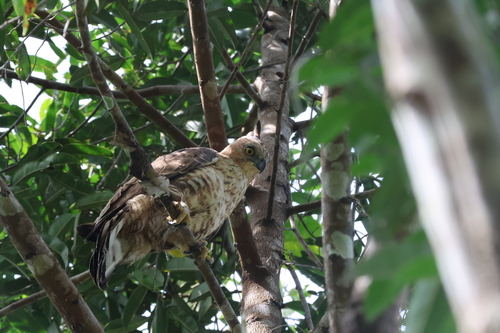 Wallace's Hawk-Eagle
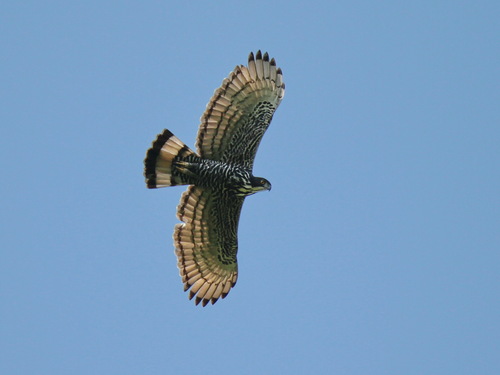 Blyth's Hawk-Eagle
In short
The most reliable field mark between Wallace's Hawk-Eagle and Blyth's Hawk-Eagle is the bold white tail band and overall darker, more contrasting plumage of adult Blyth's, compared to the more uniformly colored Wallace's. Juvenile Blyth's are also distinctive, being dark above with paler heads and underparts, while Wallace's lacks such strong contrast at any age. Both species overlap in the Malay Peninsula, Sumatra, and Borneo, but Blyth's is generally larger and more likely in open woodland, while Wallace's prefers denser lowland forest. Structure and flight jizz are similar, so focus on tail pattern, underpart barring, and overall contrast, especially in perched or soaring birds.
Identification tips
- Tail banding (adults): Blyth's Hawk-Eagle adults have a thick, bold white band across the uppertail and undertail, visible both perched and in flight. Wallace's lacks this strong white band, showing a more uniform tail.
- Overall contrast (adults): Blyth's is black above with a highly contrasting white tail band and barred underparts, while Wallace's is more uniformly colored and lacks strong contrast.
- Juvenile/immature plumage: Juvenile Blyth's are dark brown above with a paler brown head and underparts, creating a two-tone effect. Wallace's juveniles do not show this contrast, tending toward a more even coloration.
- Crest: Blyth's has a prominent, pointed crest, especially obvious when perched. Wallace's crest is less prominent.
- Underpart barring: Blyth's shows strong barring on the underparts, especially on the breast and belly; Wallace's is less distinctly barred.
- Breast spotting: Blyth's adults have black spots on the breast, a feature not noted for Wallace's.
- Size and structure: Blyth's is larger and bulkier, with a longer tail and wings, but this is subtle and best used in direct comparison or with experience.
- Habitat context: If the bird is in open woodland or forest edge, especially on islands, Blyth's is more likely. Dense, undisturbed lowland forest is more typical for Wallace's.
- Flight jizz: Both species soar and perch high, but Blyth's may appear more robust and broad-winged in flight.
- Geographic overlap: Both occur in the Malay Peninsula, Sumatra, and Borneo, so range alone does not separate them.
- Perched vs. flight views: Tail banding and underpart barring are visible both perched and in flight; use these marks whenever possible.
- Pitfalls: Immature Blyth's may be mistaken for Wallace's due to brownish tones, but look for the pale head and underparts for Blyth's. Wallace's never shows a bold white tail band at any age.
- Sex and season: No strong sexual or seasonal dimorphism is noted for either species; age-related plumage is more important.
- Voice: No diagnostic vocal differences are available from the notes.
- Crest shape: Blyth's crest is longer and more pointed, while Wallace's is shorter and less obvious.
Size
Wallace's Hawk-Eagle is notably smaller, with an average mass of 555 g [wikidata], while Blyth's Hawk-Eagle is described as a medium-sized eagle, typically 50–60 cm in length [wikipedia], and is bulkier overall. In the field, Blyth's appears more robust and longer-winged, though both are small for eagles. Size alone is subtle but can support an ID when combined with plumage.
Plumage
Juvenile and immature Blyth's Hawk-Eagle are dark brown above with a paler brown head and underparts, creating a strong contrast not seen in Wallace's at any age. Adult Blyth's is strikingly black above with a thick white band on both the uppertail and undertail, a prominent crest, black-spotted breast, and barred underparts. Wallace's Hawk-Eagle lacks the bold white tail band and has more uniform, less contrasting plumage overall. Blyth's also typically shows more extensive barring below and a more prominent crest, while Wallace's is plainer. These differences are most apparent in perched birds or when the tail is spread in flight.
Behaviour
Both species are forest raptors and may be seen soaring or perched high in trees. Blyth's Hawk-Eagle is more likely to be seen in open woodland or forest edge, sometimes soaring above the canopy, while Wallace's tends to keep to denser lowland forest. Both can be elusive and are often detected by silhouette or flight profile, but behavior is not a strong separator.
Habitat
Wallace's Hawk-Eagle is restricted to subtropical or tropical moist lowland forests, typically favoring dense, undisturbed habitats in the Malay Peninsula, Sumatra, and Borneo [wikipedia]. Blyth's Hawk-Eagle overlaps in range but is more often found in open woodland and forest edge, and on islands may occur in denser forest. If seen in a relatively open or fragmented woodland, Blyth's is more likely; deep, closed-canopy lowland forest favors Wallace's.