

Wallace's Hawk-Eagle vs Blyth's Hawk-Eagle
Nisaetus nanus contro Nisaetus alboniger
Fai un quiz con Wallace's Hawk-Eagle e Blyth's Hawk-Eagle
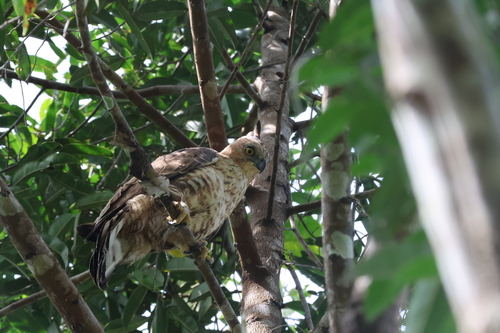 Wallace's Hawk-Eagle
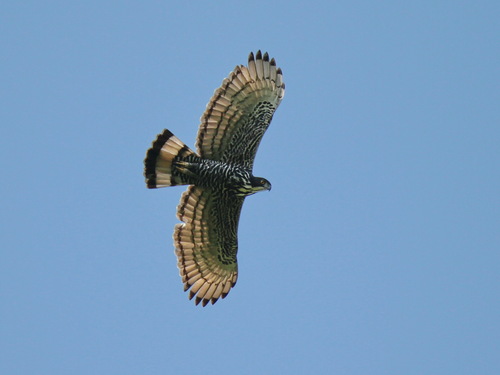 Blyth's Hawk-Eagle
In breve
Il segno distintivo più affidabile tra il Wallace's Hawk-Eagle e il Blyth's Hawk-Eagle è la spessa banda bianca sulla coda e il piumaggio complessivamente più scuro e contrastante dell'adulto Blyth's, rispetto al Wallace's, che è più uniformemente colorato. Anche i giovani Blyth's sono distintivi, essendo scuri sopra con teste e parti inferiori più chiare, mentre il Wallace's non presenta un contrasto così forte a qualsiasi età. Entrambe le specie si sovrappongono nella Penisola Malese, a Sumatra e a Borneo, ma il Blyth's è generalmente più grande e più probabile in boschi aperti, mentre il Wallace's preferisce foreste pluviali più dense. La struttura e il volo sono simili, quindi concentrati sul modello della coda, sulla barratura delle parti inferiori e sul contrasto generale, specialmente negli uccelli posati o in volo.
Consigli di identificazione
- Banda della coda (adulti): Gli adulti del Blyth's Hawk-Eagle hanno una spessa e audace banda bianca sulla coda superiore e inferiore, visibile sia posati che in volo. Il Wallace's non ha questa forte banda bianca, mostrando una coda più uniforme.
- Contrasto generale (adulti): Il Blyth's è nero sopra con una banda bianca altamente contrastante e parti inferiori barrate, mentre il Wallace's è più uniformemente colorato e manca di un forte contrasto.
- Piumaggio giovanile/immaturo: I giovani Blyth's sono marroni scuri sopra con una testa e parti inferiori marroni più chiare, creando un effetto bicolore. I giovani del Wallace's non mostrano questo contrasto, tendendo verso una colorazione più uniforme.
- Cresta: Il Blyth's ha una cresta prominente e appuntita, particolarmente evidente quando è posato. La cresta del Wallace's è meno prominente.
- Barratura delle parti inferiori: Il Blyth's mostra una forte barratura sulle parti inferiori, specialmente sul petto e sull'addome; il Wallace's è meno distintamente barrato.
- Macchie sul petto: Gli adulti del Blyth's hanno macchie nere sul petto, una caratteristica non notata per il Wallace's.
- Dimensioni e struttura: Il Blyth's è più grande e massiccio, con una coda e ali più lunghe, ma questo è sottile e meglio utilizzato in confronto diretto o con esperienza.
- Contesto dell'habitat: Se l'uccello si trova in un bosco aperto o al margine della foresta, specialmente su isole, è più probabile che sia un Blyth's. La foresta pluviale densa e indisturbata è più tipica per il Wallace's.
- Volo: Entrambe le specie planano e si posano in alto, ma il Blyth's può apparire più robusto e con ali più larghe in volo.
- Sovrapposizione geografica: Entrambe si trovano nella Penisola Malese, a Sumatra e a Borneo, quindi l'areale da solo non le separa.
- Visioni posate vs. in volo: La banda della coda e la barratura delle parti inferiori sono visibili sia posati che in volo; utilizza questi segni ogni volta che è possibile.
- Trappole: I giovani Blyth's possono essere scambiati per Wallace's a causa di toni marroni, ma cerca la testa e le parti inferiori chiare per il Blyth's. Il Wallace's non mostra mai una forte banda bianca sulla coda a qualsiasi età.
- Sesso e stagione: Non si notano forti dimorfismi sessuali o stagionali per nessuna delle due specie; il piumaggio legato all'età è più importante.
- Voce: Non sono disponibili differenze vocali diagnostiche dalle note.
- Forma della cresta: La cresta del Blyth's è più lunga e più appuntita, mentre quella del Wallace's è più corta e meno evidente.
Taglia
Il Wallace's Hawk-Eagle è notevolmente più piccolo, con una massa media di 555 g [wikidata], mentre il Blyth's Hawk-Eagle è descritto come un'aquila di dimensioni medie, tipicamente 50–60 cm di lunghezza [wikipedia], ed è complessivamente più massiccio. Sul campo, il Blyth's appare più robusto e con ali più lunghe, anche se entrambi sono piccoli per le aquile. Le dimensioni da sole sono sottili ma possono supportare un'identificazione quando combinate con il piumaggio.
Piumaggio
I giovani e immaturi Blyth's Hawk-Eagle sono marroni scuri sopra con una testa e parti inferiori marroni più chiare, creando un forte contrasto non visto nel Wallace's a qualsiasi età. L'adulto Blyth's è sorprendentemente nero sopra con una spessa banda bianca sia sulla coda superiore che inferiore, una cresta prominente, un petto macchiato di nero e parti inferiori barrate. Il Wallace's Hawk-Eagle manca della spessa banda bianca sulla coda e ha un piumaggio più uniforme e meno contrastante nel complesso. Il Blyth's mostra anche tipicamente una barratura più estesa sotto e una cresta più prominente, mentre il Wallace's è più semplice. Queste differenze sono più evidenti negli uccelli posati o quando la coda è aperta in volo.
Comportamento
Entrambe le specie sono rapaci forestali e possono essere viste planare o posarsi in alto sugli alberi. Il Blyth's Hawk-Eagle è più probabile da vedere in boschi aperti o al margine della foresta, a volte planando sopra la chioma, mentre il Wallace's tende a rimanere in foreste pluviali più dense. Entrambi possono essere elusivi e sono spesso rilevati per silhouette o profilo di volo, ma il comportamento non è un forte separatore.
Habitat
Il Wallace's Hawk-Eagle è ristretto a foreste pluviali umide subtropicali o tropicali, tipicamente favorendo habitat densi e indisturbati nella Penisola Malese, a Sumatra e a Borneo [wikipedia]. Il Blyth's Hawk-Eagle si sovrappone nell'areale ma si trova più spesso in boschi aperti e al margine della foresta, e su isole può verificarsi in foreste più dense. Se visto in un bosco relativamente aperto o frammentato, è più probabile che sia un Blyth's; la foresta pluviale profonda e a chioma chiusa favorisce il Wallace's.
Wallace's Hawk-Eagle · Blyth's Hawk-Eagle · I miei uccelli difficili