

Vitelline Masked-Weaver vs Southern Red Bishop
Ploceus vitellinus versus Euplectes orix
Play a quiz with Vitelline Masked-Weaver and Southern Red Bishop
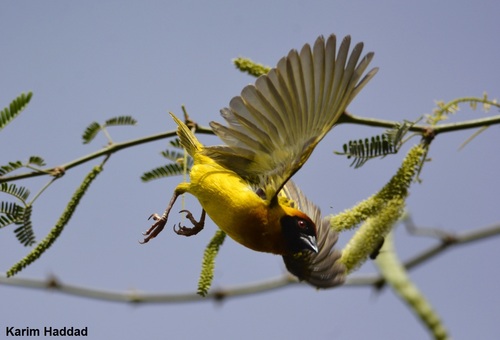 Vitelline Masked-Weaver
 Southern Red Bishop
In short
The most reliable field mark between Vitelline Masked-Weaver and Southern Red Bishop is the breeding male's plumage: Southern Red Bishop males are strikingly red and black, while Vitelline Masked-Weaver males are yellow with a black face mask. Non-breeding males and females of both species are streaky brown and can be confusing, but bishops are generally smaller and more compact. Southern Red Bishops are strongly associated with wetlands and grasslands, while Vitelline Masked-Weavers are more widespread in western, central, and eastern Africa. In flight or at a distance, focus on overall color impression and habitat context.
Identification tips
- Breeding male plumage is the key separator: Southern Red Bishop males are unmistakable with their bright red (sometimes orange) and black pattern, including a black face, throat, and belly, and red on the rest of the head and upperparts. Vitelline Masked-Weaver males are yellow with a black face mask and lack any red or orange. This mark is only useful during the breeding season and for adult males.
- Non-breeding and female confusion: Both species' non-breeding males and females are streaky brown above and paler below, making them very difficult to separate visually. In these plumages, do not rely on color alone.
- Size and structure: Southern Red Bishop is a small, compact weaver, with females smaller than males. Vitelline Masked-Weaver is similar in size, but bishops may appear slightly more compact. Size is not a strong field mark unless you see both together.
- Bill shape: Both have thick, conical bills typical of weavers. Bill shape is not a reliable separator in the field.
- Tail and wing pattern: No distinctive juvenile or immature upperwing or tail patterns are described for either species in these notes. Do not rely on wing or tail pattern for separation.
- Habitat context: Southern Red Bishop is almost always found in wetlands, reedbeds, and grasslands, especially in southern Africa. If you see a weaver in a marsh or grassy wetland, bishop is much more likely. Vitelline Masked-Weaver is more flexible in habitat and occurs in a wider range across western, central, and eastern Africa.
- Geographic range: Southern Red Bishop is found in Africa south of the Equator. If you are north of the Equator, Vitelline Masked-Weaver is more likely, though always check for local bishop species.
- Behavior: Displaying Southern Red Bishop males perch prominently and perform fluttering flights in reeds or tall grasses. Vitelline Masked-Weaver is less tied to such display behavior in wetlands.
- Voice: Southern Red Bishop gives twittering and nasal calls, with a buzzing male song. No vocal details are given for Vitelline Masked-Weaver, so do not use voice as a separator unless you know the bishop's calls well.
- Seasonal context: Only breeding males are easily separated by plumage. In non-breeding season or among females and juveniles, rely more on habitat and range than on plumage.
- Community tip: When in doubt with a streaky brown weaver in a wetland, Southern Red Bishop is a good guess in southern Africa; elsewhere, check for other weaver species and consider Vitelline Masked-Weaver if the location fits.
- Common pitfalls: Do not assume all yellow and black weavers are bishops; only the bishop has the red/black combination in breeding males. Non-breeding bishops are not red and can be mistaken for masked-weavers.
- Mixed flocks: Both species may occur in mixed weaver flocks, especially outside the breeding season. Look for any remaining bright plumage or habitat clues.
- Immature birds: No distinctive immature wing or tail patterns are described for either species, so immature birds are best identified by context and, if possible, by association with adults.
- Summary for tricky birds: If you cannot see a clear red or yellow/black adult male, use habitat, location, and flock composition to guide your ID. When in doubt, note all features and consult local checklists.
Size
Southern Red Bishop is a small, compact weaver with an average body mass of 23.1g [wikidata]. Vitelline Masked-Weaver's mass is not specified here, but both are similar in size and structure, with the bishop possibly appearing slightly more compact and shorter-tailed. Female bishops are noted as smaller than males. Size alone is not a strong separator in the field between these two.
Plumage
Breeding males are easiest: Southern Red Bishop males show a vivid red (sometimes orange) and black pattern, with a black face, throat, and belly, and red on the rest of the head, upperparts, upper breast, and undertail-coverts. Their wings and tail are brown. Vitelline Masked-Weaver breeding males are yellow with a black mask, lacking any red or orange. Non-breeding males and females of both species are streaky brown above and paler below, making them much harder to separate visually. No distinctive juvenile or first-winter upperwing patterns are described for either species in the sources. Female bishops are smaller and share the streaky brown appearance. In all non-breeding and female plumages, plumage alone is not a reliable separator.
Behaviour
Both species are active, social weavers, but Southern Red Bishop males are especially conspicuous during the breeding season, displaying in reeds or tall grasses with fluttering flights and prominent perching. Vitelline Masked-Weaver behavior is not detailed here, but as a typical weaver, it is likely to be seen in a variety of habitats, often near water but not as strictly tied to wetlands as the bishop.
Habitat
Southern Red Bishop is strongly tied to wetlands and grasslands in Africa south of the Equator, often seen in reedbeds and marshy areas. Vitelline Masked-Weaver is found in a wider range across western, central, and eastern Africa and is not as closely linked to wetlands. If you are birding in a wetland or grassy marsh in southern Africa, Southern Red Bishop is much more likely; in drier or more varied habitats, especially outside southern Africa, Vitelline Masked-Weaver is the better bet.
Voice
Southern Red Bishop gives various twittering calls and a nasal contact call, with males producing a buzzing song. No vocalization details are provided for Vitelline Masked-Weaver in these notes, so voice is not a reliable separator based on this information.
Vitelline Masked-Weaver · Southern Red Bishop · My Tricky Birds