

Violet-headed Hummingbird vs Violet Sabrewing
Klais guimeti versus Campylopterus hemileucurus
Play a quiz with Violet-headed Hummingbird and Violet Sabrewing
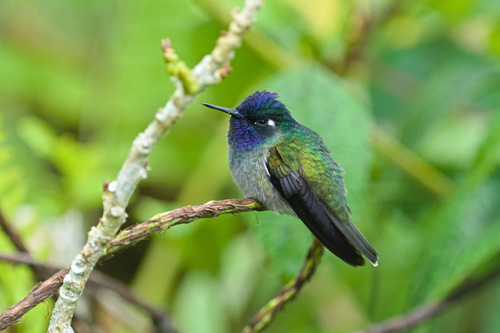 Violet-headed Hummingbird
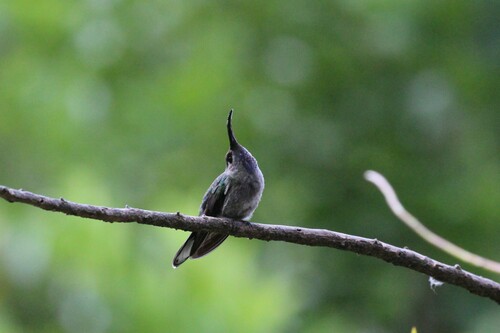 Violet Sabrewing
In short
The most reliable field mark between Violet-headed Hummingbird and Violet Sabrewing is size: Violet Sabrewing is dramatically larger, nearly twice the length and several times the mass of Violet-headed Hummingbird. If you see a hummingbird with an intense violet or blue head and throat, check its size and bill length—Violet Sabrewing is robust and long-billed, while Violet-headed is tiny and short-billed. Both can show metallic greens and violets, but only Violet-headed Hummingbird males have a crisp white spot behind the eye. Females of both are duller, but the Sabrewing is still much larger and bulkier. In flight or perched, the Sabrewing’s broad tail with wide white tips is a strong clue, while Violet-headed Hummingbird’s tail is smaller with tiny pale spots. Habitat and elevation can help: Violet-headed prefers lowland to foothill forests, while Sabrewing is a montane species.
Identification tips
- Size is the most immediate clue: If the hummingbird is large and robust, it is Violet Sabrewing; if tiny and delicate, it is Violet-headed. This holds for all ages and sexes.
- Bill structure: Sabrewing has a longer, thicker bill (especially in some subspecies), while Violet-headed has a short, straight bill (about 13 mm). Compare with nearby hummingbirds if possible.
- Head and throat color (males): Violet-headed males have an intense violet or blue head and throat, while Sabrewing males have a dusky crown with a bluish-green gloss and metallic violet-blue face and underparts. The Sabrewing’s violet is more extensive on the body, less concentrated on the head.
- White spot behind the eye: Present and conspicuous in both sexes of Violet-headed Hummingbird, absent in Sabrewing. This is a quick field mark at close range.
- Tail pattern: Sabrewing’s tail is broad with wide white tips on the outer feathers (both sexes), visible in flight or when fanned. Violet-headed’s tail is green with tiny white-grey spots, never with broad white tips.
- Underparts (males): Violet-headed males have a green breast fading to a gray belly, while Sabrewing males are metallic violet-blue throughout the underparts, sometimes bluer on the belly.
- Underparts (females): Violet-headed females are gray below with a blue cap and green back; Sabrewing females have a violet-blue throat, mostly gray underparts with a whiter belly, and metallic green spots along the sides.
- Back and rump: Both species show metallic green, but Sabrewing’s lower back and uppertail coverts are especially bright and extensive.
- Behavior at flowers/feeders: Sabrewings are dominant and may chase other hummingbirds. Violet-headed is more likely to feed quietly and avoid confrontation.
- Habitat and elevation: If you are above 1,500 m in humid montane forest or at a highland garden feeder, expect Sabrewing. In lowland or foothill forest, Violet-headed is more likely.
- Perched jizz: Sabrewing appears large, heavy-bodied, and long-tailed when perched. Violet-headed is compact, with a proportionately shorter tail and bill.
- Flight appearance: Sabrewing’s broad tail and heavy build are obvious in flight. Violet-headed appears more fluttery and slight.
- Vocalizations: If you hear loud, varied, sharp chipping and warbles, it is Sabrewing. Silence or lack of distinctive song does not confirm Violet-headed, but Sabrewing’s song is a positive clue.
- Sex differences: Both species’ females are duller, but size and tail pattern still separate them reliably.
- Juvenile/immature birds: No specific juvenile wing or flight pattern differences are noted, so use size, bill, and tail pattern for all ages.
Size
Violet Sabrewing is the largest hummingbird in Mexico and Central America, measuring 13–15 cm in length and weighing 9–12 g. In contrast, Violet-headed Hummingbird is much smaller, averaging only 8.1 cm in length and with a proportionately lighter build (weight not specified, but typical for a small hummingbird). The Sabrewing’s bill is also longer and more robust, especially in some subspecies. When seen together or with other hummingbirds for scale, the Sabrewing’s bulk and length are unmistakable, while Violet-headed appears tiny and delicate.
Plumage
- Adult males: Violet-headed Hummingbird males have an intense violet or blue head and throat with a clear white spot behind the eye, metallic bluish-green or bronze-green back, green breast fading to a gray belly, and a green tail with tiny white-grey spots. Violet Sabrewing males have a dusky crown with bluish-green gloss, metallic violet-blue face, nape, upper back, and underparts (bluer on the belly), metallic green lower back, and a broad tail with bluish-green to bluish-black central feathers and wide white tips on the outer tail feathers.
- Adult females: Violet-headed females are duller, with a blue cap, green back, gray underparts, and the same white post-ocular spot as males. Violet Sabrewing females have a dusky crown, metallic green to bronze-green upperparts, more bluish-green rump, violet-blue throat, mostly gray underparts with a whiter belly, metallic green spots along the sides, and green undertail coverts. Their tail is broad with wide white tips, unlike the tiny pale tail spots of Violet-headed.
- Juvenile/immature: No specific juvenile wing or flight pattern differences are described in the sources for either species, so focus on size, structure, and tail pattern for all ages.
Behaviour
Both species feed on nectar and small insects, but Violet Sabrewing is more dominant and aggressive, often defending flower patches and feeders, and chasing away other hummingbirds. Violet-headed Hummingbird is more likely to be seen feeding quietly at understory flowers, sometimes in loose aggregations. Sabrewings may be seen trap-lining (following a circuit of flowers) or at leks (males singing together), while Violet-headed is less conspicuous and more solitary.
Habitat
Violet-headed Hummingbird prefers subtropical or tropical moist lowland and foothill forests, including degraded and secondary growth. It is typically found at lower elevations. Violet Sabrewing, by contrast, is a montane species, found from 500–2,500 m (Mexico) or 1,500–2,400 m (Costa Rica), in humid evergreen montane forests, mature secondary forests, banana plantations, and gardens. If you are in highland forest or at a nectar feeder in the mountains, Sabrewing is far more likely; in lowland or foothill forest, Violet-headed is the expected species.
Voice
Violet Sabrewing has a distinctive, loud, and varied song described as high-pitched, sharp chipping and warbles, with explosive notes. Its calls are sharp chippering and single chips in flight. No vocal description is available for Violet-headed Hummingbird in the sources, so voice is only diagnostic if you hear the Sabrewing’s characteristic song.
Violet-headed Hummingbird · Violet Sabrewing · My Tricky Birds