

Verdin vs Cerulean Warbler
Auriparus flaviceps versus Setophaga cerulea
Play a quiz with Verdin and Cerulean Warbler
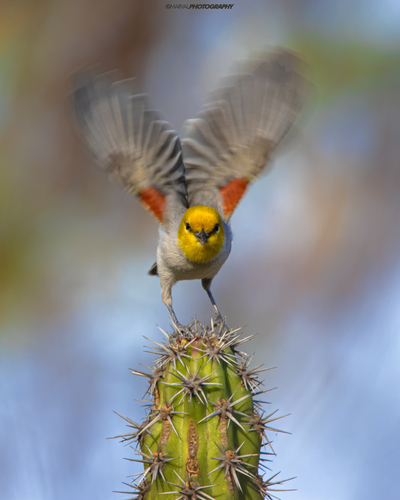 Verdin
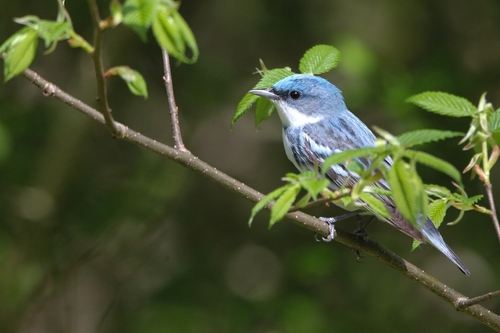 Cerulean Warbler
In short
The most reliable field mark to separate Verdin from Cerulean Warbler is the Verdin’s bright yellow head and rufous shoulder patch in adults, which are never present on any Cerulean Warbler. Juvenile Verdins, however, lack both yellow and rufous, appearing plain gray, which can lead to confusion with female or immature Cerulean Warblers. In all ages, Cerulean Warblers show two bold white wing bars and white tail spots, features Verdins never have. Bill shape is also distinctive: Verdins have a sharply pointed, conical bill, while Cerulean Warblers have a thin, straight warbler bill. Cerulean Warblers are canopy specialists of eastern forests, while Verdins are desert birds of the Southwest, so context is often a strong clue.
Identification tips
- Wing Bars and Tail Spots: All Cerulean Warblers, regardless of age or sex, show two bold white wing bars and white tail spots. Verdins never show wing bars or tail spots at any age. This is the most reliable separation, especially in flight or on perched birds with spread wings.
- Adult Verdin Head and Shoulder: Adult Verdins have a bright yellow head and a rufous shoulder patch (lesser coverts), unique in this comparison. Cerulean Warblers never show yellow on the head or rufous on the shoulder.
- Juvenile Verdin Pitfall: Juvenile Verdins are plain gray, lacking both yellow and rufous, which can superficially resemble female or immature Cerulean Warblers. However, they still lack wing bars and tail spots, and their bill is thicker and more pointed.
- Supercilium in Cerulean Warbler: Female and immature Cerulean Warblers have a distinct pale stripe above the eye (supercilium), which Verdins lack at all ages.
- Bill Shape: Verdins have a short, sharply pointed bill that is thick at the base and draws to a fine point—more tit-like. Cerulean Warblers have a thin, straight warbler bill, never thick at the base.
- Color Above and Below: Adult male Cerulean Warblers are deep blue above with a black necklace and white below; females and immatures are bluish-green above and yellowish below. Verdins (adult) are gray above and below, with yellow only on the head.
- Shoulder Patch: The rufous shoulder patch is unique to adult Verdins. Cerulean Warblers never show rufous anywhere on the wing.
- Song and Calls: Cerulean Warbler’s buzzy, accelerating song and metallic 'zzee' call are very different from the Verdin's short, staccato 'tschep' and 'tseet' calls. If you hear a musical, buzzy song, it is not a Verdin.
- Habitat Context: Verdins are found in desert scrub and thorny brush, never in tall eastern forests. Cerulean Warblers are canopy birds of mature hardwood forests (breeding) or subtropical forests (winter), never in arid scrub.
- Foraging Behavior: Verdins often hang upside down and forage at or below eye level. Cerulean Warblers stay high in the canopy, rarely coming low.
- Size and Shape: Both are tiny, but Verdins are more compact and round-bodied with a shorter tail, while Cerulean Warblers are longer-tailed and more streamlined.
- Leg and Iris Color: Not reliably useful in the field for separation between these two species.
- Seasonal Pitfalls: During migration, Cerulean Warblers may be seen lower in trees and in mixed flocks, but will still show wing bars and tail spots. Verdins do not migrate and are resident in the Southwest.
- Sexual Dimorphism: Cerulean Warbler males and females differ strongly; Verdins are less sexually dimorphic, with both sexes of adults showing yellow heads and rufous shoulders.
- Geographic Range: If you are in the Southwest desert, Cerulean Warbler is extremely unlikely; if in an eastern forest, Verdin is almost impossible.
Size
Both species are very small, with nearly identical lengths (about 11 cm/4.5 in). However, Cerulean Warbler has a longer wingspan (20 cm vs. Verdin's much shorter wings), and is slightly heavier (8–10 g for Cerulean Warbler). In the field, Verdins look more compact and round-bodied, with a shorter tail and wings, while Cerulean Warblers appear more streamlined and longer-tailed, especially in flight. Bill structure is a key difference: Verdins have a short, sharply pointed bill that is thick at the base, while Cerulean Warblers have a thin, straight bill typical of warblers.
Plumage
Juvenile Verdins are plain light gray overall, lacking both the yellow head and rufous shoulder patch of adults. They also lack any wing bars or tail spots. In contrast, all Cerulean Warblers—regardless of age or sex—show two prominent white wing bars and white tail spots, which are especially visible in flight and when perched. Adult male Cerulean Warblers are deep cerulean blue above with a black breast necklace and white below, while females and immatures are bluish-green above with a pale supercilium and yellowish underparts. Verdins (adult) are gray overall with a bright yellow head and a distinct rufous patch on the shoulder (lesser coverts), never showing wing bars or tail spots. The absence of any wing markings in Verdins is a key separation from all Cerulean Warblers. Bill color also differs: Cerulean Warbler adults have black (male) or dark gray (female) bills, while Verdins have a dark, sharply pointed bill. Leg color is not a reliable field mark here.
Behaviour
Verdins are active, acrobatic foragers in desert scrub, often hanging upside down and probing among twigs, sometimes giving rapid 'tschep' calls as they move. They are usually solitary or in pairs. Cerulean Warblers forage high in the canopy, moving quickly along branches and often making short flights to catch insects. They are more likely to be seen in mixed-species flocks during migration. Cerulean Warblers are strongly territorial on breeding grounds, while Verdins are more loosely territorial.
Habitat
Habitat is a strong clue: Verdins are found in arid desert regions of the southwestern US and northern Mexico, in thorny scrub and open desert with scattered trees. Cerulean Warblers breed in mature deciduous forests of eastern North America, especially in tall, unbroken tracts of hardwoods, and winter in subtropical forests on the eastern slope of the Andes. Finding a Cerulean Warbler in desert scrub or a Verdin in a tall eastern forest is extremely unlikely.
Voice
Verdins give a rapid, repetitive 'tschep' call and a variety of other short, high-pitched notes, including 'tseet' and 'gee-gee-gee-gee' alarms. Their calls are loud for their size but not musical. Cerulean Warblers have a buzzy, accelerating song ('zray zray zray zray zeeee') and a metallic 'zzee' call. Males sing frequently on territory, and their song is distinctive among warblers. Verdins do not sing in the warbler sense; their calls are more tit-like and lack the musical quality of Cerulean Warbler.