

Velvet Scoter vs Common Scoter
Melanitta fusca versus Melanitta nigra
Play a quiz with Velvet Scoter and Common Scoter
 Velvet Scoter
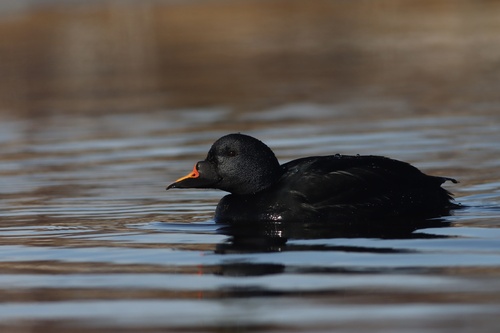 Common Scoter
In short
The most reliable field mark between Velvet Scoter and Common Scoter is the presence of large white wing patches and a small white spot behind the eye in adult male Velvet Scoter, which are completely absent in Common Scoter of any age or sex. In flight, these white wing panels are conspicuous on Velvet Scoter, while Common Scoter shows all-dark wings. Females of both species are brown, but Velvet Scoter females are bulkier and lack the sharply pale cheeks of Common Scoter females. Structural differences—particularly the thicker neck and longer, broader bill of Velvet Scoter—are helpful at a distance. Size is also a clue, with Velvet Scoter being distinctly heavier and longer, but this can be hard to judge in the field.
Identification tips
- White wing patch in flight (all ages, males most obvious): Velvet Scoter always shows a bold white patch on the upperwing, visible in flight and often at rest; Common Scoter never shows any white in the wing.
- White spot behind eye (adult male): Male Velvet Scoter has a small but distinct white spot behind the eye; Common Scoter males are all black in this area.
- Bill color and shape (adult males): Velvet Scoter has a long, broad bill with some orange on it; Common Scoter's bill is shorter, bulbous, and mostly black with a yellow area around the nostrils.
- Female cheek pattern: Female Common Scoter has distinctly pale cheeks, contrasting with the rest of the face; Velvet Scoter females are dull brown overall with no sharply pale cheek.
- Overall size and bulk: Velvet Scoter is larger and bulkier, with a thicker neck and more elongated body; Common Scoter is more compact and slimmer.
- Glossiness (adult males): Velvet Scoter males are glossy black; Common Scoter males are a duller black.
- Tail shape: Velvet Scoter has a more pointed tail, which can be noticeable when swimming or flying; Common Scoter's tail is less pointed.
- Flock composition: In mixed scoter flocks, look for the larger, bulkier birds with white in the wing (Velvet) among the smaller, all-dark birds (Common).
- Resting posture: Velvet Scoter often appears higher in the water due to its bulk; Common Scoter sits lower and looks sleeker.
- Bill structure (females): Female Velvet Scoter's bill is longer and broader than that of Common Scoter, but this can be subtle at a distance.
- Absence of white in Common Scoter: If you see a scoter with no white anywhere on the plumage, especially in the wings, and a yellowish bill base, it's a Common Scoter.
- Contextual clues (region/season): In the UK and western Europe in winter, Common Scoter is much more numerous, but Velvet Scoter can be found in smaller numbers, often within Common Scoter flocks.
- Juvenile/immature separation: Even in juvenile and immature birds, the presence of a white wing patch is diagnostic for Velvet Scoter; its absence confirms Common Scoter.
- Bill color in females: Female Velvet Scoter may show a duller, less contrasting bill than Common Scoter females, but this is subtle and not always reliable.
- Sex differences: Both species show sexual dimorphism, but the key marks (white wing patch, white face spot) are present only in male Velvet Scoter; females are best separated by cheek pattern and structure.
Size
Velvet Scoter is notably larger and heavier than Common Scoter. Velvet Scoter measures 51–56 cm in length with a wingspan of 90–99 cm and a body mass around 1762 g [wikidata]. Common Scoter is smaller, at 43–54 cm in length (wingspan not specified here), and is visibly more compact and less bulky in direct comparison. These size differences are most apparent when birds are side by side or in mixed flocks, but can be subtle at a distance or on water.
Plumage
Adult male Velvet Scoter is glossy black with large white wing patches (visible both at rest and in flight) and a small white spot behind the eye; the bill is partly orange. Adult male Common Scoter is entirely black with no white anywhere on the plumage, and the bill is mostly black with a yellow area around the nostrils. Female Velvet Scoter is dull brown, lacks gloss, and is bulkier, with no sharply defined pale cheek; female Common Scoter is brown with distinctly pale cheeks, which can be a key separation point. In all ages and sexes, Common Scoter lacks any white in the wing. Juvenile and immature plumages are not described in detail in the sources, but the presence or absence of white wing panels remains diagnostic for all age classes in flight.
Behaviour
Both species are sea ducks that dive for food, often forming large flocks in winter. No strong behavioral differences are highlighted in the sources for field separation. Both can be seen diving for molluscs and crustaceans, and both may be found in mixed scoter flocks, especially in winter.
Habitat
Both Velvet and Common Scoter breed in the far north of Europe and the Palearctic, wintering in temperate coastal waters. Both are found on large lakes, rivers, and coastal seas, often in similar habitats. There is no strong habitat separation in the field, though local abundance may differ (Common Scoter is more numerous in the UK and western Europe, especially in winter [ebird]).
Voice
No diagnostic vocal differences are described for these two species in the provided sources. Vocalizations are more useful for separating Common Scoter from Black Scoter, not Velvet Scoter.