
Variable Sunbird vs Copper Sunbird
Cinnyris venustus versus Cinnyris cupreus
Play a quiz with Variable Sunbird and Copper Sunbird
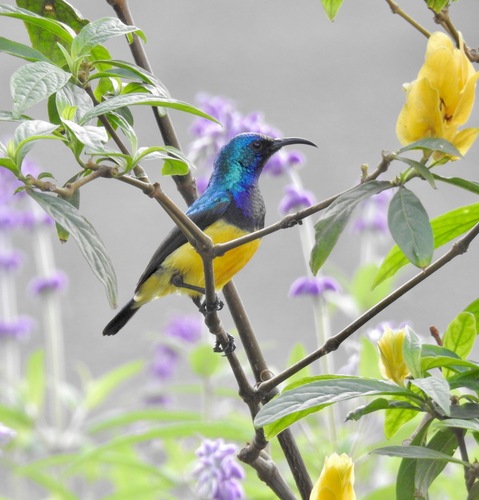 Variable Sunbird
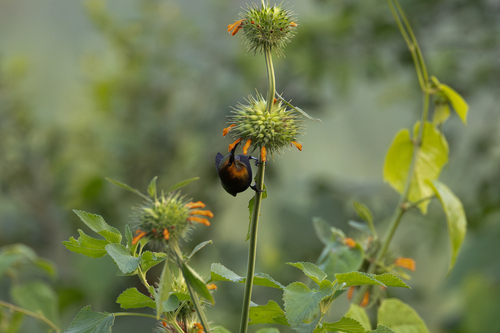 Copper Sunbird
In short
The most reliable field mark to separate Variable Sunbird from Copper Sunbird is overall size and the male's plumage: Variable Sunbird is noticeably smaller and, in adult males, shows a glossy green head and throat with a maroon breast band and yellow (sometimes orange or white) belly. Copper Sunbird is larger and, in adult males, typically appears darker and more uniformly metallic, lacking the maroon breast band and bright yellow belly. Females of both species are drab, but Variable Sunbird females have a clear pale supercilium and yellower underparts. Structural differences are subtle, but Variable Sunbird is more delicate overall. Both species share similar feeding behaviors and habitats, so focus on size and male plumage for quick separation.
Identification tips
- Size is a strong clue: Variable Sunbird is much smaller and lighter (5.6 g) than Copper Sunbird (8.6 g). If a sunbird looks noticeably petite, Variable is more likely.
- Adult male plumage is diagnostic: Look for a glossy green head, throat, and nape with a maroon breast band and yellow belly in Variable Sunbird. Copper Sunbird males are darker, more uniformly metallic, and lack the maroon band and yellow belly.
- Female and eclipse male Variable Sunbirds show a pale supercilium: This pale eyebrow is obvious in Variable Sunbird females and absent or much less distinct in Copper Sunbird females.
- Underpart color in females: Variable Sunbird females have yellowish underparts, while Copper Sunbird females are duller and less contrasting below.
- Bill structure: Both have medium-length, down-curved bills, but Variable Sunbird's bill is relatively finer and shorter, matching its smaller size.
- General structure/jizz: Variable Sunbird appears more delicate and compact, while Copper Sunbird is bulkier and heavier-bodied.
- Eclipse (non-breeding) males: Variable Sunbird eclipse males resemble females but retain some green on the throat. Copper Sunbird eclipse males are not described, but likely remain darker overall.
- No distinctive wing or flight pattern differences: Both species lack described age-specific upperwing or flight marks, so do not rely on this feature.
- Voice: If you hear a clear 'tew-tew-tew-tew-tew' call, it points to Variable Sunbird. Absence of this call is not diagnostic for Copper Sunbird.
- Habitat and feeding behavior: Both species share similar habitats and feeding strategies, so do not use habitat as a separator.
- Juvenile/immature birds: No specific marks are described, but use supercilium and underpart color as for females.
- Seasonal variation: Male Variable Sunbirds are brightest in breeding plumage; eclipse males and females are duller but still show the supercilium and yellowish underparts.
- Contextual clues: If you see a group of sunbirds, compare relative size and look for the brightest male—Variable Sunbird males stand out with their yellow belly and maroon band.
- Common pitfalls: Do not rely on feeding posture or habitat, as both species often perch to feed and occur in similar environments.
- When in doubt: Focus on size, male plumage (especially the maroon breast band and yellow belly), and the presence or absence of a pale supercilium in females and eclipse males.
Size
Variable Sunbird is distinctly smaller, with a body mass of about 5.6 g, compared to Copper Sunbird's 8.6 g [wikidata]. This size difference is usually noticeable in the field, especially when both species are seen side by side or compared to familiar sunbirds. Variable Sunbird also appears more delicate, with a shorter, finer bill and a more compact body. Copper Sunbird is bulkier and heavier-bodied, which can be apparent even at a distance.
Plumage
No age-specific upperwing or flight pattern differences are described for either species in the available sources. For adult males, Variable Sunbird is striking with a glossy green head, throat, and nape, a maroon breast band, and a yellow (occasionally orange or white) belly. Copper Sunbird males are more uniformly dark and metallic, lacking the maroon band and bright yellow belly; their plumage can appear coppery or bronzy, especially in good light. Female Variable Sunbirds are grey-brown above with yellowish underparts and a distinct pale supercilium, while Copper Sunbird females are generally duller and lack the strong supercilium, with less contrast between upper- and underparts. Eclipse (non-breeding) male Variable Sunbirds resemble females but retain some green, especially on the throat. Juvenile and immature plumages are not described in detail for either species, but the presence or absence of the supercilium and underpart color can help separate females and immatures.
Behaviour
Both species feed mainly on nectar, sometimes hovering but more often perching to feed. They also take insects, especially when feeding young. Flight in both is fast and direct on short wings. There are no described behavioral differences that are diagnostic between these two species, so behavior alone is not a reliable separator.
Habitat
Both Variable and Copper Sunbirds are found in open woodland, cultivation, and similar habitats across tropical and equatorial Africa [wikipedia]. Their ranges overlap broadly, and both are common in their respective regions. Habitat choice is not a reliable field mark for separation.
Voice
The only described vocalization is for Variable Sunbird: a clear 'tew-tew-tew-tew-tew' call [wikipedia]. No vocal description is available for Copper Sunbird in the provided sources, so voice is not a reliable separator unless the Variable Sunbird's call is heard clearly.