

Ural Owl vs Long-eared Owl
Strix uralensis versus Asio otus
Play a quiz with Ural Owl and Long-eared Owl
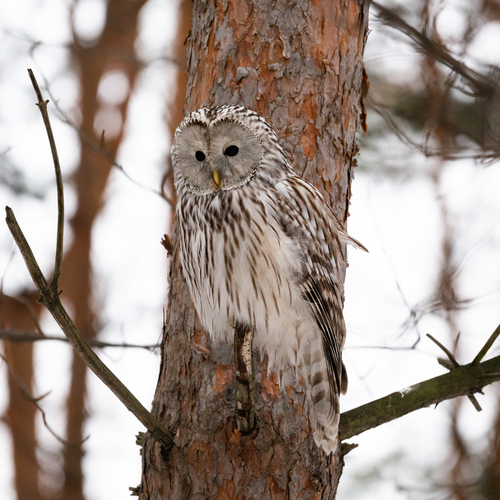 Ural Owl
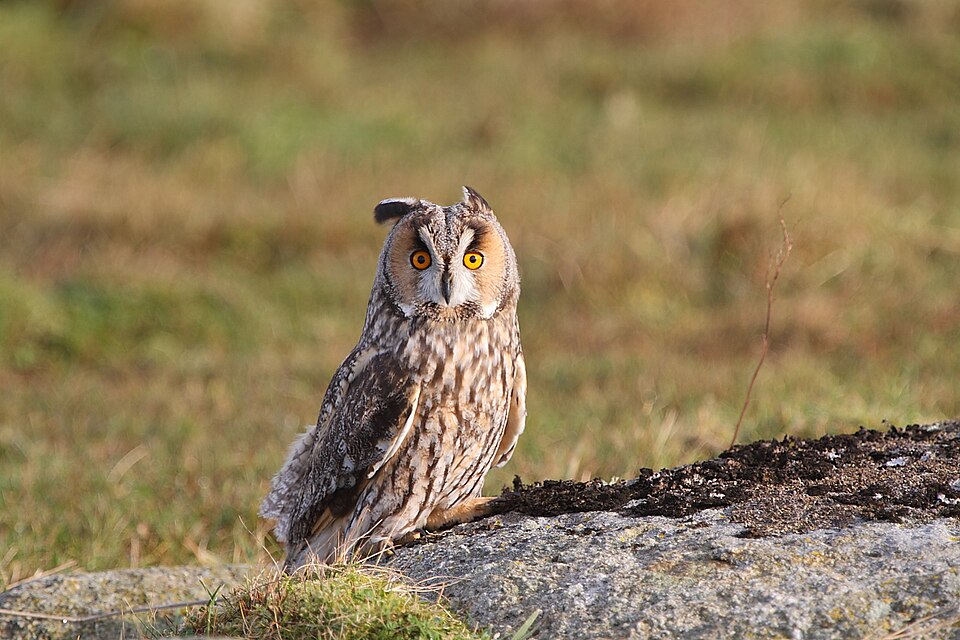 Long-eared Owl
In short
The most reliable way to separate Ural Owl from Long-eared Owl is by structure and facial features: Ural Owl is a much larger, bulkier bird with a rounded head lacking ear tufts, while Long-eared Owl is slender, distinctly smaller, and always shows prominent, upright ear tufts. In flight or perched, Ural Owl’s long tail and heavy, straight underpart streaking contrast with the shorter tail and herringbone (crossbarred) underparts of Long-eared Owl. Ural Owl’s face is plain and pale with no concentric lines or ear tufts, while Long-eared Owl has a well-marked facial disc, often with a dark rim and white central lines, and orange to orange-red eyes. Juvenile and immature flight patterns are not described as diagnostic between these two, so focus on overall shape, head, and plumage details.
Identification tips
- Ear tufts: Long-eared Owl always shows prominent, upright ear tufts, visible even at a distance when perched or in flight. Ural Owl never has ear tufts—its head is smoothly rounded. This is the fastest field check in any season or age.
- Head shape: Ural Owl’s head is large, round, and plain; Long-eared Owl’s head looks narrower and elongated, accentuated by the ear tufts.
- Facial disc: Ural Owl has a pale, plain facial disc with no concentric lines or strong rim; Long-eared Owl’s facial disc is well-marked, often with a dark rim and white central lines or a 'moustache.'
- Eye color: Ural Owl has dark eyes; Long-eared Owl’s eyes are orange to orange-red, a subtle but useful check at close range.
- Underpart streaking: Ural Owl shows heavy, straight, vertical streaks on the underparts; Long-eared Owl has dusky streaks on the upper breast and a herringbone pattern (crossbars and shaft-streaks) below, often giving a more patterned look.
- Upperparts and scapulars: Long-eared Owl’s upperparts are ochraceous-tawny with blackish streaks and spots, and it shows contrasting whitish scapulars; Ural Owl is paler and more uniform above, lacking strong scapular contrast.
- Flight silhouette: Ural Owl is large and broad-winged with a long tail, appearing powerful and heavy in flight. Long-eared Owl is much slimmer, with long, narrow wings and a shorter tail, giving a more buoyant, agile flight profile.
- Size and jizz: Ural Owl is much larger and bulkier overall. If size is apparent (e.g., compared to crows or other owls), this is a strong clue.
- Perched posture: Ural Owl sits upright and appears massive, with a long tail often visible. Long-eared Owl is slim, often elongated, and may appear more alert or nervous.
- Facial markings: Long-eared Owl often shows a dark rim to the facial disc and white lines down the center or as a 'moustache,' which Ural Owl lacks.
- Primary panels in flight: Long-eared Owl can show buff or orange panels at the base of the primaries, especially in flight; Ural Owl does not show this feature.
- Tail length: Ural Owl’s tail is noticeably longer and more prominent, both perched and in flight, than Long-eared Owl’s shorter tail.
- Habitat context: Ural Owl is more likely in extensive, mature forests; Long-eared Owl is more flexible and often found in smaller woods, shelterbelts, or near open country.
- Behavior: Ural Owl can be seen hunting in daylight (especially in spring/summer); Long-eared Owl is mostly nocturnal or crepuscular.
- Voice: Not described as diagnostic in the provided notes, but in the field, Ural Owl’s deep, far-carrying hoots differ from the more nasal, cat-like calls of Long-eared Owl if heard.
Size
Ural Owl is substantially larger and heavier than Long-eared Owl. Ural Owl is a large Strix owl with a robust body, long tail, and broad wings, while Long-eared Owl is a medium-sized owl, much lighter and slimmer, with a wingspan of 86–102 cm and a length of 31–40 cm [wikipedia]. Ural Owl’s presence is imposing, and it appears much bulkier than the slender, almost delicate Long-eared Owl, which is about half the weight of a Tawny Owl and considerably lighter than Ural Owl [wikipedia, avonet].
Plumage
-
Juvenile/immature wing pattern: No age-specific upperwing or flight pattern differences are described as diagnostic between these two species in the sources. Focus on structural and facial features for all ages.
-
Adults: Ural Owl has a pale, rounded facial disc with no ear tufts and lacks concentric lines; its underparts show heavy, straight streaking. Long-eared Owl always shows prominent, upright ear tufts, a well-developed facial disc with a dark rim and often white central lines or a 'moustache,' and underparts with dusky streaks above and herringbone (crossbarred and shaft-streaked) pattern below. Ural Owl’s upperparts are generally pale and uniform compared to the ochraceous-tawny, variably streaked and spotted Long-eared Owl. Long-eared Owl also shows contrasting whitish scapulars and, in flight, buff or orange panels at the base of the primaries, which are not present in Ural Owl. Eye color is also a clue: Ural Owl has dark eyes, Long-eared Owl’s are orange to orange-red.
Behaviour
Ural Owl is generally more robust and sits upright with a large, rounded head and long tail, often appearing calm and unhurried. Long-eared Owl is slim, often appearing elongated when perched, with ear tufts held erect and a more nervous or alert demeanor. In flight, Ural Owl looks heavy and powerful with a long tail, while Long-eared Owl is buoyant and agile, with long, narrow wings and a shorter tail. Ural Owl can be partially diurnal, especially in the breeding season, while Long-eared Owl is mostly nocturnal and crepuscular.
Habitat
Both species can occur in forested habitats, but Ural Owl favors mature, extensive woodlands, often in more northern or upland areas, and is more likely to be found in deep forest or at forest edges. Long-eared Owl is more adaptable, found in a wider range of wooded habitats, including smaller copses, shelterbelts, and even near open country, and is generally more widespread across Europe and the Palearctic. Ural Owl’s presence often indicates larger, older forest tracts, while Long-eared Owl can be found in more fragmented or open landscapes.