

Upcher's Warbler vs Great Reed Warbler
Hippolais languida versus Acrocephalus arundinaceus
Play a quiz with Upcher's Warbler and Great Reed Warbler
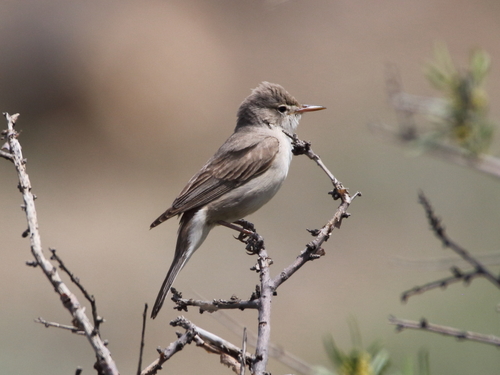 Upcher's Warbler
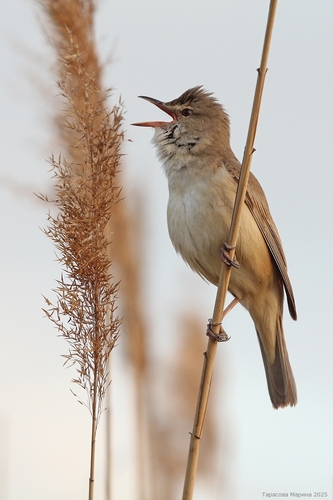 Great Reed Warbler
In short
The most reliable field mark to separate Upcher's Warbler from Great Reed Warbler is size and structure: Great Reed Warbler is much larger, with a heavy, thrush-like build and a strong supercilium, while Upcher's is slimmer, with a longer tail and frequent tail flicking. Upcher's Warbler is overall greyer and more delicate, often showing restless tail movement, whereas Great Reed Warbler is bulkier, brown above, and lacks the tail action. In flight or perched, the size difference is striking, and habitat can also help: Great Reed Warbler is almost always in reedbeds, while Upcher's prefers bushy, drier habitats. Vocalizations are very different and diagnostic if heard.
Identification tips
- Size is the first check: Great Reed Warbler is much larger and heavier than Upcher's Warbler. If the bird looks thrush-sized, it's Great Reed Warbler; if it's more delicate, think Upcher's.
- Supercilium: Great Reed Warbler shows a strong, pale supercilium above the eye, especially obvious in adults. Upcher's Warbler lacks this feature or shows only a weak suggestion.
- Tail length and movement: Upcher's Warbler has a noticeably long tail, which it flicks and fans frequently. This restless tail action is diagnostic and is not shown by Great Reed Warbler.
- Bill and head shape: Great Reed Warbler has a strong, pointed bill and a flattened forehead, giving it a heavy-headed look. Upcher's has a slightly longer bill than Icterine Warbler, but its head is not as massive or flat as Great Reed Warbler's.
- Plumage color: Upcher's is overall greyish, especially above, while Great Reed Warbler is rich brown above and buffish-white below. Juvenile Great Reed Warblers are warmer buff below but still brown above.
- Habitat: If you find the bird in a reedbed, especially in Europe or the Western Palearctic, it's almost certainly Great Reed Warbler. Upcher's avoids reedbeds and prefers dry, bushy habitats.
- Song: Great Reed Warbler's song is loud, harsh, and repetitive, often heard from exposed reed stems. Upcher's song is much softer and more typical of Hippolais, and not likely to be confused.
- Behavior: Upcher's is more active, with constant tail flicking and agile movements in bushes. Great Reed Warbler is slower, more deliberate, and often clambers through reeds.
- Wing and tail proportions: Upcher's has shorter wings and a longer tail relative to its body, while Great Reed Warbler has longer wings and a proportionally shorter tail.
- Perched posture: Great Reed Warbler often appears upright and heavy, while Upcher's is more horizontal and slender.
- Juvenile confusion: Juvenile Great Reed Warblers are richer buff below but otherwise similar to adults; they do not show the restless tail action of Upcher's.
- Flight style: Great Reed Warbler is heavy and slow in flight, while Upcher's is lighter and more agile.
- Bill color and shape: Both have strong bills, but Great Reed Warbler's is more robust and fits its larger head.
- Geographic range: Upcher's breeds from Turkey to Pakistan; Great Reed Warbler breeds across Europe and the Western Palearctic. Overlap is limited, so location can help.
- Pitfalls: Do not rely on general brown/grey tones alone, as light can mislead. Focus on structure, tail action, and habitat for the best separation.
Size
Great Reed Warbler is the largest European warbler, measuring 16–21 cm in length and weighing 22–38 g, with a wingspan of 25–30 cm [wikipedia]. Upcher's Warbler is medium-sized for a Hippolais, similar to Icterine Warbler but with a longer tail and shorter wings; it is noticeably smaller and slimmer than Great Reed Warbler [wikipedia]. The difference is obvious in direct comparison: Great Reed Warbler is thrush-sized and robust, while Upcher's is much more delicate.
Plumage
There are no distinctive age-specific upperwing or flight marks described for either species that would allow for easy separation of juveniles or immatures in flight. Adult Great Reed Warbler is unstreaked brown above and dull buffish-white below, with a strong supercilium and a flattened forehead. Juveniles are richer buff below but otherwise similar. Upcher's Warbler is overall greyish, with a slightly longer bill, shorter wings, and a longer tail than Icterine Warbler; it lacks the strong supercilium of Great Reed Warbler and is more uniformly grey. The tail of Upcher's is proportionally longer and often in motion, while Great Reed Warbler's tail is shorter relative to its body. Supercilium is a key mark: strong and obvious in Great Reed Warbler, weak or absent in Upcher's.
Behaviour
Upcher's Warbler is highly active, with constant tail flicking and movement reminiscent of Sylvia warblers or chats. This tail action is diagnostic and rarely matched by Great Reed Warbler. Great Reed Warbler is more ponderous and less active in its movements, often clambering through dense reeds and singing from exposed reed stems. In flight, Great Reed Warbler appears heavy and slow, while Upcher's is lighter and more agile.
Habitat
Great Reed Warbler is almost exclusively found in reedbeds during the breeding season, and in reedbeds, bush thickets, rice fields, and forest clearings in winter [wikipedia]. Upcher's Warbler breeds in dry, bushy areas from Turkey to Pakistan and is not a reedbed specialist. If the bird is in a dense reedbed, Great Reed Warbler is far more likely; if in dry scrub or open bush, Upcher's is the better candidate.
Voice
The songs are entirely different and diagnostic. Upcher's Warbler has a distinctive Hippolais song, not at all like Great Reed Warbler. Great Reed Warbler's song is very loud, far-carrying, and includes chattering, croaking, and varied phrases (carr-carr-cree-cree-cree-jet-jet), sometimes with mimicry. If you hear a loud, harsh, repetitive song from a reedbed, it's Great Reed Warbler. Upcher's song is softer, more typical of Hippolais, and not likely to be confused by ear.