

Motmot

Tundra Bean Goose vs Pink-footed Goose

Anser serrirostris versus Anser brachyrhynchus

Play a quiz with Tundra Bean Goose and Pink-footed Goose
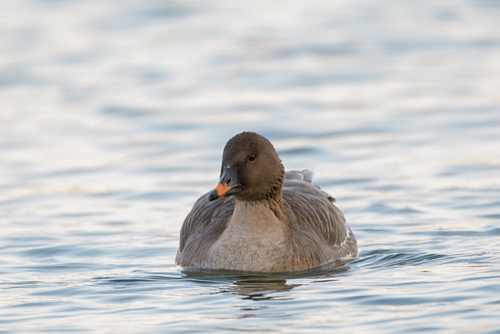
Tundra Bean Goose (Anser serrirostris) Tundra Bean Goose
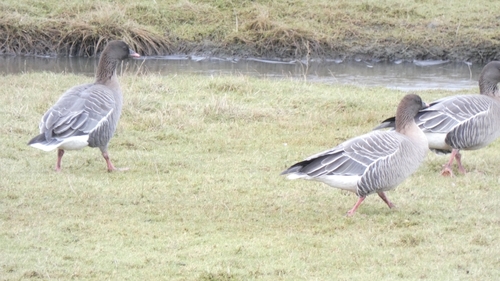
Pink-footed Goose (Anser brachyrhynchus) Pink-footed Goose

Media

Loading…

In short

The most reliable field mark between Tundra Bean Goose and Pink-footed Goose is the color of the bill and legs: Tundra Bean Goose shows a black bill with an orange band and bright orange legs, while Pink-footed Goose has a short bill with a bright pink band and pink legs and feet. In flight or at rest, Pink-footed Goose also shows paler bluish-grey upperwing coverts, contrasting with the darker brown coverts of Tundra Bean Goose. Both species are similar in size and overall shape, so careful attention to bill and leg color, as well as subtle differences in wing coloration, is essential. Juvenile and adult plumages are broadly similar in both species, so age-specific wing patterns are not a primary separator here.

Identification tips

  1. Bill color and pattern: Tundra Bean Goose has a black bill with a narrow to broad orange band (depending on subspecies), while Pink-footed Goose has a short bill with a bright pink band. This is the single most reliable field mark at close range.
  2. Leg and foot color: Tundra Bean Goose shows bright orange legs and feet; Pink-footed Goose has pink legs and feet. This is visible when birds are standing or walking.
  3. Upperwing coverts in flight or at rest: Tundra Bean Goose has dark brown upperwing coverts with narrow white fringes, giving a darker, less contrasting wing. Pink-footed Goose shows paler, bluish-grey upperwing coverts, often creating a more contrasting and 'cleaner' look in flight, especially compared to the body and flight feathers.
  4. Body and head coloration: Both species are brownish-grey with darker heads and necks, but Pink-footed Goose tends to have a richer, darker brown head and neck, and a mid-grey-brown body. Tundra Bean Goose is more uniformly brownish.
  5. Tail and rump: Pink-footed Goose has a grey tail with a broad white tip and a white rump and vent, but these features are subtle and rarely diagnostic unless seen well in flight.
  6. Bill structure: Tundra Bean Goose's bill is longer and stouter (especially in the larger serrirostris subspecies), while Pink-footed Goose's bill is noticeably shorter and more delicate.
  7. Size and structure: Tundra Bean Goose averages slightly larger and heavier, but there is much overlap; size is not reliable unless birds are side by side.
  8. Flock size and context: In northwest Europe, Pink-footed Goose is vastly more numerous and forms huge flocks. Tundra Bean Goose is rare and usually found in much smaller groups, often with other geese.
  9. Vocalizations: Pink-footed Goose is very vocal, with high-pitched honking, especially in flight. Tundra Bean Goose is quieter and less likely to be heard in large, noisy flocks.
  10. Juvenile and immature birds: No distinctive age-specific upperwing or body patterns separate juveniles of these two species; bill and leg color remain the best marks for all ages.
  11. Seasonal context: In Britain and northwest Europe, Pink-footed Goose is expected from autumn through spring. Tundra Bean Goose is a rare winter visitor; any 'bean goose' outside the core wintering areas is more likely Pink-footed.
  12. Pitfalls: Beware of variable orange or pink tones in low light or at distance; always try to see both bill and leg color together. Mud or staining can obscure leg color. Bill color can appear duller in poor light.
  13. Subspecies confusion: The smaller Tundra Bean Goose subspecies (rossicus) can appear similar in size and bill shape to Pink-footed Goose, but still shows orange (not pink) on bill and legs.
  14. Comparison with other geese: Both species are more similar to each other than to Greylag or White-fronted Goose, but Pink-footed's paler upperwing and pink legs are unique among Eurasian geese.
  15. When in doubt: If bill and leg color cannot be seen clearly, and flock context is ambiguous, identification may not be possible to species level in the field.

Size

Both species are medium to large geese and overlap considerably in size. Tundra Bean Goose averages slightly larger, with a length of 68–90 cm and wingspan of 140–174 cm, while Pink-footed Goose is 60–75 cm long with a wingspan of 135–170 cm. Mass is also similar, with Pink-footed Goose averaging around 2.5 kg (from Wikidata), and Tundra Bean Goose males averaging 3.2 kg and females 2.84 kg (Wikipedia). In the field, size alone is not a reliable separator unless birds are side by side, and even then, overlap is substantial.

Plumage

Juvenile and adult Tundra Bean Goose and Pink-footed Goose are both generally brownish-grey geese with dark heads and necks, but key differences are visible in the bill, legs, and wing coverts. Tundra Bean Goose of all ages shows dark brown upperwing coverts with narrow white fringes, while Pink-footed Goose has paler, bluish-grey upperwing coverts reminiscent of Greylag Goose. The bill of Tundra Bean Goose is black with an orange band (narrower in the smaller rossicus subspecies, broader in serrirostris), and the legs and feet are bright orange. Pink-footed Goose has a noticeably shorter bill with a bright pink band and pink legs and feet. The tail of Pink-footed Goose is grey with a broad white tip, and the rump and vent are white, but these are subtle in flight. No age-specific upperwing patterns (such as black 'W' or strong trailing edges) are noted for either species.

Behaviour

Both species are typically seen in flocks and graze in open fields or wetlands. Pink-footed Goose is especially known for forming very large, noisy flocks in wintering areas, sometimes numbering in the tens of thousands. Tundra Bean Goose also forms flocks, but is less likely to be found in such spectacular numbers in northwest Europe. Both species feed on grasses and crops, and their behavior in the field is broadly similar, so behavior alone is not a reliable separator.

Habitat

Tundra Bean Goose breeds in northern Siberian tundra and winters further south in Asia, with rare vagrants to northwest Europe. Pink-footed Goose breeds in Greenland, Iceland, Svalbard, and recently Novaya Zemlya, and winters in northwest Europe (especially Britain, Ireland, the Netherlands, and Denmark). In Britain and northwest Europe, Pink-footed Goose is much more abundant and likely, especially in large winter flocks. Tundra Bean Goose is rare and local in these areas, so context and abundance can help, but should not be used alone for ID.

Voice

Pink-footed Goose is noted for its high-pitched honking calls, especially when flying in large, noisy flocks. Tundra Bean Goose is less vocal in the field and does not produce the same deafening chorus as Pink-footed Goose flocks. However, vocalizations are not always diagnostic unless birds are calling in flight.

Submit a better description

Use the same sections as the comparison. Your text is published immediately.

The most reliable field mark between Tundra Bean Goose and Pink-footed Goose is the color of the bill and legs: Tundra Bean Goose shows a black bill with an orange band and bright orange legs, while Pink-footed Goose has a short bill with a bright pink band and pink legs and feet. In flight or at rest, Pink-footed Goose also shows paler bluish-grey upperwing coverts, contrasting with the darker brown coverts of Tundra Bean Goose. Both species are similar in size and overall shape, so careful attention to bill and leg color, as well as subtle differences in wing coloration, is essential. Juvenile and adult plumages are broadly similar in both species, so age-specific wing patterns are not a primary separator here.

  1. Bill color and pattern: Tundra Bean Goose has a black bill with a narrow to broad orange band (depending on subspecies), while Pink-footed Goose has a short bill with a bright pink band. This is the single most reliable field mark at close range.
  2. Leg and foot color: Tundra Bean Goose shows bright orange legs and feet; Pink-footed Goose has pink legs and feet. This is visible when birds are standing or walking.
  3. Upperwing coverts in flight or at rest: Tundra Bean Goose has dark brown upperwing coverts with narrow white fringes, giving a darker, less contrasting wing. Pink-footed Goose shows paler, bluish-grey upperwing coverts, often creating a more contrasting and 'cleaner' look in flight, especially compared to the body and flight feathers.
  4. Body and head coloration: Both species are brownish-grey with darker heads and necks, but Pink-footed Goose tends to have a richer, darker brown head and neck, and a mid-grey-brown body. Tundra Bean Goose is more uniformly brownish.
  5. Tail and rump: Pink-footed Goose has a grey tail with a broad white tip and a white rump and vent, but these features are subtle and rarely diagnostic unless seen well in flight.
  6. Bill structure: Tundra Bean Goose's bill is longer and stouter (especially in the larger serrirostris subspecies), while Pink-footed Goose's bill is noticeably shorter and more delicate.
  7. Size and structure: Tundra Bean Goose averages slightly larger and heavier, but there is much overlap; size is not reliable unless birds are side by side.
  8. Flock size and context: In northwest Europe, Pink-footed Goose is vastly more numerous and forms huge flocks. Tundra Bean Goose is rare and usually found in much smaller groups, often with other geese.
  9. Vocalizations: Pink-footed Goose is very vocal, with high-pitched honking, especially in flight. Tundra Bean Goose is quieter and less likely to be heard in large, noisy flocks.
  10. Juvenile and immature birds: No distinctive age-specific upperwing or body patterns separate juveniles of these two species; bill and leg color remain the best marks for all ages.
  11. Seasonal context: In Britain and northwest Europe, Pink-footed Goose is expected from autumn through spring. Tundra Bean Goose is a rare winter visitor; any 'bean goose' outside the core wintering areas is more likely Pink-footed.
  12. Pitfalls: Beware of variable orange or pink tones in low light or at distance; always try to see both bill and leg color together. Mud or staining can obscure leg color. Bill color can appear duller in poor light.
  13. Subspecies confusion: The smaller Tundra Bean Goose subspecies (rossicus) can appear similar in size and bill shape to Pink-footed Goose, but still shows orange (not pink) on bill and legs.
  14. Comparison with other geese: Both species are more similar to each other than to Greylag or White-fronted Goose, but Pink-footed's paler upperwing and pink legs are unique among Eurasian geese.
  15. When in doubt: If bill and leg color cannot be seen clearly, and flock context is ambiguous, identification may not be possible to species level in the field.

Both species are medium to large geese and overlap considerably in size. Tundra Bean Goose averages slightly larger, with a length of 68–90 cm and wingspan of 140–174 cm, while Pink-footed Goose is 60–75 cm long with a wingspan of 135–170 cm. Mass is also similar, with Pink-footed Goose averaging around 2.5 kg (from Wikidata), and Tundra Bean Goose males averaging 3.2 kg and females 2.84 kg (Wikipedia). In the field, size alone is not a reliable separator unless birds are side by side, and even then, overlap is substantial.

Juvenile and adult Tundra Bean Goose and Pink-footed Goose are both generally brownish-grey geese with dark heads and necks, but key differences are visible in the bill, legs, and wing coverts. Tundra Bean Goose of all ages shows dark brown upperwing coverts with narrow white fringes, while Pink-footed Goose has paler, bluish-grey upperwing coverts reminiscent of Greylag Goose. The bill of Tundra Bean Goose is black with an orange band (narrower in the smaller rossicus subspecies, broader in serrirostris), and the legs and feet are bright orange. Pink-footed Goose has a noticeably shorter bill with a bright pink band and pink legs and feet. The tail of Pink-footed Goose is grey with a broad white tip, and the rump and vent are white, but these are subtle in flight. No age-specific upperwing patterns (such as black 'W' or strong trailing edges) are noted for either species.

Both species are typically seen in flocks and graze in open fields or wetlands. Pink-footed Goose is especially known for forming very large, noisy flocks in wintering areas, sometimes numbering in the tens of thousands. Tundra Bean Goose also forms flocks, but is less likely to be found in such spectacular numbers in northwest Europe. Both species feed on grasses and crops, and their behavior in the field is broadly similar, so behavior alone is not a reliable separator.

Tundra Bean Goose breeds in northern Siberian tundra and winters further south in Asia, with rare vagrants to northwest Europe. Pink-footed Goose breeds in Greenland, Iceland, Svalbard, and recently Novaya Zemlya, and winters in northwest Europe (especially Britain, Ireland, the Netherlands, and Denmark). In Britain and northwest Europe, Pink-footed Goose is much more abundant and likely, especially in large winter flocks. Tundra Bean Goose is rare and local in these areas, so context and abundance can help, but should not be used alone for ID.

Pink-footed Goose is noted for its high-pitched honking calls, especially when flying in large, noisy flocks. Tundra Bean Goose is less vocal in the field and does not produce the same deafening chorus as Pink-footed Goose flocks. However, vocalizations are not always diagnostic unless birds are calling in flight.

Discard your changes?

You have unsaved edits. If you leave now, those changes will be lost.

Tundra Bean Goose · Pink-footed Goose · My Tricky Birds