

Thick-billed Green-Pigeon vs Jambu Fruit-Dove
Treron curvirostra versus Ramphiculus jambu
Play a quiz with Thick-billed Green-Pigeon and Jambu Fruit-Dove
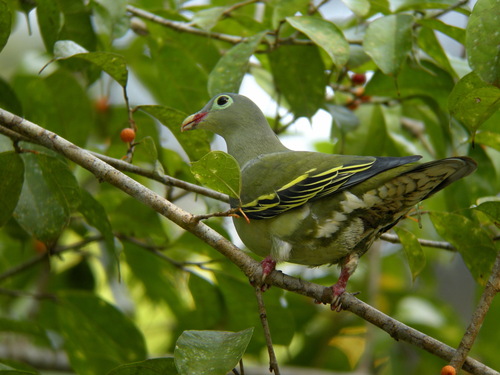 Thick-billed Green-Pigeon
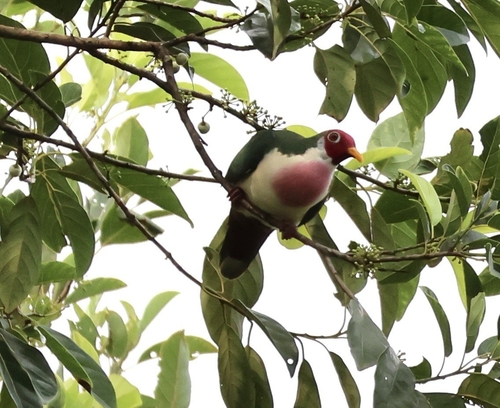 Jambu Fruit-Dove
In short
The most reliable field mark to separate Thick-billed Green-Pigeon from Jambu Fruit-Dove is the combination of head and undertail pattern: Thick-billed Green-Pigeon shows a grey crown, broad bluish-green eye ring, and (in males) a maroon mantle and chestnut undertail, while Jambu Fruit-Dove males have a striking crimson face, white eye ring, and chocolate brown undertail. Females and immatures differ as well, but undertail and face color remain key. In flight or perched, note the thick, pale bill with red base on Thick-billed, versus the orange bill and red legs of Jambu. Both are small green pigeons, but careful attention to head, undertail, and wing edge coloration will separate all ages and sexes.
Identification tips
- Head Color (Adult Male): Jambu Fruit-Dove males have a vivid crimson face and black chin, while Thick-billed Green-Pigeon males have a grey crown and lack any red or purple on the face. This is the single most striking difference at close range.
- Eye Ring: Thick-billed Green-Pigeon has a broad bluish-green eye ring; Jambu Fruit-Dove has a white eye ring. This can be seen well in good light and is useful for both sexes.
- Bill Color: Thick-billed Green-Pigeon shows a thick, pale greenish bill with a red base; Jambu Fruit-Dove has a thinner orange bill. Bill color is visible at close range or in photos.
- Undertail Pattern (Sex/Age): Thick-billed Green-Pigeon males have dull chestnut undertail coverts; females have greenish undertail with whitish scales. Jambu Fruit-Dove males have a chocolate brown undertail; females show cinnamon or buff undertail. Immature Jambu Fruit-Doves also show a dull undertail, but not chestnut.
- Mantle/Upper Back: Male Thick-billed Green-Pigeon has a maroon mantle (upper back), absent in all Jambu Fruit-Doves. This is a strong mark if the bird is perched with back visible.
- Underparts: Jambu Fruit-Dove males have ivory white underparts with a pink breast patch; Thick-billed Green-Pigeon is green below in both sexes. Female Jambu is dull green below with a white belly, but still paler than Thick-billed.
- Leg Color: Jambu Fruit-Dove has red legs, which can be visible when perched. Thick-billed Green-Pigeon leg color is not specified, but is not red.
- Face Color (Female/Immature): Female Jambu Fruit-Dove has a dull purple face with dark chin; immatures have a green face. Thick-billed Green-Pigeon of both sexes has a grey crown and green face, never purple or crimson.
- Wing Pattern: Both species have dark green upperwings, but Thick-billed Green-Pigeon has black primaries and secondaries with a yellow outer edge. This yellow edge may be visible in flight or at rest, especially in good light. Jambu Fruit-Dove upperparts are unmarked dark green.
- Thighs: Thick-billed Green-Pigeon has dark green thighs with whitish scales, visible at close range. Not described for Jambu Fruit-Dove.
- Behavior: Both species are shy, but Thick-billed Green-Pigeon may be seen walking along branches, while Jambu Fruit-Dove is more often perched or feeding in the canopy or on dropped fruit.
- Size/Jizz: Both are small, plump pigeons; size is not a reliable separator in the field.
- Habitat: Both occur in lowland forests and mangroves. Jambu Fruit-Dove is more restricted to the Sundaic region (Malay Peninsula, Sumatra, Borneo, Java), while Thick-billed Green-Pigeon ranges more widely, but this is not reliable where both occur.
- Voice: Jambu Fruit-Dove gives a soft, low coo; Thick-billed Green-Pigeon voice not described here, so do not rely on vocalization.
- Pitfalls: Immature Jambu Fruit-Doves can look similar to female Thick-billed Green-Pigeon, but always check for face color (green in immature Jambu, grey crown in Thick-billed), undertail (never chestnut in Jambu), and bill/eye ring color.
Size
Both species are small green pigeons, with Jambu Fruit-Dove measuring 23–27 cm in length and Thick-billed Green-Pigeon slightly under 26 cm. Their size overlap is nearly complete and not a reliable field mark. Jambu Fruit-Dove is described as plump and small-headed, but this is subtle and easily missed in the field. Weight is only given for Jambu (about 42 g), but this is not a practical field cue.
Plumage
-
Juvenile/Immature: Jambu Fruit-Dove immatures resemble females but have a green face, lacking the vivid adult male's crimson or female's purple face. Thick-billed Green-Pigeon immatures are not described in detail, but both sexes show green underparts and dark green thighs with whitish scales. No age-specific upperwing flight marks are described for either species, so focus on head and undertail.
-
Adult Male: Thick-billed Green-Pigeon males have a grey crown, broad bluish-green eye ring, maroon mantle (upper back), and dull chestnut undertail coverts. Jambu Fruit-Dove males have a crimson face with black chin, white eye ring, ivory underparts with a pink breast patch, and a chocolate brown undertail. Their upperparts are unmarked dark green.
-
Adult Female: Thick-billed Green-Pigeon females lack the maroon mantle and have greenish undertail coverts with whitish scales. Jambu Fruit-Dove females have a dull purple face with dark chin, dull green underparts, white belly, and cinnamon or buff undertail.
-
Bill and Eye Ring: Thick-billed Green-Pigeon has a thick, pale greenish bill with a red base and a broad bluish-green eye ring. Jambu Fruit-Dove has an orange bill, white eye ring, and red legs.
Behaviour
Both species are generally shy and inconspicuous, feeding quietly in the canopy. Thick-billed Green-Pigeon is known to walk slowly along branches while feeding on figs. Jambu Fruit-Dove is usually seen alone or in pairs, sometimes gathering in small flocks at fruiting trees. Jambu Fruit-Dove can feed on fruit both in trees and on the ground, especially if fruit is dropped by other animals. Behavioral differences are subtle and not usually diagnostic in the field.
Habitat
Both species overlap in Southeast Asian lowland forests and mangroves. Thick-billed Green-Pigeon ranges more widely from the Eastern Himalayas through Southeast Asia, including the Indian subcontinent, while Jambu Fruit-Dove is restricted to the Malay Peninsula, Sumatra, Borneo, and Java. Both prefer lowland rainforests and mangroves, but Jambu Fruit-Dove is also found in secondary woodland up to 1,500 m. Habitat alone is not a reliable separator where ranges overlap.
Voice
Jambu Fruit-Dove gives a soft, low coo. No vocalization is described for Thick-billed Green-Pigeon in the provided notes, so voice is not a reliable separator with this information.
Thick-billed Green-Pigeon · Jambu Fruit-Dove · My Tricky Birds