

Motmot

Thick-billed Flowerpecker vs Yellow-bellied Flowerpecker

Pachyglossa agilis versus Pachyglossa melanozantha

Play a quiz with Thick-billed Flowerpecker and Yellow-bellied Flowerpecker
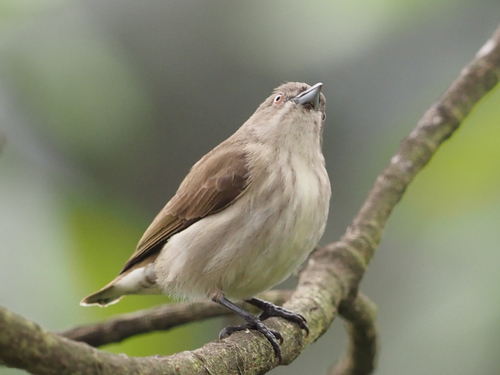
Thick-billed Flowerpecker (Pachyglossa agilis) Thick-billed Flowerpecker
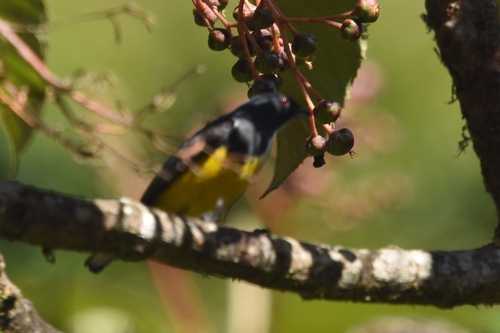
Yellow-bellied Flowerpecker (Pachyglossa melanozantha) Yellow-bellied Flowerpecker

Media

Loading…

In short

The most reliable field mark to separate Thick-billed from Yellow-bellied Flowerpecker is the underparts color: Thick-billed is dull greyish with diffuse streaking on buffy underparts, while Yellow-bellied shows a clear yellow belly. Both are tiny, active canopy birds with short tails and similar structure, but Thick-billed has a notably stouter, heavier bill and subtle tail patterning (whitish tail tips). Juvenile Thick-billeds are paler below with fewer streaks, but still lack the strong yellow of Yellow-bellied. If you see a flowerpecker with a bright yellow belly, it's not Thick-billed.

Identification tips

  1. Underparts color is the most reliable field mark: Thick-billed never shows a bright yellow belly; its underparts are dull greyish with diffuse streaking on buffy, sometimes appearing dirty or washed out. Yellow-bellied always shows a clear yellow belly, which stands out even at a distance.
  2. Bill structure: Thick-billed has a noticeably stouter, heavier bill than Yellow-bellied. If you see a flowerpecker with a chunky, dark bill, especially in profile, favor Thick-billed.
  3. Tail pattern: Thick-billed shows whitish spots at the tips of the tail feathers, which may be visible when the tail is fanned or in good light. This is not described for Yellow-bellied.
  4. Juvenile confusion: Young Thick-billeds are paler below with less streaking, but still lack any yellow wash. If you see a pale-bellied flowerpecker, check for yellow tones—absence suggests Thick-billed.
  5. Sexes similar: Both species are sexually monomorphic in the field, so do not rely on sex-based differences.
  6. No strong wing pattern difference: Neither species is described as having distinctive upperwing marks in any age, so do not rely on wing panels, triangles, or trailing edges.
  7. Perched jizz: Both are short-tailed and compact, but Thick-billed may look slightly bulkier due to its bill and head.
  8. Foraging height and behavior: Both forage actively in the canopy. Thick-billed is noted for tail-jerking and for wiping seeds on branches, but these behaviors are subtle and not always visible.
  9. Habitat overlap: Both occur in forest and woodland, with Thick-billed sometimes in more open or cultivated areas. Habitat is not a safe separator where ranges overlap.
  10. Vocalizations: Only Thick-billed's call and song are described; absence of a 'spick' call does not confirm Yellow-bellied, but presence may suggest Thick-billed.
  11. Subspecies variation: Some Thick-billed subspecies (e.g., Sri Lankan) are smaller and darker above, but this is only relevant locally and does not affect the main underpart contrast.
  12. Iris color: Thick-billed is described as having a reddish iris, but this is rarely visible in the field and not mentioned for Yellow-bellied.
  13. Crown display: Thick-billed males may show a white crown stripe when displaying, but this is rarely seen and not a practical field mark.
  14. Nest placement and structure: Not useful for field ID unless you are observing nesting behavior closely.
  15. If in doubt, focus on underparts color and bill shape: These are the most consistently reliable marks in all seasons and ages.

Size

Both species are very small flowerpeckers, about 10 cm long for Thick-billed [wikipedia]. No direct size comparison is available for Yellow-bellied, but both are among the smallest passerines in their range and are similar in overall size and proportions. The Sri Lankan Thick-billed subspecies is noted as smaller and darker, but this is only relevant locally. Size is not a reliable separation point in the field.

Plumage

Adult Thick-billed Flowerpecker is dark grey-brown above, with dull greyish and diffusely streaked buffy underparts, and a slightly olive rump (in the nominate race). The bill is dark and heavy, and there are whitish spots at the tail tips. Sexes are alike. Juveniles are paler below, with a paler base to the mandible and less streaking, but still lack any strong yellow. In contrast, Yellow-bellied Flowerpecker (by name and all sources) shows a clear yellow belly, which is absent in all ages of Thick-billed. No detailed wing pattern or age-specific upperwing marks are described for either species, so separation relies on underpart color and bill structure. If you see a flowerpecker with a yellow belly, it is Yellow-bellied; if the underparts are dull and streaked, it's Thick-billed.

Behaviour

Both species are active, canopy-foraging flowerpeckers, often seen high in trees feeding on fruit and nectar. Thick-billed is noted for jerking its tail side to side when perched and for wiping mistletoe seeds on branches rather than swallowing them whole. It frequently forages higher than Pale-billed Flowerpecker (not compared here), but no direct behavioral difference with Yellow-bellied is described. Both are energetic and may be hard to observe for long.

Habitat

Both species occur in similar habitats—forests and woodland edges across South and Southeast Asia. Thick-billed is found from India to Indonesia and Timor, with the nominate race in more open or cultivated areas and other subspecies in denser lowland forests. Yellow-bellied is found from the eastern Himalayas through Southeast Asia, overlapping with Thick-billed in some regions. Habitat alone is not diagnostic, but Thick-billed may be more likely in open or cultivated areas in parts of its range.

Voice

Thick-billed gives a frequent 'spick' call and has a rambling song with notes resembling Ashy Prinia. No vocal description is given for Yellow-bellied, so voice is not a reliable separation point based on available information.

Submit a better description

Use the same sections as the comparison. Your text is published immediately.

The most reliable field mark to separate Thick-billed from Yellow-bellied Flowerpecker is the underparts color: Thick-billed is dull greyish with diffuse streaking on buffy underparts, while Yellow-bellied shows a clear yellow belly. Both are tiny, active canopy birds with short tails and similar structure, but Thick-billed has a notably stouter, heavier bill and subtle tail patterning (whitish tail tips). Juvenile Thick-billeds are paler below with fewer streaks, but still lack the strong yellow of Yellow-bellied. If you see a flowerpecker with a bright yellow belly, it's not Thick-billed.

  1. Underparts color is the most reliable field mark: Thick-billed never shows a bright yellow belly; its underparts are dull greyish with diffuse streaking on buffy, sometimes appearing dirty or washed out. Yellow-bellied always shows a clear yellow belly, which stands out even at a distance.
  2. Bill structure: Thick-billed has a noticeably stouter, heavier bill than Yellow-bellied. If you see a flowerpecker with a chunky, dark bill, especially in profile, favor Thick-billed.
  3. Tail pattern: Thick-billed shows whitish spots at the tips of the tail feathers, which may be visible when the tail is fanned or in good light. This is not described for Yellow-bellied.
  4. Juvenile confusion: Young Thick-billeds are paler below with less streaking, but still lack any yellow wash. If you see a pale-bellied flowerpecker, check for yellow tones—absence suggests Thick-billed.
  5. Sexes similar: Both species are sexually monomorphic in the field, so do not rely on sex-based differences.
  6. No strong wing pattern difference: Neither species is described as having distinctive upperwing marks in any age, so do not rely on wing panels, triangles, or trailing edges.
  7. Perched jizz: Both are short-tailed and compact, but Thick-billed may look slightly bulkier due to its bill and head.
  8. Foraging height and behavior: Both forage actively in the canopy. Thick-billed is noted for tail-jerking and for wiping seeds on branches, but these behaviors are subtle and not always visible.
  9. Habitat overlap: Both occur in forest and woodland, with Thick-billed sometimes in more open or cultivated areas. Habitat is not a safe separator where ranges overlap.
  10. Vocalizations: Only Thick-billed's call and song are described; absence of a 'spick' call does not confirm Yellow-bellied, but presence may suggest Thick-billed.
  11. Subspecies variation: Some Thick-billed subspecies (e.g., Sri Lankan) are smaller and darker above, but this is only relevant locally and does not affect the main underpart contrast.
  12. Iris color: Thick-billed is described as having a reddish iris, but this is rarely visible in the field and not mentioned for Yellow-bellied.
  13. Crown display: Thick-billed males may show a white crown stripe when displaying, but this is rarely seen and not a practical field mark.
  14. Nest placement and structure: Not useful for field ID unless you are observing nesting behavior closely.
  15. If in doubt, focus on underparts color and bill shape: These are the most consistently reliable marks in all seasons and ages.

Both species are very small flowerpeckers, about 10 cm long for Thick-billed [wikipedia]. No direct size comparison is available for Yellow-bellied, but both are among the smallest passerines in their range and are similar in overall size and proportions. The Sri Lankan Thick-billed subspecies is noted as smaller and darker, but this is only relevant locally. Size is not a reliable separation point in the field.

Adult Thick-billed Flowerpecker is dark grey-brown above, with dull greyish and diffusely streaked buffy underparts, and a slightly olive rump (in the nominate race). The bill is dark and heavy, and there are whitish spots at the tail tips. Sexes are alike. Juveniles are paler below, with a paler base to the mandible and less streaking, but still lack any strong yellow. In contrast, Yellow-bellied Flowerpecker (by name and all sources) shows a clear yellow belly, which is absent in all ages of Thick-billed. No detailed wing pattern or age-specific upperwing marks are described for either species, so separation relies on underpart color and bill structure. If you see a flowerpecker with a yellow belly, it is Yellow-bellied; if the underparts are dull and streaked, it's Thick-billed.

Both species are active, canopy-foraging flowerpeckers, often seen high in trees feeding on fruit and nectar. Thick-billed is noted for jerking its tail side to side when perched and for wiping mistletoe seeds on branches rather than swallowing them whole. It frequently forages higher than Pale-billed Flowerpecker (not compared here), but no direct behavioral difference with Yellow-bellied is described. Both are energetic and may be hard to observe for long.

Both species occur in similar habitats—forests and woodland edges across South and Southeast Asia. Thick-billed is found from India to Indonesia and Timor, with the nominate race in more open or cultivated areas and other subspecies in denser lowland forests. Yellow-bellied is found from the eastern Himalayas through Southeast Asia, overlapping with Thick-billed in some regions. Habitat alone is not diagnostic, but Thick-billed may be more likely in open or cultivated areas in parts of its range.

Thick-billed gives a frequent 'spick' call and has a rambling song with notes resembling Ashy Prinia. No vocal description is given for Yellow-bellied, so voice is not a reliable separation point based on available information.

Discard your changes?

You have unsaved edits. If you leave now, those changes will be lost.

Thick-billed Flowerpecker · Yellow-bellied Flowerpecker · My Tricky Birds