

Motmot

Tawny Owl vs Ural Owl

Strix aluco versus Strix uralensis

Play a quiz with Tawny Owl and Ural Owl
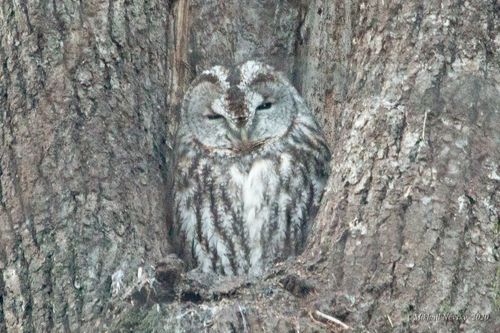
Tawny Owl (Strix aluco) Tawny Owl
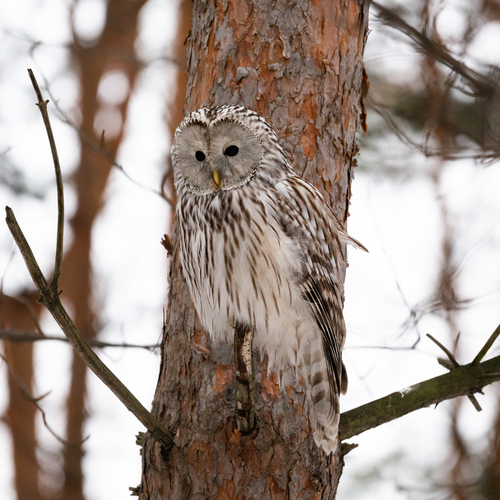
Ural Owl (Strix uralensis) Ural Owl

Media

Loading…

In short

The most reliable field mark to separate Tawny Owl from Ural Owl is size and structure: Ural Owl is much larger, with a noticeably longer tail and more elongated silhouette, while Tawny Owl is stockier and more compact with a relatively larger, rounder head. In all plumages, Tawny Owl shows pale underparts with dark streaks and crossbars, whereas Ural Owl has heavier, straighter streaking below. In flight, Ural Owl’s longer tail and broader wings stand out, while Tawny Owl appears shorter-tailed and more rounded. Both species lack ear tufts and have similar round-headed profiles, but the overall proportions and tail length are key in the field.

Identification tips

  1. Size and structure: Ural Owl is much larger and longer-tailed than Tawny Owl. If you see the bird perched, check how far the tail extends beyond the folded wings—Ural Owl’s tail is conspicuously long, while Tawny’s is short and barely projects.
  2. Jizz in flight: Ural Owl appears elongated and long-tailed in flight, with broad wings and a more stretched silhouette. Tawny Owl is compact, with rounded wings and a short tail, giving a squat appearance.
  3. Head and facial disc: Both lack ear tufts and have round heads, but Tawny Owl’s head is proportionally larger and rounder for its body size. Ural Owl’s facial disc is larger relative to the face, but not as obviously oversized as in Great Grey Owl.
  4. Underpart pattern: Tawny Owl shows pale underparts with dark streaks and crossbars (in all morphs and ages). Ural Owl has heavier, straight streaks on the underparts, lacking the crossbars—this is a subtle but consistent difference.
  5. Upperpart coloration: Tawny Owl can be rufous-brown or greyish-brown above, sometimes with intermediate tones. Ural Owl is generally paler grey-brown above, with less rufous.
  6. Facial disc markings: Both have plain facial discs without concentric barring (unlike Barred or Great Grey Owl), so this is not diagnostic between them.
  7. Tail length: Ural Owl’s tail is long and wedge-shaped, often extending well beyond the wings at rest. Tawny Owl’s tail is short and squared-off, barely visible beyond the wing tips when perched.
  8. Relative head size: Tawny Owl’s head looks large for its body, enhancing its squat look. Ural Owl’s head is proportionally smaller compared to its long body and tail.
  9. Flight style: Tawny Owl’s flight is heavy and slow, especially at takeoff, with less undulation and fewer wingbeats than other owls. Ural Owl’s flight is not described in detail, but its size and tail length make it appear more buoyant and elongated.
  10. Sexual dimorphism: Tawny Owl females are significantly larger than males, but both sexes are still much smaller than Ural Owl.
  11. Habitat context: In western Europe, Tawny Owl is much more likely in smaller woods and urban parks, while Ural Owl is rare and prefers extensive forests.
  12. Season and age: No distinctive juvenile or first-winter wing patterns are described for either species, so focus on structure and underpart streaking in all ages.
  13. Plumage morphs: Tawny Owl’s brown and grey morphs can cause confusion, but both are smaller and shorter-tailed than Ural Owl.
  14. Confusion risk: If you see a large, long-tailed, pale brown owl in deep forest, suspect Ural Owl; if the bird is compact, short-tailed, and in a park or small woodland, Tawny Owl is far more likely.
  15. Voice: Not covered in these notes, so do not rely on vocalizations for separation here.

Size

Tawny Owl is a medium-sized owl with a typical body mass around 475 g [wikidata], while Ural Owl is distinctly larger (though precise mass is not provided here, all sources agree it is much heavier and longer). Tawny Owl measures 37–46 cm in length with an 81–105 cm wingspan, and is noticeably smaller and more compact than Ural Owl. Ural Owl’s longer tail is especially conspicuous both perched and in flight, giving it a more elongated appearance. Tawny Owl is stocky and squat, with a large, rounded head relative to its body size.

Plumage

No age-specific upperwing or flight marks are described for either species, so focus is on adult and general plumage. Tawny Owl comes in brown and grey morphs, both with pale underparts marked by dark streaks and crossbars. Ural Owl, by contrast, has heavier, straight streaks on the underparts without the crossbars. The facial disc of Tawny Owl is plain and round, while Ural Owl’s is also round but larger in proportion to the face, and lacks any concentric barring (a feature that distinguishes it from similar species, but not from Tawny). Both lack ear tufts. In all ages and morphs, Tawny Owl’s underparts are paler and more patterned, while Ural Owl’s are more heavily and evenly streaked. Ural Owl’s upperparts are generally paler grey-brown, while Tawny can be rufous or greyish brown.

Behaviour

Tawny Owl flies with heavy, slow wingbeats and long glides on rounded wings, often at a greater height than other owls, but with a squat, compact look. Ural Owl’s flight is not described in detail here, but its longer tail and larger size give it a more elongated, less compact jizz in the air. Both are nocturnal, but Ural Owl is sometimes partially diurnal in warmer months. Perched, Ural Owl’s long tail often protrudes well beyond the wings, while Tawny Owl’s tail is much shorter and less obvious.

Habitat

Both species are woodland owls, but Tawny Owl is widespread in woodlands across Europe and western Siberia, often in more temperate forests. Ural Owl is more associated with boreal and mixed forests, often in colder or more eastern regions. There is some overlap in range, but Ural Owl tends to prefer larger, less fragmented tracts of forest, while Tawny Owl is more adaptable to smaller woodlots and even parks.

Submit a better description

Use the same sections as the comparison. Your text is published immediately.

The most reliable field mark to separate Tawny Owl from Ural Owl is size and structure: Ural Owl is much larger, with a noticeably longer tail and more elongated silhouette, while Tawny Owl is stockier and more compact with a relatively larger, rounder head. In all plumages, Tawny Owl shows pale underparts with dark streaks and crossbars, whereas Ural Owl has heavier, straighter streaking below. In flight, Ural Owl’s longer tail and broader wings stand out, while Tawny Owl appears shorter-tailed and more rounded. Both species lack ear tufts and have similar round-headed profiles, but the overall proportions and tail length are key in the field.

  1. Size and structure: Ural Owl is much larger and longer-tailed than Tawny Owl. If you see the bird perched, check how far the tail extends beyond the folded wings—Ural Owl’s tail is conspicuously long, while Tawny’s is short and barely projects.
  2. Jizz in flight: Ural Owl appears elongated and long-tailed in flight, with broad wings and a more stretched silhouette. Tawny Owl is compact, with rounded wings and a short tail, giving a squat appearance.
  3. Head and facial disc: Both lack ear tufts and have round heads, but Tawny Owl’s head is proportionally larger and rounder for its body size. Ural Owl’s facial disc is larger relative to the face, but not as obviously oversized as in Great Grey Owl.
  4. Underpart pattern: Tawny Owl shows pale underparts with dark streaks and crossbars (in all morphs and ages). Ural Owl has heavier, straight streaks on the underparts, lacking the crossbars—this is a subtle but consistent difference.
  5. Upperpart coloration: Tawny Owl can be rufous-brown or greyish-brown above, sometimes with intermediate tones. Ural Owl is generally paler grey-brown above, with less rufous.
  6. Facial disc markings: Both have plain facial discs without concentric barring (unlike Barred or Great Grey Owl), so this is not diagnostic between them.
  7. Tail length: Ural Owl’s tail is long and wedge-shaped, often extending well beyond the wings at rest. Tawny Owl’s tail is short and squared-off, barely visible beyond the wing tips when perched.
  8. Relative head size: Tawny Owl’s head looks large for its body, enhancing its squat look. Ural Owl’s head is proportionally smaller compared to its long body and tail.
  9. Flight style: Tawny Owl’s flight is heavy and slow, especially at takeoff, with less undulation and fewer wingbeats than other owls. Ural Owl’s flight is not described in detail, but its size and tail length make it appear more buoyant and elongated.
  10. Sexual dimorphism: Tawny Owl females are significantly larger than males, but both sexes are still much smaller than Ural Owl.
  11. Habitat context: In western Europe, Tawny Owl is much more likely in smaller woods and urban parks, while Ural Owl is rare and prefers extensive forests.
  12. Season and age: No distinctive juvenile or first-winter wing patterns are described for either species, so focus on structure and underpart streaking in all ages.
  13. Plumage morphs: Tawny Owl’s brown and grey morphs can cause confusion, but both are smaller and shorter-tailed than Ural Owl.
  14. Confusion risk: If you see a large, long-tailed, pale brown owl in deep forest, suspect Ural Owl; if the bird is compact, short-tailed, and in a park or small woodland, Tawny Owl is far more likely.
  15. Voice: Not covered in these notes, so do not rely on vocalizations for separation here.

Tawny Owl is a medium-sized owl with a typical body mass around 475 g [wikidata], while Ural Owl is distinctly larger (though precise mass is not provided here, all sources agree it is much heavier and longer). Tawny Owl measures 37–46 cm in length with an 81–105 cm wingspan, and is noticeably smaller and more compact than Ural Owl. Ural Owl’s longer tail is especially conspicuous both perched and in flight, giving it a more elongated appearance. Tawny Owl is stocky and squat, with a large, rounded head relative to its body size.

No age-specific upperwing or flight marks are described for either species, so focus is on adult and general plumage. Tawny Owl comes in brown and grey morphs, both with pale underparts marked by dark streaks and crossbars. Ural Owl, by contrast, has heavier, straight streaks on the underparts without the crossbars. The facial disc of Tawny Owl is plain and round, while Ural Owl’s is also round but larger in proportion to the face, and lacks any concentric barring (a feature that distinguishes it from similar species, but not from Tawny). Both lack ear tufts. In all ages and morphs, Tawny Owl’s underparts are paler and more patterned, while Ural Owl’s are more heavily and evenly streaked. Ural Owl’s upperparts are generally paler grey-brown, while Tawny can be rufous or greyish brown.

Tawny Owl flies with heavy, slow wingbeats and long glides on rounded wings, often at a greater height than other owls, but with a squat, compact look. Ural Owl’s flight is not described in detail here, but its longer tail and larger size give it a more elongated, less compact jizz in the air. Both are nocturnal, but Ural Owl is sometimes partially diurnal in warmer months. Perched, Ural Owl’s long tail often protrudes well beyond the wings, while Tawny Owl’s tail is much shorter and less obvious.

Both species are woodland owls, but Tawny Owl is widespread in woodlands across Europe and western Siberia, often in more temperate forests. Ural Owl is more associated with boreal and mixed forests, often in colder or more eastern regions. There is some overlap in range, but Ural Owl tends to prefer larger, less fragmented tracts of forest, while Tawny Owl is more adaptable to smaller woodlots and even parks.

Discard your changes?

You have unsaved edits. If you leave now, those changes will be lost.

Tawny Owl · Ural Owl · My Tricky Birds