

Tawny Owl vs Short-eared Owl
Strix aluco versus Asio flammeus
Play a quiz with Tawny Owl and Short-eared Owl
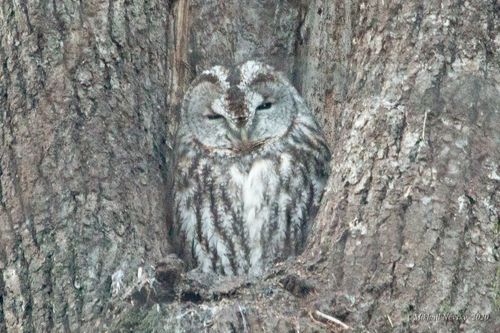 Tawny Owl
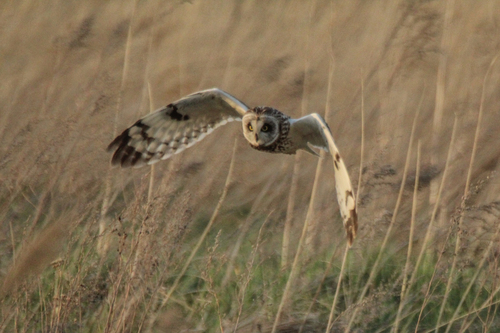 Short-eared Owl
In short
The most reliable field mark to separate Tawny Owl from Short-eared Owl is overall structure and flight style: Tawny Owl is a stocky, broad-headed woodland owl with a squat shape and rounded wings, while Short-eared Owl is slimmer, longer-winged, and often appears 'moth-like' or floppy in flight over open country. In flight, Short-eared Owl (all ages) shows pale upperwing primary patches and a bold white trailing edge to the wing, which Tawny Owl lacks. Tawny Owl is strictly nocturnal and rarely seen flying in daylight, while Short-eared Owl is often active at dawn and dusk. Perched, Tawny Owl has a plain, rounded face with dark brown eyes, while Short-eared Owl has a striking facial disc with yellow eyes and black 'mascara' marks.
Identification tips
- Flight pattern: Short-eared Owl has a floppy, buoyant, 'moth-like' flight with irregular wingbeats, often seen in daylight over open fields. Tawny Owl flies with heavy, slow, gliding wingbeats, usually at night and rarely in open areas.
- Upperwing pattern in flight (all ages): Short-eared Owl shows pale primary patches and a broad white trailing edge on the upperwing; Tawny Owl's wings are plain brown or grey with no bold pattern.
- Tail pattern: Short-eared Owl has a boldly barred tail visible in flight; Tawny Owl's tail is less distinctly marked.
- Underwing pattern: Short-eared Owl often shows dark marks on the innermost secondaries and bolder dark tips to the primaries; Tawny Owl's underwing is plain and lacks strong contrast.
- Underpart streaking: Tawny Owl is streaked throughout the underparts; Short-eared Owl's streaking is limited to the upper breast, with the belly paler and less marked.
- Facial disc and eye color: Tawny Owl has a plain, rounded facial disc with dark brown eyes; Short-eared Owl has a pale facial disc with striking yellow eyes and bold black 'mascara' marks.
- Ear tufts: Tawny Owl lacks ear tufts; Short-eared Owl has short ear tufts that are rarely visible and not a reliable field mark.
- Structure and jizz: Tawny Owl is compact, broad-headed, and squat, with rounded wings; Short-eared Owl is slimmer, longer-winged, and longer-tailed, often appearing more elongated in flight.
- Perched posture: Tawny Owl sits deep in trees, often hunched and inconspicuous; Short-eared Owl perches openly on the ground or low posts in open country.
- Habitat: Woodland or parkland strongly favors Tawny Owl; open grassland, marsh, or tundra points to Short-eared Owl.
- Activity period: Daytime or crepuscular activity in open areas is typical for Short-eared Owl; Tawny Owl is almost exclusively nocturnal.
- Size impression: Tawny Owl is heavier and bulkier, but Short-eared Owl's longer wings can make it appear larger in flight.
- Sexual dimorphism: Both species have females larger than males, but this is not a practical field mark.
- Plumage morphs: Tawny Owl can be brown or grey, but both morphs are plain and lack the bold wing/tail patterns of Short-eared Owl.
- Pitfalls: Immature Tawny Owls may appear paler, but never show the pale wing panels or bold tail barring of Short-eared Owl. Short-eared Owl's ear tufts are rarely visible, so do not rely on this feature.
Size
Tawny Owl is heavier and bulkier, with a typical body mass around 475 g [wikidata], and a length of 37–46 cm and wingspan of 81–105 cm [wikipedia]. Short-eared Owl is lighter (206–475 g), slightly shorter (34–43 cm), but can have a similar or even longer wingspan (85–110 cm) [wikipedia]. In the field, Tawny Owl looks more robust and compact, while Short-eared Owl appears slimmer and more elongated, especially in the wings.
Plumage
Age-specific upperwing pattern is key: Short-eared Owl of all ages shows obvious pale primary patches on the upperwing in flight, plus a broad white band along the rear edge of the wing—these are absent in Tawny Owl. Short-eared also has bolder tail barring and dark marks on the innermost secondaries, creating contrast on the underwing. Tawny Owl, regardless of age or morph, has plain brown or greyish upperparts with no bold wing or tail pattern, and underparts are pale with brown streaks. Short-eared Owl's underparts are streaked only on the upper breast, fading below, while Tawny Owl is streaked throughout. Facial discs differ: Tawny Owl's is plain and rounded with dark brown eyes, Short-eared's is pale with yellow eyes and bold black eye markings. Ear tufts are rarely visible in Short-eared and absent in Tawny.
Behaviour
Tawny Owl is strictly nocturnal, rarely seen flying except at night, and typically glides heavily and slowly between trees. Short-eared Owl is crepuscular and often hunts in open fields during daylight, with a buoyant, floppy, 'moth-like' flight. Tawny Owl perches deep in woodland, while Short-eared Owl often perches low or on the ground in open country. Short-eared may gather in loose flocks in breeding season, which Tawny does not.
Habitat
Tawny Owl is a woodland specialist, found in forests and wooded parks across Europe and western Siberia. Short-eared Owl favors open habitats—grasslands, meadows, marshes, and tundra—avoiding dense woodland. Finding a bird in open country strongly favors Short-eared; in mature woodland, Tawny is far more likely.
Voice
No direct comparison in the notes. Both species are vocal, but their calls are distinct and not likely to be confused in the field.