

Motmot

Taiga Bean Goose vs Pink-footed Goose

Anser fabalis versus Anser brachyrhynchus

Play a quiz with Taiga Bean Goose and Pink-footed Goose
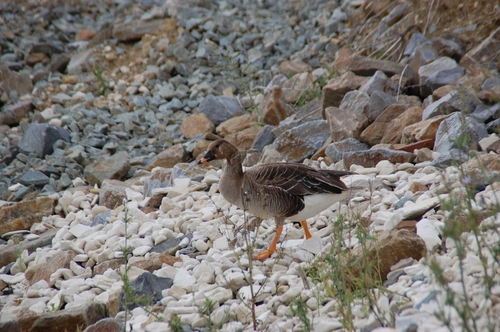
Taiga Bean Goose (Anser fabalis) Taiga Bean Goose
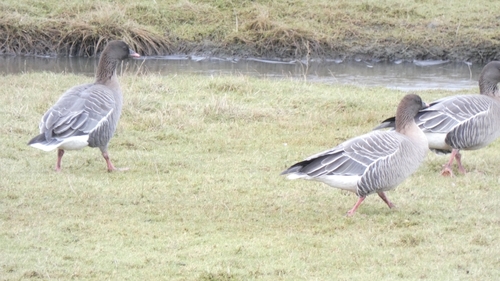
Pink-footed Goose (Anser brachyrhynchus) Pink-footed Goose

Media

Loading…

In short

The most reliable field mark between Taiga Bean Goose and Pink-footed Goose is the color of the bill and legs: Taiga Bean Goose shows a black bill with an orange band and bright orange legs, while Pink-footed Goose has a shorter bill with a bright pink band and pink legs. In flight or at rest, Pink-footed Goose also stands out with paler, bluish-grey upperwing coverts, compared to the darker brown coverts of Taiga Bean Goose. Structure and size can help: Taiga Bean Goose is noticeably heavier and longer, but beware overlap, especially with small Taiga Bean Goose subspecies. Both species can appear together in winter flocks, so careful attention to these details is essential.

Identification tips

  1. Bill color and pattern: Taiga Bean Goose has a black bill with an orange band across the middle; Pink-footed Goose has a shorter bill with a bright pink band (not orange). This is the single most reliable mark at close range for all ages and seasons.
  2. Leg and foot color: Taiga Bean Goose has bright orange legs and feet; Pink-footed Goose has pink legs and feet. This is visible in good light when birds are standing or walking.
  3. Upperwing coverts in flight and at rest: Pink-footed Goose shows pale, bluish-grey upperwing coverts (like Greylag), while Taiga Bean Goose has darker brown coverts with narrow white fringes. This contrast is especially useful when viewing flocks in flight or birds with wings outstretched.
  4. Body and head coloration: Pink-footed Goose has a mid-grey-brown body with a distinctly darker, richer brown head and neck, creating a contrast. Taiga Bean Goose is more uniformly brown, with less contrast between body and head/neck.
  5. Tail pattern: Pink-footed Goose has a grey tail with a broad white tip, and a white rump and vent. Taiga Bean Goose lacks the strong white tail tip and has less obvious rump contrast.
  6. Size and structure: Taiga Bean Goose is larger and heavier, with a longer body and broader wingspan. However, beware overlap, especially with smaller Taiga Bean Goose subspecies and larger Pink-footed individuals. Use size only in direct comparison within mixed flocks.
  7. Bill structure: Pink-footed Goose has a noticeably shorter bill than Taiga Bean Goose. This can be subtle at distance but is apparent at close range or in profile.
  8. Flock behavior: Pink-footed Goose often forms very large, dense, and noisy flocks on farmland, especially in the UK and northwest Europe. Taiga Bean Goose flocks are usually smaller and less tightly packed.
  9. Vocalizations: Listen for higher-pitched, more musical honking from Pink-footed Goose, especially in flight. Taiga Bean Goose gives deeper, more resonant honks.
  10. Habitat and context: In northwest Europe, especially the UK and adjacent areas, Pink-footed Goose is much more numerous and likely to be seen in large flocks. Taiga Bean Goose is scarcer and more localized, often in smaller groups.
  11. Seasonal context: Both species are present in winter in northwest Europe, but Pink-footed Goose is far more abundant. Taiga Bean Goose is more likely in eastern and central Europe, but small numbers winter in the UK.
  12. Pitfalls with immatures: Juvenile and immature birds of both species show the same key differences in bill, leg, and wing covert color as adults. There are no known age-specific traps for these marks.
  13. Not to be confused with Tundra Bean Goose: Both species can be confused with Tundra Bean Goose, which is structurally and plumage-wise intermediate, but for this pair, the above marks are reliable.
  14. When marks fail: In poor light or at great distance, bill and leg color may not be visible. In such cases, rely on overall size, flock structure, and especially the upperwing covert color in flight.
  15. Check multiple marks: Always use a combination of bill color, leg color, and upperwing covert tone for a confident identification, especially in mixed or distant flocks.

Size

Taiga Bean Goose is the larger of the two, with an average adult mass of about 3020 g compared to Pink-footed Goose's 2505 g. Taiga Bean Goose also has a longer body (68–90 cm vs. 60–75 cm) and a slightly broader wingspan (140–174 cm vs. 135–170 cm). However, there is some overlap, especially with smaller Taiga Bean Goose subspecies and larger Pink-footed individuals, so size alone is not always diagnostic in the field.

Plumage

Juvenile and adult Taiga Bean Geese have dark brown upperwing coverts with narrow white fringes, giving the wing a generally darker and more uniform look in flight and at rest. In contrast, Pink-footed Goose of all ages shows noticeably paler, bluish-grey upperwing coverts, similar to Greylag Goose, which can be seen both in flight and when perched. Pink-footed Goose also has a mid-grey-brown body with a richer, darker brown head and neck, a white rump and vent, and a grey tail with a broad white tip. Taiga Bean Goose is overall browner, with less contrast between body and head/neck, and lacks the crisp white tail tip. Bill and leg color are key: Taiga Bean Goose has a black bill with an orange band and orange legs, while Pink-footed Goose has a shorter bill with a pink band and pink legs. These marks are consistent across ages and seasons.

Behaviour

Both species are highly gregarious and often form large flocks, especially in winter. Pink-footed Goose is particularly known for very large, noisy flocks grazing on farmland, sometimes numbering in the tens of thousands. Taiga Bean Goose flocks are usually smaller and less tightly packed. In flight, both species form classic V-shaped skeins, but Pink-footed Goose flocks may appear more vocal and restless.

Habitat

Taiga Bean Goose breeds in northern Europe and Asia, wintering further south in Europe and Asia. Pink-footed Goose breeds in eastern Greenland, Iceland, Svalbard, and recently Novaya Zemlya, wintering in northwest Europe, especially Great Britain, Ireland, the Netherlands, and Denmark. In winter, both species can overlap in northwest Europe, especially on farmland and wetlands. Pink-footed Goose is more likely in large, dense flocks in the UK and adjacent areas, while Taiga Bean Goose is scarcer and more localized.

Voice

Taiga Bean Goose gives a loud, deep honking call, typical of large geese. Pink-footed Goose is much more vocal in flight, producing a medley of high-pitched honking calls that can be deafening in large flocks. The calls of Pink-footed Goose are higher-pitched and more musical compared to the deeper, more resonant calls of Taiga Bean Goose.

Submit a better description

Use the same sections as the comparison. Your text is published immediately.

The most reliable field mark between Taiga Bean Goose and Pink-footed Goose is the color of the bill and legs: Taiga Bean Goose shows a black bill with an orange band and bright orange legs, while Pink-footed Goose has a shorter bill with a bright pink band and pink legs. In flight or at rest, Pink-footed Goose also stands out with paler, bluish-grey upperwing coverts, compared to the darker brown coverts of Taiga Bean Goose. Structure and size can help: Taiga Bean Goose is noticeably heavier and longer, but beware overlap, especially with small Taiga Bean Goose subspecies. Both species can appear together in winter flocks, so careful attention to these details is essential.

  1. Bill color and pattern: Taiga Bean Goose has a black bill with an orange band across the middle; Pink-footed Goose has a shorter bill with a bright pink band (not orange). This is the single most reliable mark at close range for all ages and seasons.
  2. Leg and foot color: Taiga Bean Goose has bright orange legs and feet; Pink-footed Goose has pink legs and feet. This is visible in good light when birds are standing or walking.
  3. Upperwing coverts in flight and at rest: Pink-footed Goose shows pale, bluish-grey upperwing coverts (like Greylag), while Taiga Bean Goose has darker brown coverts with narrow white fringes. This contrast is especially useful when viewing flocks in flight or birds with wings outstretched.
  4. Body and head coloration: Pink-footed Goose has a mid-grey-brown body with a distinctly darker, richer brown head and neck, creating a contrast. Taiga Bean Goose is more uniformly brown, with less contrast between body and head/neck.
  5. Tail pattern: Pink-footed Goose has a grey tail with a broad white tip, and a white rump and vent. Taiga Bean Goose lacks the strong white tail tip and has less obvious rump contrast.
  6. Size and structure: Taiga Bean Goose is larger and heavier, with a longer body and broader wingspan. However, beware overlap, especially with smaller Taiga Bean Goose subspecies and larger Pink-footed individuals. Use size only in direct comparison within mixed flocks.
  7. Bill structure: Pink-footed Goose has a noticeably shorter bill than Taiga Bean Goose. This can be subtle at distance but is apparent at close range or in profile.
  8. Flock behavior: Pink-footed Goose often forms very large, dense, and noisy flocks on farmland, especially in the UK and northwest Europe. Taiga Bean Goose flocks are usually smaller and less tightly packed.
  9. Vocalizations: Listen for higher-pitched, more musical honking from Pink-footed Goose, especially in flight. Taiga Bean Goose gives deeper, more resonant honks.
  10. Habitat and context: In northwest Europe, especially the UK and adjacent areas, Pink-footed Goose is much more numerous and likely to be seen in large flocks. Taiga Bean Goose is scarcer and more localized, often in smaller groups.
  11. Seasonal context: Both species are present in winter in northwest Europe, but Pink-footed Goose is far more abundant. Taiga Bean Goose is more likely in eastern and central Europe, but small numbers winter in the UK.
  12. Pitfalls with immatures: Juvenile and immature birds of both species show the same key differences in bill, leg, and wing covert color as adults. There are no known age-specific traps for these marks.
  13. Not to be confused with Tundra Bean Goose: Both species can be confused with Tundra Bean Goose, which is structurally and plumage-wise intermediate, but for this pair, the above marks are reliable.
  14. When marks fail: In poor light or at great distance, bill and leg color may not be visible. In such cases, rely on overall size, flock structure, and especially the upperwing covert color in flight.
  15. Check multiple marks: Always use a combination of bill color, leg color, and upperwing covert tone for a confident identification, especially in mixed or distant flocks.

Taiga Bean Goose is the larger of the two, with an average adult mass of about 3020 g compared to Pink-footed Goose's 2505 g. Taiga Bean Goose also has a longer body (68–90 cm vs. 60–75 cm) and a slightly broader wingspan (140–174 cm vs. 135–170 cm). However, there is some overlap, especially with smaller Taiga Bean Goose subspecies and larger Pink-footed individuals, so size alone is not always diagnostic in the field.

Juvenile and adult Taiga Bean Geese have dark brown upperwing coverts with narrow white fringes, giving the wing a generally darker and more uniform look in flight and at rest. In contrast, Pink-footed Goose of all ages shows noticeably paler, bluish-grey upperwing coverts, similar to Greylag Goose, which can be seen both in flight and when perched. Pink-footed Goose also has a mid-grey-brown body with a richer, darker brown head and neck, a white rump and vent, and a grey tail with a broad white tip. Taiga Bean Goose is overall browner, with less contrast between body and head/neck, and lacks the crisp white tail tip. Bill and leg color are key: Taiga Bean Goose has a black bill with an orange band and orange legs, while Pink-footed Goose has a shorter bill with a pink band and pink legs. These marks are consistent across ages and seasons.

Both species are highly gregarious and often form large flocks, especially in winter. Pink-footed Goose is particularly known for very large, noisy flocks grazing on farmland, sometimes numbering in the tens of thousands. Taiga Bean Goose flocks are usually smaller and less tightly packed. In flight, both species form classic V-shaped skeins, but Pink-footed Goose flocks may appear more vocal and restless.

Taiga Bean Goose breeds in northern Europe and Asia, wintering further south in Europe and Asia. Pink-footed Goose breeds in eastern Greenland, Iceland, Svalbard, and recently Novaya Zemlya, wintering in northwest Europe, especially Great Britain, Ireland, the Netherlands, and Denmark. In winter, both species can overlap in northwest Europe, especially on farmland and wetlands. Pink-footed Goose is more likely in large, dense flocks in the UK and adjacent areas, while Taiga Bean Goose is scarcer and more localized.

Taiga Bean Goose gives a loud, deep honking call, typical of large geese. Pink-footed Goose is much more vocal in flight, producing a medley of high-pitched honking calls that can be deafening in large flocks. The calls of Pink-footed Goose are higher-pitched and more musical compared to the deeper, more resonant calls of Taiga Bean Goose.

Discard your changes?

You have unsaved edits. If you leave now, those changes will be lost.

Taiga Bean Goose · Pink-footed Goose · My Tricky Birds