
Motmot

Swallow-tailed Bee-eater vs Southern Carmine Bee-eater

Merops hirundineus versus Merops nubicoides

Play a quiz with Swallow-tailed Bee-eater and Southern Carmine Bee-eater
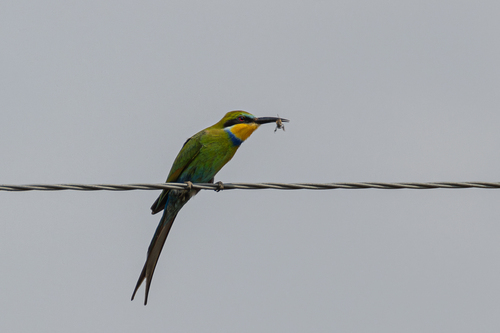
Swallow-tailed Bee-eater (Merops hirundineus) Swallow-tailed Bee-eater
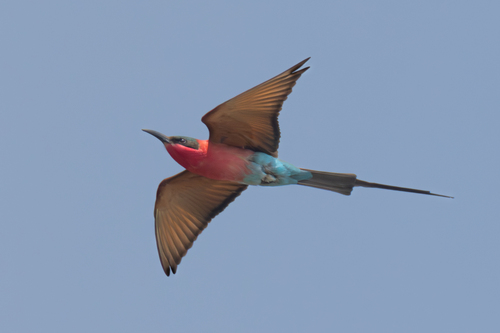
Southern Carmine Bee-eater (Merops nubicoides) Southern Carmine Bee-eater

Media

Loading…

In short

The most reliable way to separate Swallow-tailed Bee-eater from Southern Carmine Bee-eater is by overall color: Swallow-tailed is mainly green with a yellow throat and blue gorget, while Southern Carmine is predominantly carmine-red with a blue crown and undertail. The tail shape is also key—Swallow-tailed has a long, deeply forked tail, while Southern Carmine’s tail is less dramatically forked. Both are slender, colorful bee-eaters, but their color palettes and tail structure are strikingly different. If seen in flight, focus on the body color and tail shape for a quick ID.

Identification tips

  1. Overall color is the fastest field mark: Swallow-tailed is mainly green with a yellow throat and blue gorget; Southern Carmine is carmine-red with a blue crown and blue undertail. This works for all ages and sexes.
  2. Tail shape is diagnostic: Swallow-tailed Bee-eater has a long, deeply forked tail with green or blue central feathers. Southern Carmine’s tail is less deeply forked and the central feathers are blue, but the fork is not as pronounced.
  3. Face pattern: Swallow-tailed shows a black eye-stripe and black bill, with a yellow throat bordered below by a blue gorget. Southern Carmine lacks the black eye-stripe and has a blue crown instead.
  4. Underparts: Swallow-tailed’s underparts are mostly green, while Southern Carmine’s are carmine-red throughout, with blue undertail coverts.
  5. Crown color: Swallow-tailed has a green crown; Southern Carmine has a blue crown, which stands out against the carmine body.
  6. Size impression: Swallow-tailed is much smaller and more delicate. Southern Carmine is large, robust, and long-winged. If both are seen together, the size difference is obvious.
  7. Perched jizz: Swallow-tailed sits more upright and looks slim with a long, pointed tail. Southern Carmine appears bulkier and longer-bodied.
  8. Flight silhouette: Swallow-tailed’s deeply forked tail is obvious in flight; Southern Carmine’s tail is less dramatically forked and the wings are broader.
  9. Group size: Swallow-tailed is usually in pairs or small groups; Southern Carmine often forms large, noisy flocks, especially at breeding sites.
  10. Habitat context: Swallow-tailed prefers wooded savannah; Southern Carmine is more often in open country, floodplains, and riverbanks. Use this as a supporting clue, not a primary mark.
  11. No age-specific or immature wing pattern differences are described: Both species appear similar across ages in the field, so rely on color and structure.
  12. No seasonal or sex-based plumage differences: Both species are sexually monomorphic and do not have strong seasonal changes in plumage.
  13. Bill color: Swallow-tailed has a black bill; Southern Carmine’s bill is also dark, so this is not a strong separator.
  14. Vocalizations are not described as distinctive in the available notes.
  15. If in doubt, focus on the combination of overall color (green vs carmine), tail shape (deep fork vs shallow), and size (small vs large). These three together will separate all field encounters.

Size

Swallow-tailed Bee-eater is a small, light bee-eater (about 20 g [wikidata]), while Southern Carmine Bee-eater is noticeably larger and bulkier (exact mass not provided, but it is a much bigger species by visual impression and typical for carmine bee-eaters [wikipedia]). Swallow-tailed reaches 20–22 cm in length including its long tail, but Southern Carmine is longer overall due to its larger body and tail. In the field, Southern Carmine will appear much more robust and longer-winged.

Plumage

No age-specific upperwing or juvenile flight marks are described for either species in the available notes. For all plumages, Swallow-tailed Bee-eater is mainly green, with a yellow throat, blue gorget (throat band), and a black eye-stripe and bill. Its tail is long and deeply forked, with green or blue central feathers. Southern Carmine Bee-eater is predominantly carmine-red, with a blue crown and blue undertail. The face and underparts are carmine, and the blue crown and undertail contrast strongly with the red body. Both sexes are similar in each species. There is no mention of seasonal or immature-specific differences that would affect field identification between these two.

Behaviour

Both species are aerial insectivores, catching insects (especially bees) on the wing from open perches. Swallow-tailed Bee-eater is often seen in pairs or very small groups, sometimes feeding and roosting communally. Southern Carmine Bee-eater is more likely to be seen in larger, noisier flocks, especially at breeding colonies. Both are approachable and conspicuous when perched, but Southern Carmine’s larger size and tendency to gather in bigger groups may be noticeable in the field.

Habitat

Swallow-tailed Bee-eater prefers savannah woodlands and somewhat more wooded country than most bee-eaters, often found in sub-Saharan Africa. Southern Carmine Bee-eater is found across sub-equatorial Africa, typically in more open country, riverbanks, and floodplains. If the setting is open woodland, Swallow-tailed is more likely; in open floodplain or near large riverbanks, Southern Carmine is more expected. Both may overlap in some regions, so habitat is supportive but not definitive.

Submit a better description

Use the same sections as the comparison. Your text is published immediately.

The most reliable way to separate Swallow-tailed Bee-eater from Southern Carmine Bee-eater is by overall color: Swallow-tailed is mainly green with a yellow throat and blue gorget, while Southern Carmine is predominantly carmine-red with a blue crown and undertail. The tail shape is also key—Swallow-tailed has a long, deeply forked tail, while Southern Carmine’s tail is less dramatically forked. Both are slender, colorful bee-eaters, but their color palettes and tail structure are strikingly different. If seen in flight, focus on the body color and tail shape for a quick ID.

  1. Overall color is the fastest field mark: Swallow-tailed is mainly green with a yellow throat and blue gorget; Southern Carmine is carmine-red with a blue crown and blue undertail. This works for all ages and sexes.
  2. Tail shape is diagnostic: Swallow-tailed Bee-eater has a long, deeply forked tail with green or blue central feathers. Southern Carmine’s tail is less deeply forked and the central feathers are blue, but the fork is not as pronounced.
  3. Face pattern: Swallow-tailed shows a black eye-stripe and black bill, with a yellow throat bordered below by a blue gorget. Southern Carmine lacks the black eye-stripe and has a blue crown instead.
  4. Underparts: Swallow-tailed’s underparts are mostly green, while Southern Carmine’s are carmine-red throughout, with blue undertail coverts.
  5. Crown color: Swallow-tailed has a green crown; Southern Carmine has a blue crown, which stands out against the carmine body.
  6. Size impression: Swallow-tailed is much smaller and more delicate. Southern Carmine is large, robust, and long-winged. If both are seen together, the size difference is obvious.
  7. Perched jizz: Swallow-tailed sits more upright and looks slim with a long, pointed tail. Southern Carmine appears bulkier and longer-bodied.
  8. Flight silhouette: Swallow-tailed’s deeply forked tail is obvious in flight; Southern Carmine’s tail is less dramatically forked and the wings are broader.
  9. Group size: Swallow-tailed is usually in pairs or small groups; Southern Carmine often forms large, noisy flocks, especially at breeding sites.
  10. Habitat context: Swallow-tailed prefers wooded savannah; Southern Carmine is more often in open country, floodplains, and riverbanks. Use this as a supporting clue, not a primary mark.
  11. No age-specific or immature wing pattern differences are described: Both species appear similar across ages in the field, so rely on color and structure.
  12. No seasonal or sex-based plumage differences: Both species are sexually monomorphic and do not have strong seasonal changes in plumage.
  13. Bill color: Swallow-tailed has a black bill; Southern Carmine’s bill is also dark, so this is not a strong separator.
  14. Vocalizations are not described as distinctive in the available notes.
  15. If in doubt, focus on the combination of overall color (green vs carmine), tail shape (deep fork vs shallow), and size (small vs large). These three together will separate all field encounters.

Swallow-tailed Bee-eater is a small, light bee-eater (about 20 g [wikidata]), while Southern Carmine Bee-eater is noticeably larger and bulkier (exact mass not provided, but it is a much bigger species by visual impression and typical for carmine bee-eaters [wikipedia]). Swallow-tailed reaches 20–22 cm in length including its long tail, but Southern Carmine is longer overall due to its larger body and tail. In the field, Southern Carmine will appear much more robust and longer-winged.

No age-specific upperwing or juvenile flight marks are described for either species in the available notes. For all plumages, Swallow-tailed Bee-eater is mainly green, with a yellow throat, blue gorget (throat band), and a black eye-stripe and bill. Its tail is long and deeply forked, with green or blue central feathers. Southern Carmine Bee-eater is predominantly carmine-red, with a blue crown and blue undertail. The face and underparts are carmine, and the blue crown and undertail contrast strongly with the red body. Both sexes are similar in each species. There is no mention of seasonal or immature-specific differences that would affect field identification between these two.

Both species are aerial insectivores, catching insects (especially bees) on the wing from open perches. Swallow-tailed Bee-eater is often seen in pairs or very small groups, sometimes feeding and roosting communally. Southern Carmine Bee-eater is more likely to be seen in larger, noisier flocks, especially at breeding colonies. Both are approachable and conspicuous when perched, but Southern Carmine’s larger size and tendency to gather in bigger groups may be noticeable in the field.

Swallow-tailed Bee-eater prefers savannah woodlands and somewhat more wooded country than most bee-eaters, often found in sub-Saharan Africa. Southern Carmine Bee-eater is found across sub-equatorial Africa, typically in more open country, riverbanks, and floodplains. If the setting is open woodland, Swallow-tailed is more likely; in open floodplain or near large riverbanks, Southern Carmine is more expected. Both may overlap in some regions, so habitat is supportive but not definitive.

Discard your changes?

You have unsaved edits. If you leave now, those changes will be lost.

Swallow-tailed Bee-eater · Southern Carmine Bee-eater · My Tricky Birds