
Superb Sunbird vs Bates's Sunbird
Cinnyris superbus versus Cinnyris batesi
Play a quiz with Superb Sunbird and Bates's Sunbird
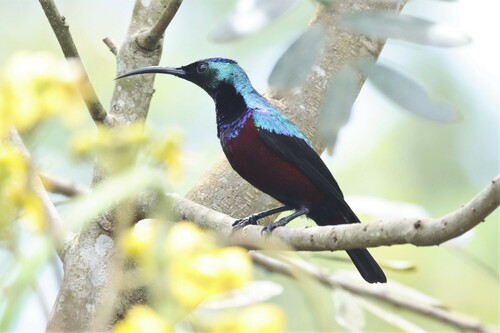 Superb Sunbird
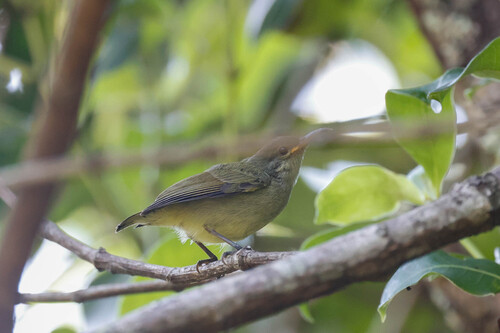 Bates's Sunbird
In short
The most reliable field mark to separate Bates's Sunbird from Superb Sunbird is overall coloration: Bates's is a very small, drab greenish sunbird with a short tail and yellowish or buffy belly, while Superb Sunbird is larger and more vividly colored. Bates's Sunbird appears dull olive above with pale underparts and subtle yellow or white wispy breast feathers, making it easy to overlook. Superb Sunbird, by contrast, is more striking and less uniformly dull. Both inhabit African rainforests, but Bates's is especially inconspicuous due to its muted tones and furtive behavior. Size and tail length also help: Bates's is distinctly smaller and shorter-tailed.
Identification tips
- Size is a major clue: Bates's Sunbird is much smaller (9–10 cm, 5.7–7g) than Superb Sunbird. If the bird appears tiny and delicate, favor Bates's.
- Tail length and shape: Bates's has a short tail with black and olive edges/tips; Superb Sunbird is longer-tailed and appears more elongated overall.
- Overall coloration: Bates's is drab, dull olive-green above with pale grey underparts and a pale buffy or yellowish belly. Superb Sunbird is more vividly colored and never this uniformly dull.
- Breast feather tufts: Look for long, wispy yellow (male) or white (female) feathers on the sides of the breast in Bates's Sunbird. These are absent or much less prominent in Superb Sunbird.
- Supercilium: Bates's has a vague pale supercilium (eyebrow), which can be a subtle but helpful mark.
- Wing pattern: Bates's wings are dark brown with pale fringes. No distinctive upperwing panels or flight marks are noted for either species, so this is not a strong separator in flight.
- Bill shape: Bates's has a short, decurved bill. Superb Sunbird's bill may be longer and more curved, but this is not detailed in the notes.
- Underpart color: Bates's has paler, greyer underparts with a buffy or yellowish belly, while Superb Sunbird is more colorful below.
- Sex differences: In Bates's, the female's wispy breast feathers are shorter and whiter than the male's yellow ones, but both sexes are drab. Superb Sunbird shows more sexual dimorphism in color (not detailed here).
- Behavior: Bates's is furtive and easily missed; if the bird is skulking and hard to spot, consider Bates's. Superb Sunbird is likely more conspicuous.
- Habitat overlap: Both can occur in the same rainforest habitats, so do not rely on habitat alone unless you are outside Bates's more localized Central/West African range.
- No strong flight marks: Neither species is described as having diagnostic upperwing or flight pattern marks for immatures or adults, so focus on perched birds.
- Juvenile/immature confusion: No special juvenile/immature marks are noted for either species, so age is not a strong separator.
- Voice: No vocal differences are provided, so do not rely on song or call for separation.
- Pitfall: The drab, greenish, and small appearance of Bates's Sunbird is the main trap—do not mistake a dull female or immature Superb Sunbird for Bates's unless the size and breast feather tufts also match.
Size
Bates's Sunbird is significantly smaller, measuring only 9–10 cm in length and weighing 5.7–7g [wikipedia]. Superb Sunbird is notably larger, though precise measurements are not provided in the notes, and will appear bulkier and longer-tailed in the field. This size difference is often obvious when both species are seen in the same area, but can be subtle if only one is present.
Plumage
- Juvenile/immature/first-winter plumage: No age-specific upperwing or flight pattern marks are described for either species in the notes.
- Adult males: Bates's Sunbird is dark olive above with a vague pale supercilium, dark brown wings with pale fringes, and a black tail edged and tipped with olive. The underparts are paler grey with a pale buffy center to the belly. Long, wispy yellow feathers on the sides of the breast are a key feature. Superb Sunbird is not described in detail here, but is known to be more colorful and less drab overall.
- Adult females: Bates's female is similar to the male but with whiter, shorter wispy breast feathers. Both sexes of Bates's are much duller and more greenish than Superb Sunbird.
- General: Bates's Sunbird always appears drab, greenish, and small, while Superb Sunbird is more vivid and larger. Bates's can be easily overlooked due to its muted colors.
Behaviour
Bates's Sunbird is described as furtive and easily overlooked, likely spending more time hidden in foliage and less time in conspicuous display than Superb Sunbird. Superb Sunbird, being larger and more colorful, may be more obvious and active, but specific behavioral contrasts are not detailed in the notes.
Habitat
Both species occur in African tropical rainforests. Bates's Sunbird is found in Western and Central African forests and locally in other forest types within Central Africa. Superb Sunbird is widely spread across the African tropical rainforest. Habitat overlap is substantial, so context is not a strong separator unless you are outside the known range of one species.