

Motmot

Stripe-backed Bittern vs Least Bittern

Botaurus involucris versus Botaurus exilis

Play a quiz with Stripe-backed Bittern and Least Bittern
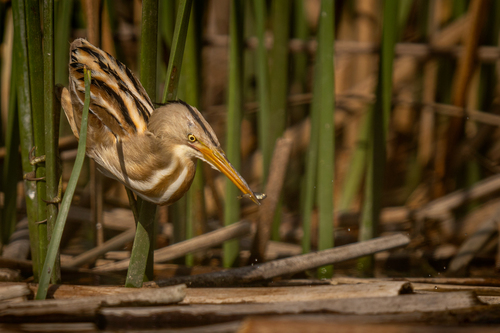
Stripe-backed Bittern (Botaurus involucris) Stripe-backed Bittern
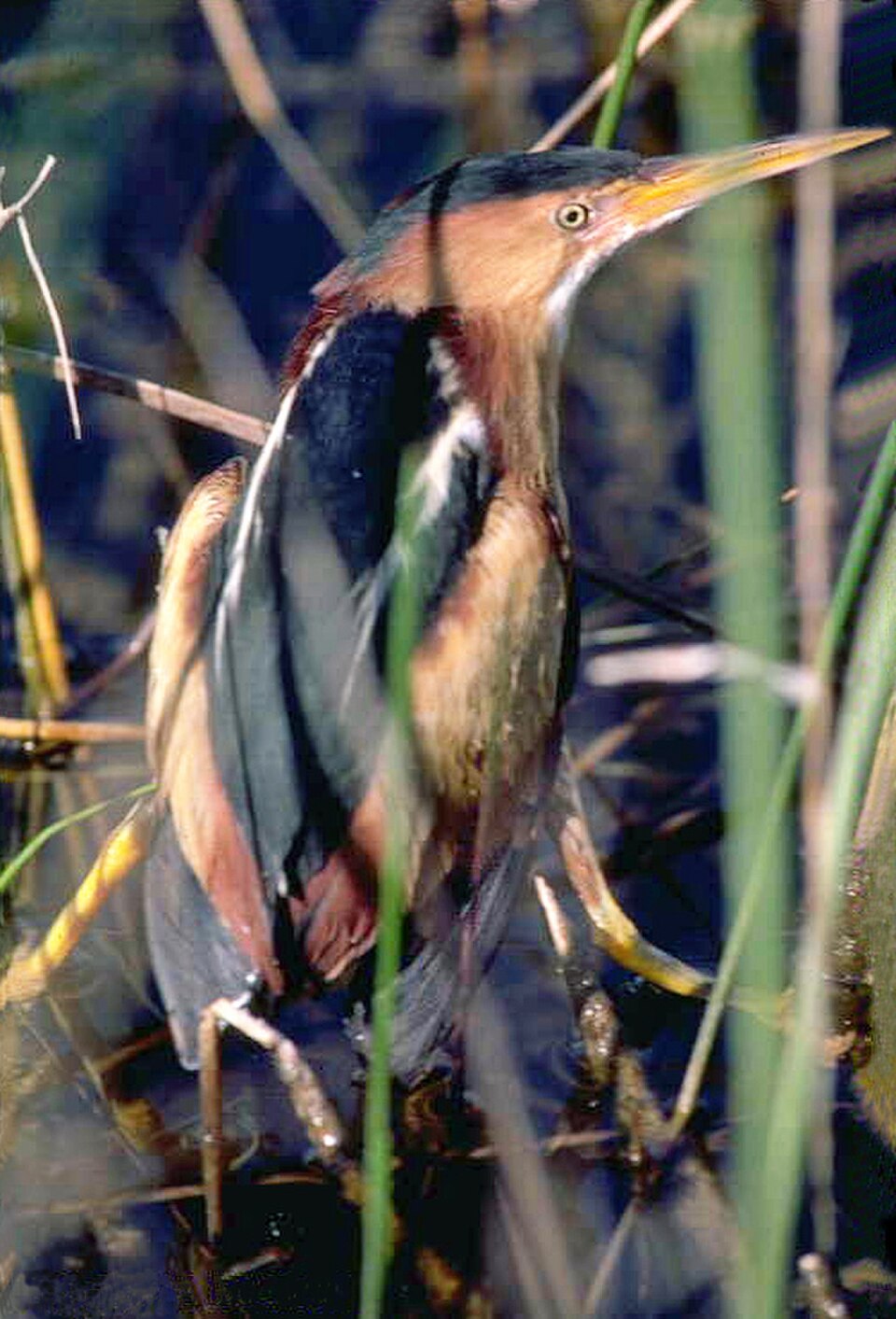
Least Bittern (Botaurus exilis) Least Bittern

Media

Loading…

In short

The most reliable way to separate Stripe-backed Bittern from Least Bittern is by the pattern of the upperparts: Stripe-backed Bittern has a pale brown back and wings heavily streaked with black and yellowish-beige, while Least Bittern shows a solid, glossy dark back (blackish in males, brown in females) with little to no streaking, and contrasting pale wing patches. Least Bittern also has rufous tones on the sides of the head and neck, especially in females, which are absent in Stripe-backed. Both species are very small, secretive marsh bitterns with similar body mass, but their upperpart patterns and subtle head coloration differences are the key field marks. Juvenile and immature plumages are not well described for Stripe-backed Bittern, so caution is needed with young birds.

Identification tips

  1. Back and wing pattern: Stripe-backed Bittern always shows a pale brown back and wings with heavy black and yellowish-beige streaks, blending the back and wing pattern; Least Bittern has a solid, glossy dark back (blackish in males, brown in females) with no streaks and contrasting pale brown wing coverts in flight. This is the single most reliable field mark for all ages and sexes.
  2. Rufous on head/neck: Least Bittern (especially females) shows rufous or light brown on the sides of the head and neck; Stripe-backed Bittern lacks this, having a more uniform head coloration with black stripes on a darker brown crown.
  3. Shoulder lines: Least Bittern adults have white lines on the shoulders, which are lacking or not described in Stripe-backed Bittern.
  4. Underparts: Both have streaked underparts, but Least Bittern's are white with light brown streaks, while Stripe-backed's are lighter brown with white stripes. This is subtle and not always reliable in poor light.
  5. Bill color: Stripe-backed Bittern's bill can be pale green to orange; Least Bittern's is yellow. This is a minor mark and can be variable.
  6. Sexual dimorphism: Stripe-backed Bittern shows no sexual dimorphism; Least Bittern males are glossy blackish above, females are glossy brown. If you see a strongly black-backed bird, it's a male Least Bittern.
  7. Flight view: In flight, Least Bittern shows contrasting pale brown wing coverts against a dark back; Stripe-backed Bittern's streaked pattern continues across the back and wings, so there is less contrast.
  8. Juvenile/immature: Juvenile Stripe-backed Bittern is not described, so be cautious with young birds; Least Bittern immatures resemble females but still lack heavy back streaking.
  9. Posture: Both species freeze with bill up when alarmed and can be extremely difficult to spot; posture is not a separator.
  10. Habitat and range: If you are in North America, you are almost certainly seeing Least Bittern; Stripe-backed Bittern occurs only in South America. In South America, check the back pattern for confirmation.
  11. Group size: Stripe-backed Bittern is usually solitary or in pairs; Least Bittern may be more often heard than seen but can be found in suitable habitat in small numbers.
  12. Egg color (not field mark): Stripe-backed Bittern eggs have a unique pale blue with a translucent green layer, but this is not a field separation.
  13. Size and structure: Both are extremely similar in size and shape; do not rely on this for separation.
  14. Voice: No diagnostic vocal differences are described in the sources provided.
  15. Behavior: Both species use similar predator-avoidance behaviors and are equally elusive; behavior is not a reliable separator.

Size

Both species are among the smallest herons, with nearly identical average body mass (80 g) and similar length (28–36 cm for Least Bittern, 28–35 cm for Stripe-backed Bittern) [wikidata, wikipedia]. In the field, size is not a reliable separator. Their overall structure is similar, and both can appear slender and compressed when adopting their characteristic upright posture.

Plumage

The most diagnostic difference is in the upperparts and wing pattern. Stripe-backed Bittern (all ages and sexes, as far as known) shows a pale brown back and wings with extensive black and yellowish-beige streaks, creating a blended, streaked appearance across the back and wings. In contrast, Least Bittern adults have a solid, glossy dark back (blackish in males, brown in females) that is unmarked, sharply set off from the paler, rufous-toned sides of the neck and face. Least Bitterns also show pale brown (rufous) wing coverts in flight, contrasting with the dark back. Females and immatures of Least Bittern are browner above but still lack the heavy streaking of Stripe-backed. Stripe-backed Bittern lacks the rufous tones on the sides of the head and neck that are present in Least Bittern, especially in females. Underparts in both are streaked, but Least Bittern's are white with light brown streaks, while Stripe-backed's are lighter brown with white stripes. Juvenile plumage for Stripe-backed Bittern is not described, so caution is needed with young birds.

Behaviour

Both species are extremely secretive and often freeze with neck and bill pointed skyward when alarmed, blending into marsh vegetation. Both tend to perch or straddle reeds rather than wade in open water. Stripe-backed Bittern is typically solitary or in pairs, while Least Bittern may be more often heard than seen and is also elusive. Both species use similar predator-avoidance postures, making behavioral separation difficult.

Habitat

Stripe-backed Bittern is restricted to South America, found near freshwater swamps, marshes, lake shores, and streams, often in disjunct populations on both sides of the Andes. Least Bittern has a much broader range, breeding from southern Canada to northern Argentina, and migrates in North America. Both prefer dense marsh vegetation, but Least Bittern is more widespread and likely in North American marshes, while Stripe-backed is only in South America.

Submit a better description

Use the same sections as the comparison. Your text is published immediately.

The most reliable way to separate Stripe-backed Bittern from Least Bittern is by the pattern of the upperparts: Stripe-backed Bittern has a pale brown back and wings heavily streaked with black and yellowish-beige, while Least Bittern shows a solid, glossy dark back (blackish in males, brown in females) with little to no streaking, and contrasting pale wing patches. Least Bittern also has rufous tones on the sides of the head and neck, especially in females, which are absent in Stripe-backed. Both species are very small, secretive marsh bitterns with similar body mass, but their upperpart patterns and subtle head coloration differences are the key field marks. Juvenile and immature plumages are not well described for Stripe-backed Bittern, so caution is needed with young birds.

  1. Back and wing pattern: Stripe-backed Bittern always shows a pale brown back and wings with heavy black and yellowish-beige streaks, blending the back and wing pattern; Least Bittern has a solid, glossy dark back (blackish in males, brown in females) with no streaks and contrasting pale brown wing coverts in flight. This is the single most reliable field mark for all ages and sexes.
  2. Rufous on head/neck: Least Bittern (especially females) shows rufous or light brown on the sides of the head and neck; Stripe-backed Bittern lacks this, having a more uniform head coloration with black stripes on a darker brown crown.
  3. Shoulder lines: Least Bittern adults have white lines on the shoulders, which are lacking or not described in Stripe-backed Bittern.
  4. Underparts: Both have streaked underparts, but Least Bittern's are white with light brown streaks, while Stripe-backed's are lighter brown with white stripes. This is subtle and not always reliable in poor light.
  5. Bill color: Stripe-backed Bittern's bill can be pale green to orange; Least Bittern's is yellow. This is a minor mark and can be variable.
  6. Sexual dimorphism: Stripe-backed Bittern shows no sexual dimorphism; Least Bittern males are glossy blackish above, females are glossy brown. If you see a strongly black-backed bird, it's a male Least Bittern.
  7. Flight view: In flight, Least Bittern shows contrasting pale brown wing coverts against a dark back; Stripe-backed Bittern's streaked pattern continues across the back and wings, so there is less contrast.
  8. Juvenile/immature: Juvenile Stripe-backed Bittern is not described, so be cautious with young birds; Least Bittern immatures resemble females but still lack heavy back streaking.
  9. Posture: Both species freeze with bill up when alarmed and can be extremely difficult to spot; posture is not a separator.
  10. Habitat and range: If you are in North America, you are almost certainly seeing Least Bittern; Stripe-backed Bittern occurs only in South America. In South America, check the back pattern for confirmation.
  11. Group size: Stripe-backed Bittern is usually solitary or in pairs; Least Bittern may be more often heard than seen but can be found in suitable habitat in small numbers.
  12. Egg color (not field mark): Stripe-backed Bittern eggs have a unique pale blue with a translucent green layer, but this is not a field separation.
  13. Size and structure: Both are extremely similar in size and shape; do not rely on this for separation.
  14. Voice: No diagnostic vocal differences are described in the sources provided.
  15. Behavior: Both species use similar predator-avoidance behaviors and are equally elusive; behavior is not a reliable separator.

Both species are among the smallest herons, with nearly identical average body mass (80 g) and similar length (28–36 cm for Least Bittern, 28–35 cm for Stripe-backed Bittern) [wikidata, wikipedia]. In the field, size is not a reliable separator. Their overall structure is similar, and both can appear slender and compressed when adopting their characteristic upright posture.

The most diagnostic difference is in the upperparts and wing pattern. Stripe-backed Bittern (all ages and sexes, as far as known) shows a pale brown back and wings with extensive black and yellowish-beige streaks, creating a blended, streaked appearance across the back and wings. In contrast, Least Bittern adults have a solid, glossy dark back (blackish in males, brown in females) that is unmarked, sharply set off from the paler, rufous-toned sides of the neck and face. Least Bitterns also show pale brown (rufous) wing coverts in flight, contrasting with the dark back. Females and immatures of Least Bittern are browner above but still lack the heavy streaking of Stripe-backed. Stripe-backed Bittern lacks the rufous tones on the sides of the head and neck that are present in Least Bittern, especially in females. Underparts in both are streaked, but Least Bittern's are white with light brown streaks, while Stripe-backed's are lighter brown with white stripes. Juvenile plumage for Stripe-backed Bittern is not described, so caution is needed with young birds.

Both species are extremely secretive and often freeze with neck and bill pointed skyward when alarmed, blending into marsh vegetation. Both tend to perch or straddle reeds rather than wade in open water. Stripe-backed Bittern is typically solitary or in pairs, while Least Bittern may be more often heard than seen and is also elusive. Both species use similar predator-avoidance postures, making behavioral separation difficult.

Stripe-backed Bittern is restricted to South America, found near freshwater swamps, marshes, lake shores, and streams, often in disjunct populations on both sides of the Andes. Least Bittern has a much broader range, breeding from southern Canada to northern Argentina, and migrates in North America. Both prefer dense marsh vegetation, but Least Bittern is more widespread and likely in North American marshes, while Stripe-backed is only in South America.

Discard your changes?

You have unsaved edits. If you leave now, those changes will be lost.

Stripe-backed Bittern · Least Bittern · My Tricky Birds