

Stone-curlew vs Grey Plover
Burhinus oedicnemus versus Pluvialis squatarola
Play a quiz with Stone-curlew and Grey Plover
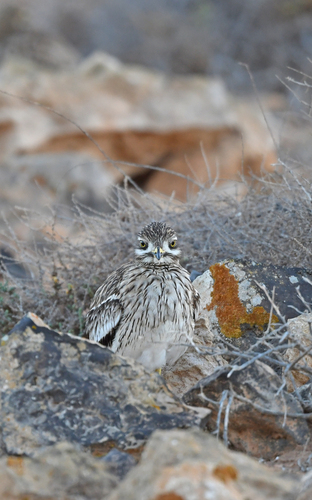 Stone-curlew
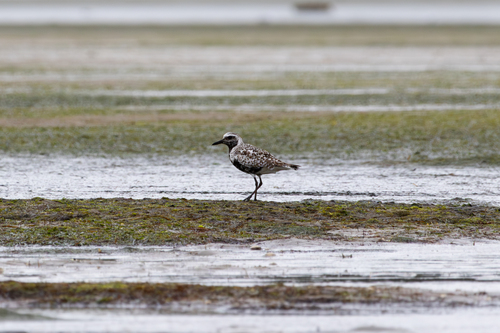 Grey Plover
In short
The most reliable separation between Stone-curlew and Grey Plover, especially in flight, is the wing pattern: Stone-curlew shows bold black and white wing markings, while Grey Plover (of all ages) has black axillaries and inner flanks visible as dark underwing patches. Juvenile and first-winter Grey Plovers have a distinctive black-and-white upperwing pattern, but Stone-curlew immatures resemble adults. Structurally, Stone-curlew is larger, longer-legged, and 'goggle-eyed' with a thick yellow bill base, while Grey Plover is more compact, with a heavier all-black bill and shorter legs. On the ground, Stone-curlew's cryptic, sandy plumage and striking yellow eyes contrast with Grey Plover's plover-like jizz and seasonal plumage changes. Both can be found in open habitats, but Stone-curlew prefers dry, stony ground, while Grey Plover is coastal.
Identification tips
- Flight underwing pattern (all ages): Grey Plover always shows black axillaries and inner flanks in flight, creating a dark patch at the base of the underwing—Stone-curlew never shows this, instead flashing bold black and white wing markings.
- Flight upperwing pattern: Stone-curlew has striking black and white wing markings visible from above and below; Grey Plover lacks these, showing plainer wings with only subtle pale and dark contrasts.
- Juvenile/first-winter upperparts: Juvenile Grey Plovers have a blackish back with creamy white feather edges, while Stone-curlew immatures are sandy and cryptic, similar to adults.
- Bill structure: Stone-curlew has a strong yellow and black bill, with yellow at the base; Grey Plover has a shorter, heavier, all-black bill (24–34 mm), noticeably stubbier and thicker relative to head size.
- Eye color and size: Stone-curlew has very large, bright yellow eyes—often described as 'goggle-eyed'—whereas Grey Plover has dark, unremarkable eyes.
- Legs: Stone-curlew has long, pale yellowish legs, giving it a tall, upright stance; Grey Plover has shorter, dark legs, typical of plovers.
- Body shape and posture: Stone-curlew stands tall and upright, often hunched and motionless; Grey Plover is more compact, with a horizontal posture and active feeding behavior.
- Adult breeding plumage: Grey Plover in spring/summer is boldly black and white, with a black face, neck, breast, and belly, and white rump—Stone-curlew is always cryptic sandy-brown, never black and white.
- Adult non-breeding plumage: Grey Plover becomes plain grey above with a speckled breast and white belly; Stone-curlew remains sandy and streaked, with no strong seasonal change.
- Facial pattern: Stone-curlew has a plain face with a strong yellow eye and bill base; Grey Plover may show a faint supercilium in non-breeding plumage but lacks the 'goggle-eyed' look.
- Tail and rump: Grey Plover has a white rump and black-banded tail, visible in flight; Stone-curlew's tail is less contrasting and not a key field mark.
- Habitat context: Stone-curlew is almost never found on coastal mudflats or beaches; Grey Plover is almost always coastal outside the breeding season.
- Behavior: Stone-curlew is often motionless and relies on camouflage; Grey Plover is active, running and stopping in typical plover fashion.
- Size impression: Stone-curlew appears much larger and longer-legged than Grey Plover, even at a distance.
- Pitfall: In poor light or at distance, Stone-curlew's cryptic plumage can make it appear similar to a large, pale plover, but the yellow eye and bill, long legs, and wing pattern in flight are always diagnostic.
Size
Stone-curlew is noticeably larger and heavier: 38–46 cm in length, 76–88 cm wingspan, and 290–535 g in weight [wikipedia]. Grey Plover is smaller and more compact, at 27–30 cm length, 71–83 cm wingspan, and 190–280 g (up to 345 g pre-migration) [wikipedia]. In the field, Stone-curlew's long legs and upright stance make it appear even larger relative to Grey Plover's more squat, plover-like profile.
Plumage
-
Juvenile/First-winter: Grey Plover juveniles and first-winters have a blacker back with creamy white feather edges and, crucially, always show black axillaries and inner flanks in flight—this is diagnostic at all ages. Stone-curlew immatures are similar to adults and lack this underwing contrast, instead showing bold black and white wing markings in flight.
-
Adult breeding: Grey Plover adults in spring/summer are strikingly black and white above, with a black face, neck, breast, and belly, bordered with white, and a white rump and barred tail. Stone-curlew adults are cryptically patterned brown and sandy above, with no black belly or face, and have a strong yellow and black bill and large yellow eyes.
-
Adult non-breeding: Grey Plover becomes plain grey above with a speckled breast and white belly. Stone-curlew remains cryptic and sandy, with no strong seasonal change.
-
In flight: Stone-curlew shows bold black and white wing markings (upper and underwing), while Grey Plover shows black axillaries and inner flanks, and a white rump with black-banded tail.
Behaviour
Stone-curlew is often seen standing upright with long, prominent legs and a hunched, motionless posture, especially during the day when it is less active. It is primarily crepuscular or nocturnal, often remaining still and relying on camouflage. In flight, Stone-curlew appears long-winged and broad, with slow, deep wingbeats and prominent black and white wing flashes.
Grey Plover is more active by day, often seen running and pausing in typical plover fashion on open mudflats or beaches. In flight, it is fast and direct, with pointed wings and a compact body. On the ground, it is more likely to be seen in flocks, especially outside the breeding season.
Habitat
Stone-curlew favors dry, open, stony or sandy ground, often inland heaths, fallow fields, or steppe-like habitats. It avoids wet coastal mudflats and is rarely seen near water.
Grey Plover is strongly associated with coastal habitats outside the breeding season: sandy or muddy estuaries, tidal flats, and beaches. It breeds in Arctic tundra but is almost always coastal in migration and winter.