

Motmot

Stock Dove vs Yellow-eyed Pigeon

Columba oenas versus Columba eversmanni

Play a quiz with Stock Dove and Yellow-eyed Pigeon
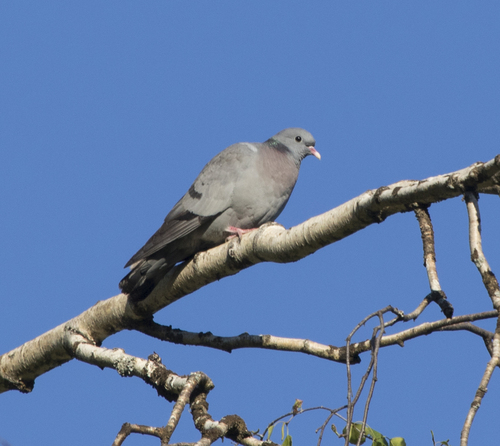
Stock Dove (Columba oenas) Stock Dove
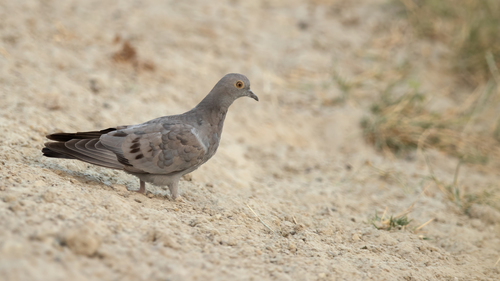
Yellow-eyed Pigeon (Columba eversmanni) Yellow-eyed Pigeon

Media

Loading…

In short

The most reliable field mark between Stock Dove and Yellow-eyed Pigeon is the eye color: Stock Dove always has dark eyes, while Yellow-eyed Pigeon shows a striking yellow iris and bare yellowish skin around the eye. In flight, Stock Dove (all ages) shows a dark trailing edge to the wing and a grey underwing, while Yellow-eyed Pigeon has a pale or white underwing and rump. Both are medium-sized pigeons with similar overall shape, but Stock Dove is heavier and has a deeper, more blue-grey tone. If you see the bird perched, check for the iridescent neck patch (Stock Dove adult only) and the color of the bill and eye. Juvenile Stock Doves lack the neck gloss but still have dark eyes, while Yellow-eyed Pigeon always has yellow eyes and a paler back. Habitat and range rarely overlap, but if you are in Central Asia or NW India in winter, Yellow-eyed Pigeon is possible.

Identification tips

  1. Eye color is the most reliable mark: Stock Dove always has dark eyes; Yellow-eyed Pigeon has a yellow iris and bare yellowish skin around the eye. Use this in all ages and seasons.
  2. Underwing color in flight: Stock Dove (all ages) shows a dark grey underwing and trailing edge; Yellow-eyed Pigeon shows a white or pale grey underwing and rump. This is best seen in birds overhead or flying away.
  3. Rump color: Stock Dove's rump is grey, blending with the back; Yellow-eyed Pigeon has a white or pale rump, contrasting with the back. This is visible in flight or when preening.
  4. Wingbars: Stock Dove has two short, incomplete dark bars on the wing coverts; Yellow-eyed Pigeon has a single, more distinct black bar. Juvenile Stock Doves may have even less obvious bars.
  5. Tail band: Both have a dark tail band, but Yellow-eyed Pigeon's is more diffuse and the tail is paler above it; Stock Dove's is broad and sharply defined.
  6. Neck gloss: Adult Stock Dove shows a green or purple iridescent patch on the neck sides; juveniles lack this. Yellow-eyed Pigeon has a pinkish-purple sheen on the crown, throat, and breast, but not a discrete neck patch.
  7. Bill color: Stock Dove's bill is pink with a yellow tip; Yellow-eyed Pigeon's is yellowish overall. This can be subtle at distance.
  8. Breast color: Both have a pinkish-purple suffusion, but Stock Dove's is lighter and more restricted to the breast; Yellow-eyed Pigeon may show a broader sheen.
  9. Body tone: Stock Dove is blue-grey overall, giving a colder impression; Yellow-eyed Pigeon is paler and browner above.
  10. Size and structure: Stock Dove is heavier and more robust, with a deeper chest; Yellow-eyed Pigeon is slimmer and lighter.
  11. Vocalization: Stock Dove gives a deep, grunting "Ooo-uu-ooh"; Yellow-eyed Pigeon is mostly silent, rarely giving a faint "oo-oo-oo".
  12. Habitat: Stock Dove prefers woodland edges, farmland, and parkland with trees; Yellow-eyed Pigeon is found in open steppe, semi-desert, and arid farmland.
  13. Range: Stock Dove is western Palearctic; Yellow-eyed Pigeon is Central Asian and winters in NW India and NE Pakistan. Overlap is rare.
  14. Display behavior: Stock Dove displays with wing claps and branch-walking; Yellow-eyed Pigeon is less demonstrative.
  15. Juvenile confusion: Juvenile Stock Dove lacks neck gloss but still has dark eyes and grey underwing; Yellow-eyed Pigeon juveniles retain yellow eyes and pale underwing, so eye and underwing color remain diagnostic.

Size

Stock Dove is slightly larger and noticeably heavier, with males weighing 303–365 g and females 286–290 g, compared to Yellow-eyed Pigeon's 183–234 g. Both species are about 28–34 cm (Stock Dove) or 30 cm (Yellow-eyed Pigeon) in length. The Stock Dove has a broader, more robust build, while Yellow-eyed Pigeon is slimmer. Wingspan is similar (Stock Dove: 60–66 cm), but Stock Dove's greater mass gives it a bulkier impression, especially when perched.

Plumage

Juvenile and adult Stock Doves both have a blue-grey body with two short, incomplete dark wingbars (on tertials and greater coverts), a broad dark tail band, and a grey rump. In flight, all ages show a dark trailing edge and a uniformly grey underwing—never white. Adults have a pinkish-purple suffusion on the breast and a green or purple iridescent neck patch, which is absent in juveniles. The eye is always dark. Yellow-eyed Pigeon, by contrast, is paler overall with a brownish tinge to the upperparts, a pinkish-purple sheen on the crown, throat, and breast, and a single black wing bar. Its lower back, rump, and underwing are white or pale grey, creating a much paler impression in flight. The eye is yellow with bare yellowish skin around it, and the bill is yellowish. Both sexes are similar, but Stock Dove is always darker and lacks the white rump and underwing of Yellow-eyed Pigeon.

Behaviour

Stock Dove often perches in trees or on branches, especially during display, walking with a swollen neck, lowered wings, and fanned tail. Its flight is quick and regular, with sharp wing flicks and occasional wing claps during display. Yellow-eyed Pigeon is generally more ground-oriented and is often seen in open country or agricultural fields, sometimes in flocks. It is generally silent and less demonstrative in display than Stock Dove.

Habitat

Stock Dove is widespread in the western Palearctic, favoring open woodlands, parkland, and farmland with old trees for nesting. It is resident in western and southern parts of its range, migratory in the northeast. Yellow-eyed Pigeon breeds in Central Asian steppe and semi-desert, winters in NE Pakistan, NW India, and adjacent regions. It prefers open, arid habitats and is rarely found in woodland. The two species do not normally overlap in range, except possibly as rare vagrants.

Voice

Stock Dove has a distinctive deep, grunting "Ooo-uu-ooh" call, quite unlike the modulated cooing of Wood Pigeon. Yellow-eyed Pigeon is generally silent but may give a faint "oo-oo-oo" during the breeding season. In most field situations, Stock Dove is much more vocal and its call is a useful clue.

Submit a better description

Use the same sections as the comparison. Your text is published immediately.

The most reliable field mark between Stock Dove and Yellow-eyed Pigeon is the eye color: Stock Dove always has dark eyes, while Yellow-eyed Pigeon shows a striking yellow iris and bare yellowish skin around the eye. In flight, Stock Dove (all ages) shows a dark trailing edge to the wing and a grey underwing, while Yellow-eyed Pigeon has a pale or white underwing and rump. Both are medium-sized pigeons with similar overall shape, but Stock Dove is heavier and has a deeper, more blue-grey tone. If you see the bird perched, check for the iridescent neck patch (Stock Dove adult only) and the color of the bill and eye. Juvenile Stock Doves lack the neck gloss but still have dark eyes, while Yellow-eyed Pigeon always has yellow eyes and a paler back. Habitat and range rarely overlap, but if you are in Central Asia or NW India in winter, Yellow-eyed Pigeon is possible.

  1. Eye color is the most reliable mark: Stock Dove always has dark eyes; Yellow-eyed Pigeon has a yellow iris and bare yellowish skin around the eye. Use this in all ages and seasons.
  2. Underwing color in flight: Stock Dove (all ages) shows a dark grey underwing and trailing edge; Yellow-eyed Pigeon shows a white or pale grey underwing and rump. This is best seen in birds overhead or flying away.
  3. Rump color: Stock Dove's rump is grey, blending with the back; Yellow-eyed Pigeon has a white or pale rump, contrasting with the back. This is visible in flight or when preening.
  4. Wingbars: Stock Dove has two short, incomplete dark bars on the wing coverts; Yellow-eyed Pigeon has a single, more distinct black bar. Juvenile Stock Doves may have even less obvious bars.
  5. Tail band: Both have a dark tail band, but Yellow-eyed Pigeon's is more diffuse and the tail is paler above it; Stock Dove's is broad and sharply defined.
  6. Neck gloss: Adult Stock Dove shows a green or purple iridescent patch on the neck sides; juveniles lack this. Yellow-eyed Pigeon has a pinkish-purple sheen on the crown, throat, and breast, but not a discrete neck patch.
  7. Bill color: Stock Dove's bill is pink with a yellow tip; Yellow-eyed Pigeon's is yellowish overall. This can be subtle at distance.
  8. Breast color: Both have a pinkish-purple suffusion, but Stock Dove's is lighter and more restricted to the breast; Yellow-eyed Pigeon may show a broader sheen.
  9. Body tone: Stock Dove is blue-grey overall, giving a colder impression; Yellow-eyed Pigeon is paler and browner above.
  10. Size and structure: Stock Dove is heavier and more robust, with a deeper chest; Yellow-eyed Pigeon is slimmer and lighter.
  11. Vocalization: Stock Dove gives a deep, grunting "Ooo-uu-ooh"; Yellow-eyed Pigeon is mostly silent, rarely giving a faint "oo-oo-oo".
  12. Habitat: Stock Dove prefers woodland edges, farmland, and parkland with trees; Yellow-eyed Pigeon is found in open steppe, semi-desert, and arid farmland.
  13. Range: Stock Dove is western Palearctic; Yellow-eyed Pigeon is Central Asian and winters in NW India and NE Pakistan. Overlap is rare.
  14. Display behavior: Stock Dove displays with wing claps and branch-walking; Yellow-eyed Pigeon is less demonstrative.
  15. Juvenile confusion: Juvenile Stock Dove lacks neck gloss but still has dark eyes and grey underwing; Yellow-eyed Pigeon juveniles retain yellow eyes and pale underwing, so eye and underwing color remain diagnostic.

Stock Dove is slightly larger and noticeably heavier, with males weighing 303–365 g and females 286–290 g, compared to Yellow-eyed Pigeon's 183–234 g. Both species are about 28–34 cm (Stock Dove) or 30 cm (Yellow-eyed Pigeon) in length. The Stock Dove has a broader, more robust build, while Yellow-eyed Pigeon is slimmer. Wingspan is similar (Stock Dove: 60–66 cm), but Stock Dove's greater mass gives it a bulkier impression, especially when perched.

Juvenile and adult Stock Doves both have a blue-grey body with two short, incomplete dark wingbars (on tertials and greater coverts), a broad dark tail band, and a grey rump. In flight, all ages show a dark trailing edge and a uniformly grey underwing—never white. Adults have a pinkish-purple suffusion on the breast and a green or purple iridescent neck patch, which is absent in juveniles. The eye is always dark. Yellow-eyed Pigeon, by contrast, is paler overall with a brownish tinge to the upperparts, a pinkish-purple sheen on the crown, throat, and breast, and a single black wing bar. Its lower back, rump, and underwing are white or pale grey, creating a much paler impression in flight. The eye is yellow with bare yellowish skin around it, and the bill is yellowish. Both sexes are similar, but Stock Dove is always darker and lacks the white rump and underwing of Yellow-eyed Pigeon.

Stock Dove often perches in trees or on branches, especially during display, walking with a swollen neck, lowered wings, and fanned tail. Its flight is quick and regular, with sharp wing flicks and occasional wing claps during display. Yellow-eyed Pigeon is generally more ground-oriented and is often seen in open country or agricultural fields, sometimes in flocks. It is generally silent and less demonstrative in display than Stock Dove.

Stock Dove is widespread in the western Palearctic, favoring open woodlands, parkland, and farmland with old trees for nesting. It is resident in western and southern parts of its range, migratory in the northeast. Yellow-eyed Pigeon breeds in Central Asian steppe and semi-desert, winters in NE Pakistan, NW India, and adjacent regions. It prefers open, arid habitats and is rarely found in woodland. The two species do not normally overlap in range, except possibly as rare vagrants.

Stock Dove has a distinctive deep, grunting "Ooo-uu-ooh" call, quite unlike the modulated cooing of Wood Pigeon. Yellow-eyed Pigeon is generally silent but may give a faint "oo-oo-oo" during the breeding season. In most field situations, Stock Dove is much more vocal and its call is a useful clue.

Discard your changes?

You have unsaved edits. If you leave now, those changes will be lost.

Stock Dove · Yellow-eyed Pigeon · My Tricky Birds