

Steller's Sea-Eagle vs Bald Eagle
Haliaeetus pelagicus versus Haliaeetus leucocephalus
Play a quiz with Steller's Sea-Eagle and Bald Eagle
 Steller's Sea-Eagle
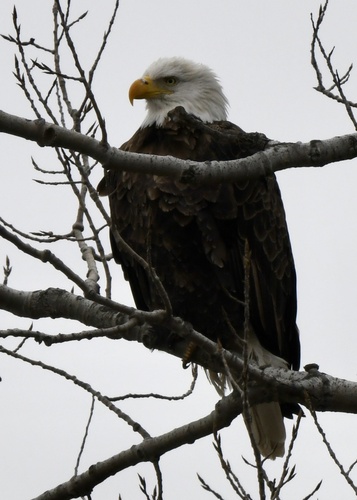 Bald Eagle
In short
The most reliable field mark for separating Steller's Sea-Eagle from Bald Eagle is the bold, contrasting white on the wings, tail, and thighs of adult Steller's, versus the clean white head and tail (with otherwise dark body and wings) of adult Bald Eagle. For immatures, Steller's Sea-Eagle is bulkier with a much more massive bill, a longer, diamond-shaped white tail with dark mottling, and overall darker, more uniform body plumage, whereas immature Bald Eagles show messy white streaking throughout and lack the sharply contrasting white wing and tail patches. In flight, Steller's Sea-Eagle shows paddle-like wings and a longer, more diamond-shaped tail, while Bald Eagle has broader, squarer wings and a shorter, wedge-shaped tail. Structure and bill size are crucial for distant or poor-light views, especially for young birds.
Identification tips
- Adult wing and tail pattern: Adult Steller's Sea-Eagle shows bold white patches on the lesser and median upperwing coverts, underwing coverts, thighs, and a long, diamond-shaped white tail. Adult Bald Eagle has a clean white head and tail, but the wings and body are uniformly dark brown with no white patches.
- Immature plumage: Immature Steller's Sea-Eagle is overall dark sooty-brown with occasional grey-brown streaking on the head and neck, and a white tail with black mottling at the tip. Immature Bald Eagle is dark brown with messy white streaking throughout the body and wings, and the head and tail gradually become white over several years.
- Bill size and color: Steller's Sea-Eagle of all ages has a much more massive, deep-based bill than Bald Eagle. In adults, the bill is bright yellow; in immatures, it is blackish-brown but still huge. Bald Eagle's bill is large but less deep and variable in size, especially in southern birds.
- Tail shape: Steller's Sea-Eagle has a longer, diamond-shaped tail, especially obvious in flight. Bald Eagle's tail is shorter and wedge-shaped.
- Wing shape in flight: Steller's Sea-Eagle has paddle-like wings, appearing broader and more rounded at the tips. Bald Eagle's wings are broad but squarer, and the flight silhouette is less paddle-like.
- Body bulk: Steller's Sea-Eagle is heavier and bulkier, with a barrel-chested appearance, especially when perched. Bald Eagle is still large but less massive overall.
- Leg and thigh color: Adult Steller's shows white thighs, contrasting with the dark body. Bald Eagle's thighs are dark, blending with the rest of the body.
- Head and neck color: Adult Bald Eagle has a striking white head and neck, sharply contrasting with the dark body. Steller's Sea-Eagle's head is dark except for the yellow bill and eyes.
- Eye color: Adult Steller's has yellow eyes; immatures have dark brown eyes. Bald Eagle adults also have yellow eyes, but immatures have darker eyes.
- Feet color: Both species have yellow feet as adults, but Steller's is more vivid; immatures of Steller's have whitish legs.
- Plumage progression: Both species take 4–5 years to reach adult plumage, but Steller's transitions from uniform dark to pied, while Bald Eagle transitions from streaky brown-and-white to the classic white head and tail.
- Geographic context: In North America, any eagle with extensive white on the wings or thighs is almost certainly not a Bald Eagle. In Asia, both species can occur together, so structural and plumage differences are more important.
- Jizz and flight style: Steller's appears more ponderous and heavy in flight, with slower, deeper wingbeats. Bald Eagle is slightly more agile and less lumbering.
- Rare dark morph: A very rare dark morph of Steller's lacks white except on the tail, but is still bulkier and has the massive bill and diamond-shaped tail; confusion with Bald Eagle is possible only at great distance or in poor light.
- Pitfalls in immature birds: At a distance, immature Steller's can be confused with immature Bald Eagle, but look for the more uniform, darker body, larger bill, and tail pattern (white with black mottling) in Steller's, versus the messy white streaking and lack of strong tail contrast in Bald Eagle.
Size
Steller's Sea-Eagle is significantly heavier and bulkier than Bald Eagle, with an average body mass of about 6675 g compared to the Bald Eagle's 4740 g [wikidata]. This size difference is most obvious when the two species are seen together, but can still be appreciated in the field by the Steller's more imposing, barrel-chested build and especially its enormous, deep-based bill. Both species are among the largest eagles, but Steller's is the heavier and more robust overall.
Plumage
For adults, Steller's Sea-Eagle is unmistakable: it has mostly dark brown to black plumage with sharply contrasting white on the lesser and median upperwing coverts, underwing coverts, thighs, under-tail coverts, and a long, diamond-shaped white tail. The bill, eyes, and feet are bright yellow. Bald Eagle adults, in contrast, have a dark brown body and wings, but a clean white head and tail, with no white on the wings or thighs, and the tail is shorter and wedge-shaped.
For immatures and subadults, Steller's Sea-Eagle is overall darker and more uniform, with a sooty-brown body, occasional grey-brown streaking on the head and neck, and a white tail with black mottling at the tip. The bill is already large and darkish in young birds, and the legs are whitish. As the bird matures, the tail becomes whiter and the bill and eyes lighten. In contrast, immature Bald Eagles are dark brown with extensive messy white streaking throughout the body and wings, and the head and tail gradually become white over several years. The immature Bald Eagle never shows the sharply defined white wing patches or the long, diamond-shaped tail of Steller's. Both species take about 4–5 years to reach full adult plumage, but the intermediate stages are more streaky and patchy in Bald Eagle, and more uniform and dark in Steller's.
Behaviour
Both species are large, powerful fish-eating eagles, often seen soaring or perched near water. Steller's Sea-Eagle may appear even more ponderous and heavy in flight, with slower, deeper wingbeats and a more lumbering jizz due to its bulk and paddle-like wings. Bald Eagles are also powerful but may appear slightly more agile and less heavyset. Both species can be aggressive at carcasses or when defending territory, but Steller's Sea-Eagle is generally more dominant where they overlap.
Habitat
Steller's Sea-Eagle is native to northeastern Asia, especially coastal Russia, the Sea of Okhotsk, and the Kamchatka Peninsula, where it favors large rivers, estuaries, and coastal habitats. Bald Eagle is found throughout North America, from Alaska and Canada to northern Mexico, and occupies a similar ecological niche near large bodies of water, lakes, and rivers. In North America, any eagle with extensive white on the wings or thighs is highly unlikely to be a Bald Eagle. In the rare event of a vagrant Steller's in North America, habitat overlap is possible, but context and range should always be considered.