
Square-tailed Drongo-Cuckoo vs Common Hawk-Cuckoo
Surniculus lugubris versus Hierococcyx varius
Play a quiz with Square-tailed Drongo-Cuckoo and Common Hawk-Cuckoo
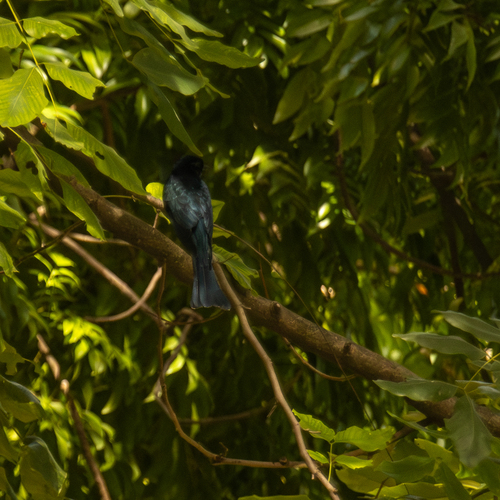 Square-tailed Drongo-Cuckoo
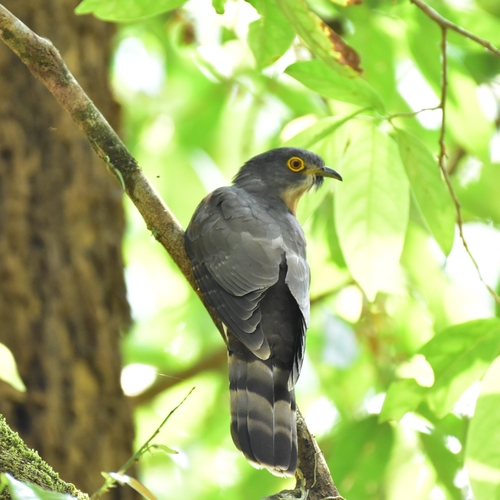 Common Hawk-Cuckoo
In short
The most reliable field mark is the overall color and barring: Square-tailed Drongo-Cuckoo is glossy blackish with a square-tipped tail and a white-barred vent, while Common Hawk-Cuckoo is ashy grey above, whitish below with strong brown barring, and has a broadly barred tail. In flight, Square-tailed Drongo-Cuckoo shows a white wing-stripe from below and a distinctly notched, not forked, tail; Common Hawk-Cuckoo lacks the wing-stripe but has a hawk-like silhouette and flight style. Juveniles of Common Hawk-Cuckoo are heavily streaked and chevron-marked below, unlike the drongo-cuckoo. Bill shape and tail structure are also key: drongo-cuckoo has a downcurved bill and only a shallow notch at the tail tip, while hawk-cuckoo has a straight bill and a broad, rounded tail. Voice is distinctive if heard: drongo-cuckoo gives sharp, choppy whistles, while hawk-cuckoo gives a loud, repeated three-note 'brain-fever' call.
Identification tips
- Juvenile/immature underparts: If the bird has a streaked breast and large brown chevrons on the belly, it is a juvenile Common Hawk-Cuckoo. Square-tailed Drongo-Cuckoo does not show this pattern at any age.
- Adult underparts: Square-tailed Drongo-Cuckoo is glossy blackish with a white-barred vent and outer undertail; Common Hawk-Cuckoo is ashy grey above, whitish below with strong brown cross-barring.
- Tail shape: Drongo-cuckoo has a notched (but not forked) tail with slightly flared tips; hawk-cuckoo has a broadly barred, rounded tail. The tail of drongo-cuckoo is never deeply forked or broadly rounded.
- White wing-stripe in flight: Only Square-tailed Drongo-Cuckoo shows a white wing-stripe from below in flight. Hawk-cuckoo lacks this mark.
- Bill shape: Drongo-cuckoo has a noticeably downcurved bill, while hawk-cuckoo's bill is straight and raptor-like.
- Yellow eye-ring: Common Hawk-Cuckoo has a distinctive yellow eye-ring; drongo-cuckoo lacks this feature.
- Overall color: Drongo-cuckoo is uniformly dark and glossy; hawk-cuckoo is paler, with a clear contrast between grey upperparts and pale, barred underparts.
- Flight style: Hawk-cuckoo uses a flap-and-glide flight, resembling a small hawk or shikra, and often shakes its tail after landing. Drongo-cuckoo's flight is more direct and drongo-like, with less gliding.
- Perched jizz: Drongo-cuckoo perches upright, often looking like a Black Drongo; hawk-cuckoo perches more like a small hawk, sometimes with a hunched posture.
- Alarm response: Hawk-cuckoo often triggers alarm calls and mobbing by small birds and squirrels, due to its hawk-like appearance. Drongo-cuckoo does not.
- Voice: Drongo-cuckoo gives sharp, choppy whistles; hawk-cuckoo gives a loud, repeated three-note 'brain-fever' call. If you hear the classic call, ID is certain.
- Size: Hawk-cuckoo is much larger and bulkier (pigeon-sized), while drongo-cuckoo is smaller and more slender (drongo-sized).
- Habitat/range: If in peninsular India, hawk-cuckoo is much more likely; in the eastern Himalayas and Southeast Asia, drongo-cuckoo is more likely. However, overlap occurs, so always check plumage and structure.
- Sex/season: Both species are sexually monomorphic, so sex is not a field mark. Season does not strongly affect plumage in either species.
- Host context: Both are brood parasites of babblers, but this is not a field mark. Do not rely on host presence for identification.
Size
Common Hawk-Cuckoo is noticeably larger, about the size of a pigeon (ca. 34 cm), and is bulkier overall. Square-tailed Drongo-Cuckoo is smaller and more slender, closely resembling a Black Drongo in size and shape. Males and females are similar in both species, but male hawk-cuckoos tend to be slightly larger than females. This size difference is often apparent in direct comparison or when seen perched in the open.
Plumage
- Juveniles/Immatures: Common Hawk-Cuckoo juveniles have a streaked breast and large brown chevrons on the belly, resembling young shikras. Young Square-tailed Drongo-Cuckoo are not described in detail, but no similar streaking or chevrons are noted, so any heavily streaked or chevron-marked underparts point to hawk-cuckoo.
- Adults: Square-tailed Drongo-Cuckoo is glossy blackish overall with a white-barred vent and outer undertail, and a white wing-stripe visible from below in flight. The tail is only notched, not forked, with slightly flared tips. Common Hawk-Cuckoo is ashy grey above, whitish below with strong brown cross-barring, and a broadly barred tail. Both sexes are alike in both species.
- Key contrasts: Drongo-cuckoo never shows the hawk-cuckoo's pale underparts with brown barring, nor the yellow eye-ring. Hawk-cuckoo never shows the drongo-cuckoo's glossy black plumage, white vent barring, or white wing-stripe.
Behaviour
Square-tailed Drongo-Cuckoo perches upright and can resemble a Black Drongo in posture. In flight, it shows a white wing-stripe from below and a notched tail. Common Hawk-Cuckoo mimics the flight and perching style of a small hawk (especially shikra), using a flap-and-glide flight and often shaking its tail side to side after landing. Small birds and squirrels often mob hawk-cuckoos, mistaking them for raptors. Drongo-cuckoo does not typically elicit this response. Both are brood parasites of babblers, but this is not a field mark.
Habitat
Both species are found in wooded areas and forest edges, often in the company of their babbler hosts. Square-tailed Drongo-Cuckoo ranges from the Himalayas east into Southeast Asia, while Common Hawk-Cuckoo is resident across the Indian subcontinent. Overlap is possible in northern India, but hawk-cuckoo is more widespread in peninsular India. Habitat alone is not diagnostic, but context may help with range.
Voice
Square-tailed Drongo-Cuckoo gives a series of piercing, sharp whistles that rise in pitch, delivered in a shrill and choppy manner. Common Hawk-Cuckoo is famous for its loud, repeated three-note 'brain-fever' call, rising in crescendo and ending abruptly, often heard throughout the day and at night. Female hawk-cuckoos give a series of grating notes. The two are very different: drongo-cuckoo's call is whistled and choppy, hawk-cuckoo's is loud, repetitive, and easily recognized by its rhythm.
Square-tailed Drongo-Cuckoo · Common Hawk-Cuckoo · My Tricky Birds