
Square-tailed Drongo-Cuckoo vs Ashy Drongo
Surniculus lugubris versus Dicrurus leucophaeus
Play a quiz with Square-tailed Drongo-Cuckoo and Ashy Drongo
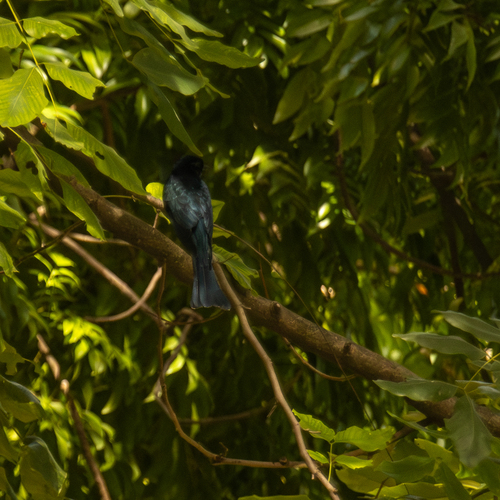 Square-tailed Drongo-Cuckoo
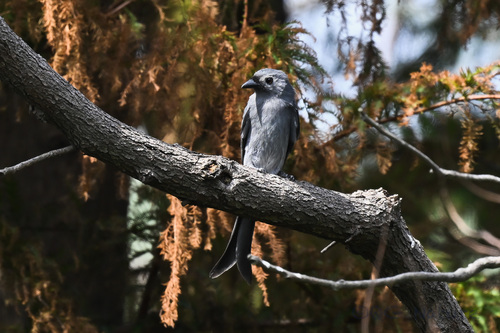 Ashy Drongo
In short
The most reliable field mark to separate Square-tailed Drongo-Cuckoo from Ashy Drongo is the tail shape: the drongo-cuckoo has a square-tipped or only slightly notched tail with flared tips, while the ashy drongo always shows a long, deeply forked tail. In flight, the drongo-cuckoo reveals a white wing-stripe from below and white barring on the vent and outer undertail, which the ashy drongo lacks. Structurally, the drongo-cuckoo has a downcurved beak and a more compact, cuckoo-like jizz, while the ashy drongo is slimmer, longer-tailed, and sits very upright. Both can appear dark and drongo-like, but careful attention to tail shape and underwing pattern will resolve most confusion, especially with immature birds.
Identification tips
- Tail shape is the most decisive mark: Square-tailed Drongo-Cuckoo always has a square-tipped or only slightly notched tail with flared tips; Ashy Drongo always has a long, deeply forked tail. This is reliable in all ages and seasons.
- White wing-stripe in flight: Only the drongo-cuckoo shows a white wing-stripe from below in flight. If you see this mark, especially in a bird with a square tail, it is not an ashy drongo.
- White barring on vent and outer undertail: The drongo-cuckoo has white barring here, visible when perched or in flight. Ashy drongo never shows this pattern; its undertail is plain.
- Bill shape: Drongo-cuckoo has a downcurved beak, while ashy drongo's bill is straight and typical of drongos. This is subtle but visible at close range.
- Body color and gloss: Drongo-cuckoo is glossy blackish; ashy drongo is dark grey (sometimes very dark in some subspecies but lacking the same gloss). Juvenile ashy drongos are dull brownish-grey, never glossy.
- Head markings: Some ashy drongo subspecies (e.g., leucogenis, salangensis) have white patches on the head or around the eye. Drongo-cuckoo never shows white on the head.
- Perching posture: Ashy drongo sits very upright and often high and exposed; drongo-cuckoo has a more horizontal, cuckoo-like posture and is less likely to perch prominently.
- Flight jizz: Ashy drongo looks longer-tailed and more buoyant in flight due to its deep tail fork. Drongo-cuckoo appears more compact and less elongated.
- Vocalizations: Drongo-cuckoo gives sharp, rising, choppy whistles; ashy drongo's calls are nasal, twangy, and often mimic other birds. If you hear mimicry or a 'gip-gip-drangh' call, suspect ashy drongo.
- Habitat context: Both can occur in similar forests, but ashy drongo is more likely to be seen high and exposed, while drongo-cuckoo may be closer to the ground or in denser cover, especially near babbler flocks.
- Juvenile confusion: Young ashy drongos are dull brownish-grey but still have a deeply forked tail and lack white barring or wing-stripe. Juvenile drongo-cuckoo resembles adults in key marks.
- Iris color: Ashy drongo has a crimson iris (in adults); this is not noted for drongo-cuckoo and may be hard to see in the field.
- No white rictal spot: Ashy drongo lacks the white rictal spot of black drongo, but this is not relevant for separating from drongo-cuckoo.
- Brood parasite behavior: If you see a drongo-like bird interacting with small babblers in a suspicious way, consider drongo-cuckoo.
- Subspecies variation: Very dark ashy drongo subspecies (longicaudatus) can look almost black, but always have a deeply forked tail and lack white barring or wing-stripe.
Size
Both species are similar in overall size, but the ashy drongo averages about 38g in body mass [wikidata]. The ashy drongo is slimmer and has a longer, more deeply forked tail, giving it a more elongated appearance. The drongo-cuckoo, while similar in length, is more compact and lacks the pronounced tail fork, making it look shorter-tailed and chunkier by comparison.
Plumage
- Juvenile/Immature/Flight views: The Square-tailed Drongo-Cuckoo (all ages) shows a white wing-stripe from below in flight, as well as white barring on the vent and outer undertail. These marks are absent in the Ashy Drongo, whose underwing and undertail are plain and whose juveniles are dull brownish-grey but still lack any white barring or wing-stripe.
- Tail: The drongo-cuckoo's tail is square-tipped or only slightly notched with flared tips, never deeply forked. The ashy drongo's tail is always long and deeply forked, a key mark at all ages.
- Body color: The drongo-cuckoo is glossy blackish overall, while the ashy drongo is mainly dark grey (sometimes very dark in some subspecies, but never with the same gloss or barring as the cuckoo). Juvenile ashy drongos are dull brownish-grey.
- Head markings: Some ashy drongo subspecies have white patches around the eye or on the head, which the drongo-cuckoo never shows. The drongo-cuckoo may show a white-barred vent and undertail, but not on the head.
Behaviour
Ashy drongo typically perches very upright and prominently, often high in trees, and forages by aerial sallies or sometimes by gleaning from trunks. It is usually seen singly, in pairs, or small groups, and during migration may fly in small flocks. Square-tailed drongo-cuckoo is more secretive, often mimicking the jizz of a drongo but with a more cuckoo-like, less upright posture. It is a brood parasite and may be seen in the company of small babblers, its hosts. Both species are active and agile, but the ashy drongo's upright stance and frequent sallying are distinctive.
Habitat
Both species can occur in similar forested habitats along the Himalayas and Southeast Asia. Ashy drongo prefers tall forest and hill forests, especially in winter, and is more likely to be seen perched high and conspicuously. Square-tailed drongo-cuckoo is also found in forested areas but is more closely associated with the presence of its host species (small babblers) and may be less conspicuous. Habitat overlap is possible, so field marks are more reliable than context.
Voice
Square-tailed drongo-cuckoo gives a series of piercing, sharp whistles that rise in pitch, delivered in a shrill and choppy manner. Ashy drongo's calls are described as more nasal and twangy, often rendered as 'drangh gip' or 'gip-gip-drangh', and it is capable of mimicking other bird calls, including the whistling notes of a common iora. While both can sound sharp, the drongo-cuckoo's call is more piercing and less musical than the ashy drongo's.