

Squacco Heron vs Lilac-breasted Roller
Ardeola ralloides versus Coracias caudatus
Play a quiz with Squacco Heron and Lilac-breasted Roller
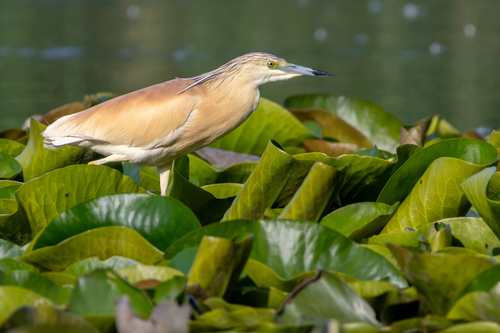 Squacco Heron
 Lilac-breasted Roller
In short
The most reliable way to separate Squacco Heron from Lilac-breasted Roller is by their overall coloration and structure, especially in flight: Squacco Heron appears mostly white-winged when flying, while Lilac-breasted Roller flashes brilliant blues and lilacs with long tail streamers (in adults). Juvenile and immature plumages are also quite different, with the heron showing tawny-buff and streaked tones, and the roller showing rufous-tawny with streaks and lacking the adult's long tail feathers. Perched, the heron is stocky and short-necked with a thick bill, while the roller is robust, large-headed, and vividly colored. Habitat and behavior further help: herons are tied to wetlands, rollers to open woodland and savanna.
Identification tips
- Flight pattern and wing color: In all ages, Squacco Heron shows strikingly white wings in flight, contrasting with its buff-brown back and neck. Lilac-breasted Roller flashes blue and black wings with lilac underparts and, in adults, long black tail streamers.
- Tail shape: Adult Lilac-breasted Rollers have long, pointed black tail streamers (8–9 cm), absent in juveniles. Squacco Heron has a short, square tail with no streamers at any age.
- Body structure: Squacco Heron is stocky, with a short neck (often hunched), short thick bill, and a compact appearance. Lilac-breasted Roller is robust but more upright, with a large head, broad bill, and long tail.
- Perched appearance: Perched Squacco Herons are subdued buff-brown with streaking, blending into reeds or marsh vegetation. Lilac-breasted Rollers are conspicuous, with bright lilac, blue, and green plumage, and are usually seen on exposed perches.
- Juvenile confusion: Juvenile Squacco Herons are tawny with lighter streaking and lack the white wing transformation when perched, but still show white wings in flight. Juvenile Rollers are streaked rufous-tawny on the throat and breast, lack tail streamers, and have duller blue in the wings.
- Bill color and shape: Squacco Heron has a straight, thick, relatively short bill suited for fishing. Lilac-breasted Roller has a broader, slightly hooked bill typical of rollers, not adapted for fishing.
- Neck length: Heron has a noticeably short neck for a heron, but still longer than the roller's compact neck. In flight, the heron's neck is retracted, while the roller's is not.
- Behavior: Herons are slow-moving, often solitary or in small groups at water edges, and rarely perch high. Rollers are active, often perched high in trees, and perform aerial displays.
- Habitat: If seen in a wetland or marsh, Squacco Heron is far more likely. In open woodland or savanna, especially away from water, expect Lilac-breasted Roller.
- Vocalization: Rollers are noisy, especially in display, with harsh, raucous calls. Squacco Heron is generally silent.
- Sex and season: Both species are not sexually dimorphic, so sex is not a field clue. Roller subspecies vary in crown and breast color, but all are much more colorful than any heron.
- Size impression: Heron is heavier and bulkier, but the roller's long tail can make it look longer when perched or in flight.
- Feet: Rollers have syndactyl feet (fused toes), but this is not visible in the field. Herons have typical wader feet.
- Pitfalls: Distant or backlit views may obscure the roller's colors, but the heron's white wings in flight are still distinctive. Perched, a roller's bright colors and upright stance contrast with the heron's hunched, cryptic look.
- Range: Squacco Heron is Old World, breeding in southern Europe and the Middle East, wintering in Africa; Lilac-breasted Roller is resident in sub-Saharan Africa and a vagrant to Arabia. Out of range, vagrancy is possible but rare for both.
Size
Squacco Heron is notably heavier and slightly longer-bodied (body mass ~288g, length 44–47 cm, wingspan 80–92 cm) than Lilac-breasted Roller (average mass ~104g, length 36–38 cm including tail streamers, wingspan 50–58 cm) [wikidata][wikipedia]. The heron is bulkier and more compact, while the roller is lighter, with a proportionally longer tail (especially in adults) and a more upright, alert posture.
Plumage
- Juvenile/Immature: Juvenile Squacco Herons are tawny-buff with lighter streaking and a buff-brown back, blending well with marsh vegetation. In flight, even young birds show strikingly white wings contrasting with the body. Juvenile Lilac-breasted Rollers are rufous-tawny on the throat and breast, broadly streaked with buffy-white and mauve margins, and lack the adult's long tail streamers. Their wings already show blue and black patterning, though less vivid than adults.
- Adult breeding: Adult Squacco Herons in summer have long neck feathers and a buff-brown back, but in flight, the transformation is dramatic: the wings appear almost entirely white, a key field mark. Adult Lilac-breasted Rollers are unmistakably colorful: lilac throat and breast (deeper in the nominate, azure in some subspecies), olive or greenish-blue crown and mantle, blue wings with black and purple-blue in the remiges, and long black tail streamers. The roller's colors are vivid even at a distance, especially in good light.
- Perched: Squacco Heron is subdued, mostly buff and brown, while Lilac-breasted Roller is a riot of color with lilac, blue, and green tones.
Behaviour
Squacco Herons are typically seen stalking quietly at the edge of marshes or standing motionless, often in small colonies with other waders. In flight, they show slow, deep wingbeats and a hunched neck. Lilac-breasted Rollers are often seen perched conspicuously atop trees in open areas, alone or in pairs, scanning for prey. Their flight is strong and acrobatic, with rolling and diving displays, especially during courtship or territorial disputes. Rollers are much more aerial and active than the heron, and their display flights are distinctive.
Habitat
Squacco Heron is almost always found near marshy wetlands, lakes, or rivers, especially in warm regions of southern Europe, the Middle East, and Africa. It is rarely seen away from water. Lilac-breasted Roller prefers open woodland and savanna, perching on exposed branches in grassy clearings, and is absent from treeless or dense forest areas. The two species rarely overlap in habitat, except perhaps at the interface of wetland and savanna.
Voice
Lilac-breasted Roller has a harsh, raucous 'kaaa, kaarsh' and a chuckling call, especially during display flights. Squacco Heron is generally quiet and not noted for any distinctive calls in the field, especially compared to the roller's noisy displays.