

Motmot

Spotted Wood-Owl vs Brown Wood-Owl

Strix seloputo versus Strix leptogrammica

Play a quiz with Spotted Wood-Owl and Brown Wood-Owl
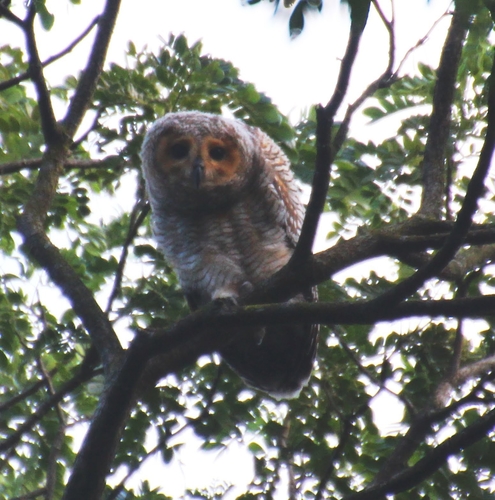
Spotted Wood-Owl (Strix seloputo) Spotted Wood-Owl
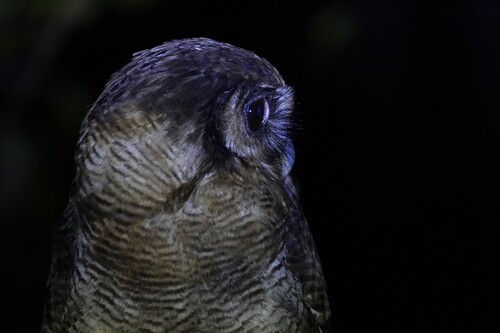
Brown Wood-Owl (Strix leptogrammica) Brown Wood-Owl

Media

Loading…

In short

The most reliable field mark between Spotted Wood-Owl and Brown Wood-Owl is the upperpart pattern: Spotted Wood-Owl shows prominent white bars and spots on a coffee-brown back, while Brown Wood-Owl is much more uniformly dark brown above, with only faint white spotting on the shoulders. Spotted Wood-Owl also has a striking orangish-buff facial disc and a yellowish throat band (in the nominate form), whereas Brown Wood-Owl's facial disc is brown or rufous, edged with white, and lacks concentric barring. Both species lack ear-tufts and have dark eyes, but their underparts and face patterns are distinct. These differences are visible in perched birds and, to a lesser extent, in flight if the upperwing is seen well. Juvenile and immature-specific upperwing patterns are not described in the sources, so adult plumage is the main basis for separation.

Identification tips

  1. Upperpart pattern is key: Spotted Wood-Owl shows bold white bars and spots on the back and wings, while Brown Wood-Owl is almost plain dark brown above with only faint white shoulder spots. This is the fastest way to separate them in perched or well-lit flight views.
  2. Facial disc color and pattern: Spotted Wood-Owl has an orangish-buff facial disc with a yellowish throat band (in the nominate form), while Brown Wood-Owl's facial disc is brown or rufous, edged with white, and lacks concentric barring. Look for the overall warmth and throat band for Spotted.
  3. Underpart markings: Spotted Wood-Owl has dull yellow underparts with broad white and narrow black bars; Brown Wood-Owl is buff below with brown streaks, not bars. Barred underparts point to Spotted.
  4. Neck band: Brown Wood-Owl shows a white neckband, which is absent or much less obvious in Spotted Wood-Owl.
  5. Eye color: Both have dark brown eyes, so this is not helpful for separation.
  6. Ear tufts: Both species lack ear tufts (are 'earless'), so do not use this feature.
  7. Bill and feet: Spotted Wood-Owl has a greenish-black bill and olive feathered toes; Brown Wood-Owl's bill and feet are not described as distinctive in the sources.
  8. Size: Brown Wood-Owl is slightly larger, but the difference is subtle and not reliable unless both are seen together.
  9. Flight views: No unique juvenile or immature wing patterns are described for either species, so rely on overall upperpart pattern and underpart barring in flight.
  10. Voice: Spotted Wood-Owl's call is a rolling 'huhuhu' and long 'whoo'; Brown Wood-Owl's voice is not described here, so do not use vocalization for separation unless you have local knowledge.
  11. Range and context: In Borneo, only Brown Wood-Owl occurs; Spotted Wood-Owl is absent. In South Asia, Brown Wood-Owl is widespread, while Spotted Wood-Owl is absent. In Southeast Asia, check local status, but do not rely on range alone in overlap zones.
  12. Sex and age: No sexual dimorphism is described; both sexes look alike. Juvenile and immature-specific marks are not detailed, so use adult field marks for all ages.
  13. Common pitfalls: Beware of poor light or distant views making Brown Wood-Owl appear more patterned than it is, or Spotted Wood-Owl less so. Focus on the boldness and extent of white in the upperparts and the face/throat color.
  14. Perched vs. flight: Both species are usually seen perched, but in flight, Spotted Wood-Owl's barred underparts and more patterned upperwing may be visible, while Brown Wood-Owl will look plainer above and streaked below.
  15. Shoulder spotting: If you see only faint white spots on the shoulder and otherwise uniform brown upperparts, suspect Brown Wood-Owl; bold white barring and spots across the back and wings indicate Spotted Wood-Owl.

Size

Both species are large, earless Strix owls, but Brown Wood-Owl is slightly larger overall. Spotted Wood-Owl measures about 44–48 cm in length with a wing length of 30–36 cm, while Brown Wood-Owl is 45–57 cm long (wing length not specified for Brown). In the field, this size difference is subtle and not a reliable separation point unless both are seen side by side.

Plumage

For adults, Spotted Wood-Owl is instantly more patterned above, with bold white bars and spots on coffee-brown upperparts, and a contrasting orangish-buff facial disc. Its underparts are dull yellow with broad white and narrow black bars. In contrast, Brown Wood-Owl is much plainer above, with uniformly dark brown upperparts and only faint white spotting on the shoulders. Its underparts are buff with brown streaking, not barred. The facial disc is brown or rufous, edged with white, and there is a white neckband, but it lacks the yellowish throat band of Spotted Wood-Owl. Both have dark eyes and no ear-tufts. Juvenile or immature-specific upperwing or flight marks are not described for either species in the sources, so these contrasts apply to all ages unless otherwise noted.

Behaviour

Both species are typical Strix owls, usually seen perched quietly in dense woodland or forest. There are no behavioral differences described in the sources that are diagnostic for separation in the field.

Habitat

Spotted Wood-Owl has a disjunct range surrounding Borneo but not on the island itself, while Brown Wood-Owl is found in India, Bangladesh, Sri Lanka, Indonesia, Taiwan, and south China. In areas of overlap (e.g., parts of Southeast Asia), habitat alone is not diagnostic, but Spotted Wood-Owl tends to be more localized and patchily distributed. Brown Wood-Owl is a resident breeder in South Asia and is generally more widespread.

Voice

Spotted Wood-Owl gives a rolling 'huhuhu' followed by a long 'whoo.' No vocal description is provided for Brown Wood-Owl in the sources, so voice is not a reliable field separation based on this material.

Submit a better description

Use the same sections as the comparison. Your text is published immediately.

The most reliable field mark between Spotted Wood-Owl and Brown Wood-Owl is the upperpart pattern: Spotted Wood-Owl shows prominent white bars and spots on a coffee-brown back, while Brown Wood-Owl is much more uniformly dark brown above, with only faint white spotting on the shoulders. Spotted Wood-Owl also has a striking orangish-buff facial disc and a yellowish throat band (in the nominate form), whereas Brown Wood-Owl's facial disc is brown or rufous, edged with white, and lacks concentric barring. Both species lack ear-tufts and have dark eyes, but their underparts and face patterns are distinct. These differences are visible in perched birds and, to a lesser extent, in flight if the upperwing is seen well. Juvenile and immature-specific upperwing patterns are not described in the sources, so adult plumage is the main basis for separation.

  1. Upperpart pattern is key: Spotted Wood-Owl shows bold white bars and spots on the back and wings, while Brown Wood-Owl is almost plain dark brown above with only faint white shoulder spots. This is the fastest way to separate them in perched or well-lit flight views.
  2. Facial disc color and pattern: Spotted Wood-Owl has an orangish-buff facial disc with a yellowish throat band (in the nominate form), while Brown Wood-Owl's facial disc is brown or rufous, edged with white, and lacks concentric barring. Look for the overall warmth and throat band for Spotted.
  3. Underpart markings: Spotted Wood-Owl has dull yellow underparts with broad white and narrow black bars; Brown Wood-Owl is buff below with brown streaks, not bars. Barred underparts point to Spotted.
  4. Neck band: Brown Wood-Owl shows a white neckband, which is absent or much less obvious in Spotted Wood-Owl.
  5. Eye color: Both have dark brown eyes, so this is not helpful for separation.
  6. Ear tufts: Both species lack ear tufts (are 'earless'), so do not use this feature.
  7. Bill and feet: Spotted Wood-Owl has a greenish-black bill and olive feathered toes; Brown Wood-Owl's bill and feet are not described as distinctive in the sources.
  8. Size: Brown Wood-Owl is slightly larger, but the difference is subtle and not reliable unless both are seen together.
  9. Flight views: No unique juvenile or immature wing patterns are described for either species, so rely on overall upperpart pattern and underpart barring in flight.
  10. Voice: Spotted Wood-Owl's call is a rolling 'huhuhu' and long 'whoo'; Brown Wood-Owl's voice is not described here, so do not use vocalization for separation unless you have local knowledge.
  11. Range and context: In Borneo, only Brown Wood-Owl occurs; Spotted Wood-Owl is absent. In South Asia, Brown Wood-Owl is widespread, while Spotted Wood-Owl is absent. In Southeast Asia, check local status, but do not rely on range alone in overlap zones.
  12. Sex and age: No sexual dimorphism is described; both sexes look alike. Juvenile and immature-specific marks are not detailed, so use adult field marks for all ages.
  13. Common pitfalls: Beware of poor light or distant views making Brown Wood-Owl appear more patterned than it is, or Spotted Wood-Owl less so. Focus on the boldness and extent of white in the upperparts and the face/throat color.
  14. Perched vs. flight: Both species are usually seen perched, but in flight, Spotted Wood-Owl's barred underparts and more patterned upperwing may be visible, while Brown Wood-Owl will look plainer above and streaked below.
  15. Shoulder spotting: If you see only faint white spots on the shoulder and otherwise uniform brown upperparts, suspect Brown Wood-Owl; bold white barring and spots across the back and wings indicate Spotted Wood-Owl.

Both species are large, earless Strix owls, but Brown Wood-Owl is slightly larger overall. Spotted Wood-Owl measures about 44–48 cm in length with a wing length of 30–36 cm, while Brown Wood-Owl is 45–57 cm long (wing length not specified for Brown). In the field, this size difference is subtle and not a reliable separation point unless both are seen side by side.

For adults, Spotted Wood-Owl is instantly more patterned above, with bold white bars and spots on coffee-brown upperparts, and a contrasting orangish-buff facial disc. Its underparts are dull yellow with broad white and narrow black bars. In contrast, Brown Wood-Owl is much plainer above, with uniformly dark brown upperparts and only faint white spotting on the shoulders. Its underparts are buff with brown streaking, not barred. The facial disc is brown or rufous, edged with white, and there is a white neckband, but it lacks the yellowish throat band of Spotted Wood-Owl. Both have dark eyes and no ear-tufts. Juvenile or immature-specific upperwing or flight marks are not described for either species in the sources, so these contrasts apply to all ages unless otherwise noted.

Both species are typical Strix owls, usually seen perched quietly in dense woodland or forest. There are no behavioral differences described in the sources that are diagnostic for separation in the field.

Spotted Wood-Owl has a disjunct range surrounding Borneo but not on the island itself, while Brown Wood-Owl is found in India, Bangladesh, Sri Lanka, Indonesia, Taiwan, and south China. In areas of overlap (e.g., parts of Southeast Asia), habitat alone is not diagnostic, but Spotted Wood-Owl tends to be more localized and patchily distributed. Brown Wood-Owl is a resident breeder in South Asia and is generally more widespread.

Spotted Wood-Owl gives a rolling 'huhuhu' followed by a long 'whoo.' No vocal description is provided for Brown Wood-Owl in the sources, so voice is not a reliable field separation based on this material.

Discard your changes?

You have unsaved edits. If you leave now, those changes will be lost.

Spotted Wood-Owl · Brown Wood-Owl · My Tricky Birds