
Spotted Nutcracker vs Daurian Jackdaw
Nucifraga caryocatactes versus Coloeus dauuricus
Play a quiz with Spotted Nutcracker and Daurian Jackdaw
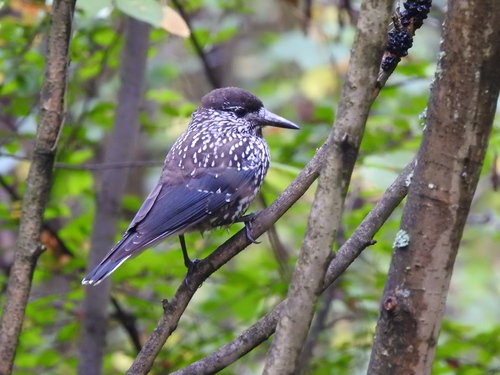 Spotted Nutcracker
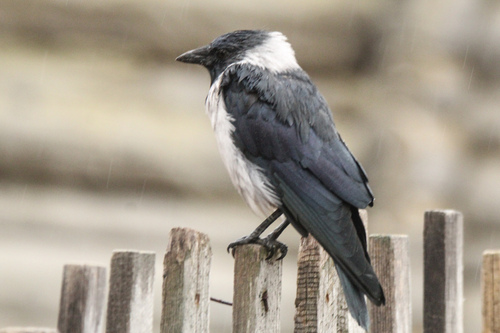 Daurian Jackdaw
In short
The most reliable field mark to separate Spotted Nutcracker from Daurian Jackdaw is the nutcracker’s dense white spotting on a chocolate-brown body, especially obvious on the face, neck, and underparts, versus the Daurian Jackdaw’s sharply pied pattern with a pale creamy-white collar and underparts contrasting with a glossy black head, wings, and tail. In flight, the nutcracker shows broad, dark wings and a short tail with white corners and a white vent, while the jackdaw’s flight is more compact and lacks any white in the wings or tail. The nutcracker’s bill is long, heavy, and sharply pointed, while the jackdaw’s is shorter and more typical of a small crow. Both are corvids of similar size, but their structure, head shape, and plumage are strikingly different at all ages.
Identification tips
- White spotting vs. pied pattern: Spotted Nutcracker of all ages shows dense white spots on a chocolate-brown body, especially on the face and underparts; Daurian Jackdaw never shows white spotting, but adults have a sharply defined creamy-white collar and underparts contrasting with a black head and wings.
- Flight pattern and tail: In flight, nutcracker shows broad, dark wings, a short tail with white corners and a white vent; Daurian Jackdaw’s wings and tail are all black, with no white, and the tail is squarer and slightly longer in proportion.
- Bill shape: Nutcracker’s bill is long, thick, and sharply pointed—noticeably larger than any jackdaw’s. Daurian Jackdaw’s bill is short, straight, and crow-like, never as heavy or pointed.
- Head shape and crest: Nutcracker has a slim, crestless head; Daurian Jackdaw’s head is rounder and proportioned like a small crow.
- Iris color: Daurian Jackdaw has black irises (unlike the pale-eyed western jackdaw); nutcracker’s eyes are also dark, so this is not diagnostic between these two, but rules out confusion with western jackdaw.
- Underparts: Nutcracker’s underparts are brown with white spots; Daurian Jackdaw’s are creamy-white (adults) or dusky (immatures), but never spotted.
- Facial pattern: Nutcracker has a white loral spot and white eye-ring; Daurian Jackdaw lacks these but has a pale collar.
- Wing gloss: Both species have glossy wings, but nutcracker’s are blackish with a greenish-blue gloss; Daurian Jackdaw’s are glossy black, matching the head and tail.
- Social behavior: Nutcrackers are usually solitary or in pairs; Daurian Jackdaws are often in flocks.
- Habitat: Nutcracker is almost always in or near coniferous forest; Daurian Jackdaw prefers open country, farmland, and urban areas.
- Feeding behavior: Nutcracker often seen hammering seeds or nuts, sometimes holding food in feet; jackdaw forages on ground, often in groups.
- Tail pattern: Only nutcracker shows white corners and a white terminal band on the undertail; Daurian Jackdaw’s tail is uniformly black.
- Juvenile confusion: Young Daurian Jackdaws are darker and can resemble western jackdaws, but never show the nutcracker’s white spotting or white vent.
- Vocalizations: Not described in sources, but both are corvids with harsh calls; voice is unlikely to be diagnostic in the field.
- Seasonal variation: Both species are resident in most of their range; irruptive nutcrackers may appear in unusual places, but plumage differences remain clear year-round.
Size
Both species are similar in overall length, with Spotted Nutcracker ranging from 32–38 cm and Daurian Jackdaw about 32 cm [wikipedia]. The nutcracker is a bit bulkier and has a noticeably larger, more robust bill. Wingspan is slightly greater in the nutcracker (49–53 cm) compared to the jackdaw, which is proportioned more compactly. In the field, the nutcracker often looks heavier and more broad-winged, while the jackdaw is neater and more compact.
Plumage
Juvenile and immature Spotted Nutcrackers already show the species’ hallmark: a chocolate-brown body thickly spotted with white, especially on the face, neck, and underparts. In flight, all ages display broad, dark wings with a greenish-blue gloss, a short tail with white corners, and a conspicuous white vent and undertail band. Daurian Jackdaws, by contrast, have a sharply pied look as adults, with a creamy-white collar and underparts, black head, throat, wings, and tail, and grizzled grey ear coverts. Juvenile and darker adults can resemble western jackdaws, but always lack the nutcracker’s white spotting and have black irises. Daurian Jackdaw never shows white in the wings or tail, and the underparts are either pale (adults) or dusky (immatures), never spotted. The nutcracker’s plumage is never pied or collared, and always shows some white spotting and a white vent.
Behaviour
Spotted Nutcrackers are often seen singly or in pairs, moving deliberately through coniferous forest or flying with slow, undulating wingbeats. They may be seen hammering seeds or nuts, sometimes holding food with their feet. Daurian Jackdaws are more social, often in flocks, and show typical jackdaw behavior: agile, direct flight, frequent perching on wires or buildings, and a tendency to forage in open areas. Nutcrackers are more arboreal and less likely to be seen in open farmland or urban settings than jackdaws.
Habitat
Spotted Nutcracker is a bird of coniferous and mixed forests, especially where large-seeded pines or spruces are present. It is rarely found far from trees and avoids open country. Daurian Jackdaw prefers open habitats, including farmland, steppe, and urban areas, and is often seen around human habitation, nesting in cavities or buildings. Overlap is minimal except perhaps at forest edges, but context can help: a spotted, brown corvid deep in pine woods is almost certainly a nutcracker.