
Spotted Flycatcher vs Thrush Nightingale
Muscicapa striata versus Luscinia luscinia
Play a quiz with Spotted Flycatcher and Thrush Nightingale
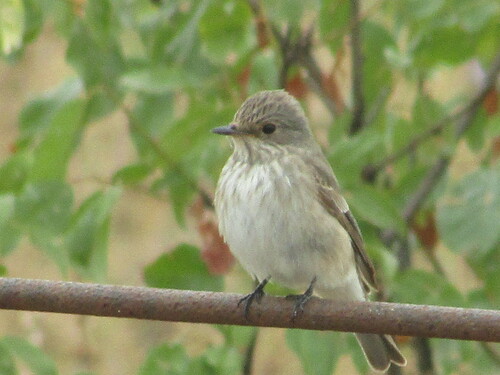 Spotted Flycatcher
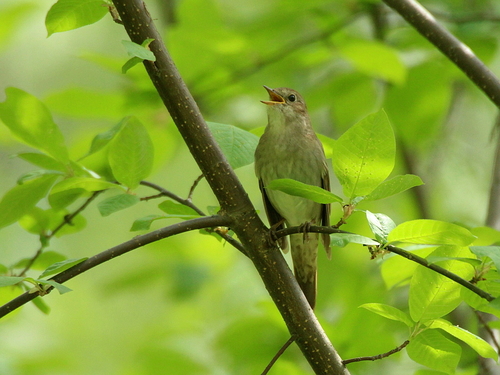 Thrush Nightingale
In short
The most reliable field mark to separate Spotted Flycatcher from Thrush Nightingale is the presence of fine streaks on the crown and breast in Spotted Flycatcher of all ages, which are never shown by Thrush Nightingale. Juvenile Spotted Flycatchers also show ochre-buff spots on the upperparts, while juvenile Thrush Nightingales are darker and more mottled overall but lack these spots. Structurally, Spotted Flycatcher is slimmer and longer-tailed, with a more upright, alert posture, while Thrush Nightingale is bulkier and more horizontal. In flight or perched, Spotted Flycatcher’s pale-edged wing feathers and overall greyer, plainer appearance contrast with the darker, olive-brown upperparts and cloudy underparts of Thrush Nightingale. Both are drab, but careful attention to streaking, structure, and context will separate them.
Identification tips
- Crown and breast streaking: Spotted Flycatcher of all ages shows fine brown streaks on the crown, throat, and breast; Thrush Nightingale never shows this feature. This is the single most reliable mark at all seasons.
- Juvenile upperparts: Juvenile Spotted Flycatchers have ochre-buff spots on the upperparts and scaly brown spots below. Juvenile Thrush Nightingales are darker, more mottled, but lack ochre-buff spots.
- Overall tone: Spotted Flycatcher is pale grey-brown above and off-white below, appearing washed out and plain. Thrush Nightingale is much darker brown above with an olive tinge and has a cloudy, mottled look below.
- Wing and tail edges: Spotted Flycatcher shows pale, thin edges to the wing and tail feathers, especially in fresh plumage. Thrush Nightingale’s wings and tail are darker, with less obvious pale edging.
- Tail color: Thrush Nightingale has a dark rufous-brown tail (not as bright as Common Nightingale), while Spotted Flycatcher’s tail is duller and matches the upperparts.
- Under tail-coverts: Thrush Nightingale’s under tail-coverts are buff, sometimes barred or marked with brown. Spotted Flycatcher’s are off-white and plain.
- Bill shape: Spotted Flycatcher has a broad-based, pointed bill typical of aerial insectivores, while Thrush Nightingale’s bill is finer and less broad at the base.
- Leg color: Both have dark legs, not a strong separator.
- Posture: Spotted Flycatcher perches upright and alert, often on exposed branches. Thrush Nightingale is more horizontal, often low or hidden in undergrowth.
- Behavior: Watch for sallying flight from a perch (Spotted Flycatcher) versus skulking and ground foraging (Thrush Nightingale).
- Habitat: Open, sunlit areas with scattered trees favor Spotted Flycatcher; dense, damp thickets and forest undergrowth favor Thrush Nightingale.
- Vocalization: A thin, descending 'tssssseeeeeppppp' call is Spotted Flycatcher. Thrush Nightingale’s song is rich and fluting, but calls are less distinctive.
- Size and shape: Spotted Flycatcher is slimmer, longer-tailed, and more delicate. Thrush Nightingale is bulkier, with a shorter tail and larger body.
- Sexes: Both species are sexually monomorphic; do not rely on sex for identification.
- Season: Both species are migratory and can overlap in late spring and early autumn; age-specific marks (juvenile spotting, streaking) are most useful in late summer and autumn.
Size
Spotted Flycatcher is slightly smaller and slimmer, averaging about 14.5 cm in length and weighing 14–20 g [wikipedia]. Thrush Nightingale is bulkier, about 16 cm long with a wingspan around 18 cm [wikipedia]. The difference is subtle in the field, but Thrush Nightingale often appears more robust with a proportionally shorter tail and larger body, while Spotted Flycatcher looks more elongated and delicate.
Plumage
Juvenile Spotted Flycatchers are browner than adults, with distinct ochre-buff spots on the upperparts and scaly brown spots below, while juvenile Thrush Nightingales are darker overall and more heavily mottled, lacking the ochre-buff spotting. Adult Spotted Flycatchers have dull grey-brown upperparts and off-white underparts, with fine brown streaks on the crown, throat, and breast, and pale-edged wing and tail feathers. In contrast, adult Thrush Nightingales are darker brown above with an olive tinge, and their underparts are pale buff or whitish, mottled and spotted with brown, giving a cloudy appearance. The tail of Thrush Nightingale is dark rufous-brown, but not as bright as Common Nightingale, and the under tail-coverts are buff, sometimes barred. Spotted Flycatcher never shows the overall dark, olive-brown tones or the cloudy, heavily mottled underparts of Thrush Nightingale. Both sexes are similar in both species.
Behaviour
Spotted Flycatcher typically perches upright and exposed, making frequent sallies to catch insects in mid-air and often returning to the same perch, showing a characteristic upright, alert posture. Thrush Nightingale is much more secretive, usually foraging on or near the ground in dense undergrowth, moving with a more horizontal stance and rarely sallying out into the open. Spotted Flycatcher’s behavior is more active and aerial, while Thrush Nightingale is skulking and ground-oriented.
Habitat
Spotted Flycatcher is found in open woodlands, gardens, parks, and edges of forests, often perching in the open. Thrush Nightingale prefers dense, damp forests and thickets, especially with heavy undergrowth, and nests near the ground. If you find the bird in a dark, tangled thicket, especially near water, Thrush Nightingale is more likely; Spotted Flycatcher is more likely in open, sunlit spots with scattered trees.
Voice
Spotted Flycatcher gives a thin, high-pitched, slightly descending 'tssssseeeeeppppp' call. Thrush Nightingale is best known for its rich, fluting song (not described in detail in these notes), but its calls are less distinctive in the field. If you hear a thin, drawn-out call, Spotted Flycatcher is more likely; Thrush Nightingale’s calls are less likely to be noticed unless singing.