

Spotted Flycatcher vs European Robin
Muscicapa striata versus Erithacus rubecula
Play a quiz with Spotted Flycatcher and European Robin
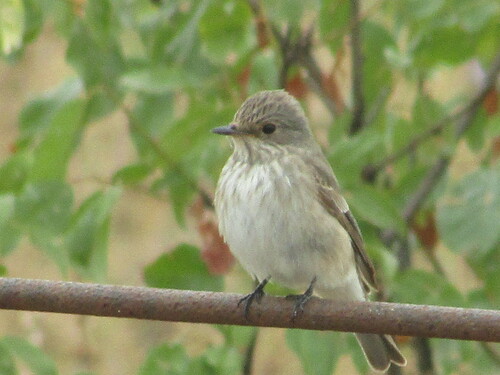 Spotted Flycatcher
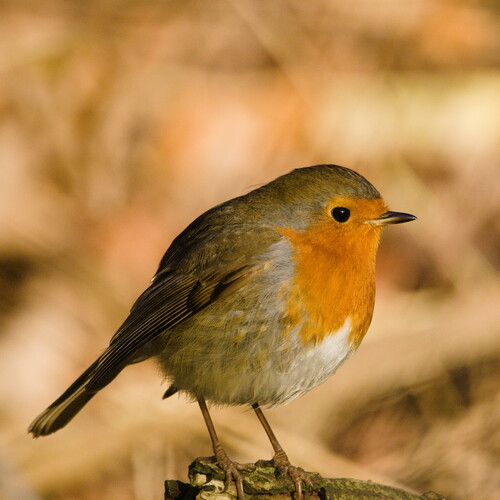 European Robin
In short
The most reliable way to separate Spotted Flycatcher and European Robin is by looking for the robin's distinctive orange-red face and breast, which is never present on Spotted Flycatcher of any age. For juveniles, both can show spotted or mottled upperparts, but only robins lack any orange and have a more uniform brown-and-white freckled look. Structurally, Spotted Flycatcher is slimmer and longer-winged, often sitting upright and sallying for insects, while robins are rounder with a shorter tail and more horizontal posture. In flight, neither species shows strong wing pattern differences in adults, but young robins are overall mottled brown, while young flycatchers have ochre-buff spots above. If you see a small, slim, streaky-breasted bird without any orange, it's likely a Spotted Flycatcher; a bird with any orange on the face or breast is a robin.
Identification tips
- Orange-red face and breast: Only European Robin (adult or older juvenile) shows any orange on the face or breast. Spotted Flycatcher never does, at any age.
- Juvenile plumage: Juvenile robins are freckled brown and white all over, lacking orange, and can be confused with Spotted Flycatcher at a glance. Look for the robin's more uniform, dense freckling and lack of streaking on the breast or crown. Juvenile flycatchers have ochre-buff spots above and scaly brown spots below, with a slimmer, longer-winged look.
- Streaked breast and crown: Adult Spotted Flycatcher has fine brown streaks on the crown, throat, and breast, which are absent in robin of any age.
- Structure: Spotted Flycatcher is slim, with long wings and tail, and sits upright. Robin is rounder, with a shorter tail and a more horizontal, fluffed-up posture.
- Bill shape: Both have thin, pointed bills, but Spotted Flycatcher's is slightly broader at the base, typical of aerial insectivores. This is subtle but can help at close range.
- Wing and tail edges: Spotted Flycatcher shows pale edges to wing and tail feathers, especially when fresh. Robin's wings are plainer and rounder, with no pale edges.
- Behavior: Watch for flycatcher's upright, sallying behavior from open perches. Robin is more likely to hop on the ground or forage in dense cover, rarely sallying for insects.
- Habitat: In dense, shaded areas or on lawns, robin is more likely. In open woodland or exposed perches, especially during migration, consider Spotted Flycatcher.
- Vocalizations: Robin's song is rich and musical; its 'tick' call is sharp and frequent. Spotted Flycatcher's call is thin, high-pitched, and descending, often overlooked.
- Sexes: Both species are sexually monomorphic—males and females look alike, so do not rely on sex for ID.
- First-winter robin: May show yellow-brown tips to wing coverts, but this is subtle and not a primary field mark. Focus on the presence or absence of orange and overall structure.
- In flight: No strong wing pattern differences, but Spotted Flycatcher is longer-winged and more direct in flight, while robin is rounder and flutters with short, rounded wings.
- Leg color: Spotted Flycatcher has black legs; robin's legs are brown. This can help at close range but is not always visible.
- Confusion risk: The main pitfall is juvenile robin vs. juvenile Spotted Flycatcher. Check for orange (robin, as it ages), streaked breast (flycatcher), and overall build.
- Season: Spotted Flycatcher is a summer migrant in most of Europe, absent in winter. Robin is present year-round and sings in winter, so a singing bird in winter is a robin.
Size
Both species are similar in length: Spotted Flycatcher averages about 14.5 cm, while European Robin ranges from 12.5–14.0 cm. Weight overlaps as well, with Spotted Flycatcher at 14–20 g and robin at 16–22 g. Robins can appear slightly bulkier and rounder, especially when fluffed up, while Spotted Flycatcher is slimmer and more elongated, especially in the wings and tail. In the field, the difference in build is often more obvious than the minor size difference.
Plumage
Juvenile plumage is the main pitfall: young robins are freckled brown and white all over, lacking any orange, and only gradually develop orange on the chin and breast after fledging. Juvenile Spotted Flycatchers are browner than adults, with ochre-buff spots on the upperparts and scaly brown spots below, but never show orange. Adult Spotted Flycatchers are plain grey-brown above, whitish below, with fine streaking on the crown, throat, and breast, and pale edges to the wings and tail. Adult robins are instantly told by their orange-red face and breast bordered by blue-grey, brown upperparts, and whitish belly. First-winter robins may show yellow-brown tips to wing coverts, but this is subtle and not a strong field mark. In flight, neither species shows bold wing panels or contrasting edges, but the flycatcher has longer, more pointed wings with pale edges, while robin's wings are rounder and plainer.
Behaviour
Spotted Flycatchers typically perch upright on exposed branches, making repeated sallies to catch flying insects and returning to the same perch. Their posture is alert and vertical, with a tendency to flick the wings and tail. European Robins are more often seen hopping on the ground or perching in a more horizontal, rounded posture. Robins may flick their wings and tail, but less often than flycatchers, and they rarely sally for insects in the same way. Robins are also bolder around people, often foraging in gardens and close to human activity, while flycatchers prefer more open perches and are less confiding.
Habitat
Both species can occur in gardens, parks, and woodland edges, but Spotted Flycatcher is more often found in open woodland, clearings, and edges with scattered trees or tall shrubs, especially during migration. Robins are ubiquitous in shaded gardens, dense hedges, and woodland undergrowth, and are more likely to be seen on or near the ground. During migration, Spotted Flycatcher may appear in similar habitats to robins, but robins are much more likely to be seen in dense cover or foraging on lawns.
Voice
Spotted Flycatcher's call is a thin, high-pitched, slightly descending 'tssssseeeeeppppp', which is soft and can be easily missed. European Robin has a rich, melodious song and a sharp 'tick' call, which is much more prominent and frequently given, especially in winter and early spring. If you hear a loud, musical song or a repeated 'tick', it's almost certainly a robin.