

Spot-crowned Euphonia vs Yellow-bellied Siskin
Euphonia imitans versus Spinus xanthogastrus
Play a quiz with Spot-crowned Euphonia and Yellow-bellied Siskin
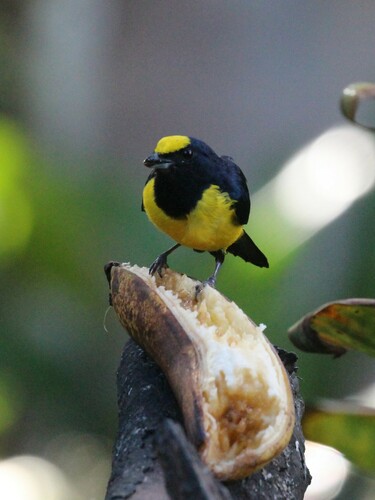 Spot-crowned Euphonia
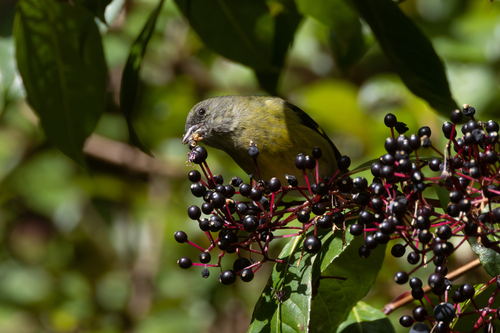 Yellow-bellied Siskin
In short
The most reliable field mark between Spot-crowned Euphonia and Yellow-bellied Siskin is the head and wing pattern, especially in males: male euphonias show a bright yellow, black-spotted forehead, while male siskins have a glossy all-black head and upperparts with no yellow on the crown. In flight or perched, siskins of all ages show extensive yellow in the wings and tail, which euphonias lack. Females are trickier, but euphonia females have a rufous-chestnut forehead and olive-green upperparts, while female siskins are dull olive-green with a pale supercilium and yellow in the wings. Juvenile siskins have pale buff wing covert tips and more yellow in the wings than any euphonia. Bill shape and structure also help: euphonias have a stubby, finch-like bill, while siskins have a finer, more pointed bill. Both species occur in Costa Rica and Panama, but siskin is more widespread further south.
Identification tips
- Male head pattern: Male Spot-crowned Euphonia has a bright yellow, black-spotted forehead; male Yellow-bellied Siskin has a glossy all-black head with no yellow. This is the single best field mark for adult males.
- Yellow in wings and tail: Siskins of all ages show bright yellow bases to the primaries, secondaries, and outer tail feathers, visible in flight and often when perched. Spot-crowned Euphonia lacks any yellow in the wings or tail—its yellow is confined to the underparts and forehead (male) or underparts and forehead (female, but rufous-chestnut, not yellow).
- Female forehead color: Female euphonias have a rufous-chestnut forehead, contrasting with the olive-green crown. Female siskins have a dull olive-green head with a pale supercilium and no rufous tones.
- Supercilium in females: Female siskins have a pale supercilium and a dusky eye-stripe, giving a faintly masked look. Female euphonias lack a supercilium and have a plainer face.
- Bill shape: Euphonias have a short, stubby, finch-like bill; siskins have a finer, more pointed bill. This is subtle but visible at close range.
- Underpart color and pattern: Both species have yellow underparts, but male euphonias are bright yellow from the lower breast down, while siskin males have yellow underparts with an olive tinge on the flanks. Female euphonias have tawny-rufous on the lower breast and belly, while female siskins are more uniformly olive-yellow below.
- Upperparts color: Male euphonias are steely blue-black above; male siskins are glossy black. Female euphonias are olive-green above with a grayish blue tinge; female siskins are dull olive-green with thin darker streaks.
- Juvenile wing pattern: Juvenile siskins have pale buff tips to the wing coverts and entirely black tail and flight feathers, plus yellow in the wings and tail. Juvenile euphonias lack these features.
- Wing coverts: Female and juvenile siskins have blackish upperwing coverts with pale yellow or olive-yellow tips; euphonias have dusky coverts with yellowish olive edges (female) but not the same panel effect.
- Tail pattern: Siskins show yellow bases to the outer tail feathers in all plumages; euphonias have a dusky tail with a blue-black tinge and no yellow.
- Flight jizz: Siskins may appear slightly longer and slimmer in flight, with more obvious wing and tail flashes; euphonias are compact and stubby-billed.
- Sexual dimorphism: Both species are sexually dimorphic, but the differences are more striking in euphonias (male's yellow forehead vs. female's rufous-chestnut) than in siskins (male's black vs. female's olive-green head).
- Range context: If seen outside Costa Rica or Panama, siskin is much more likely; euphonia is restricted to these two countries.
- Perched vs. flight views: In perched birds, focus on head and wing pattern; in flight, yellow flashes in wings and tail point to siskin.
- Habitat context: Both species overlap in habitat, so do not rely on habitat alone for separation.
Size
Both species are very close in size, with Spot-crowned Euphonia at about 10 cm and 14 g, and Yellow-bellied Siskin at 10–11.5 cm and 11–14 g. In the hand or at close range, siskins may appear slightly longer and slimmer, but with binoculars, size is not a reliable separator.
Plumage
-
Juveniles/immatures: Juvenile Yellow-bellied Siskins resemble adult females but can be picked out by their entirely black tail and flight feathers, and pale buff tips to the wing coverts. Juvenile euphonias are not described in detail, but would lack the siskin's strong yellow wing and tail panels.
-
Adult males: Spot-crowned Euphonia males have a bright yellow, black-spotted forehead and blue-black upperparts, with no yellow in the wings or tail. Yellow-bellied Siskin males are glossy black above with no yellow on the head, but show bold yellow bases to the primaries, secondaries, and outer tail feathers.
-
Adult females: Female euphonias have a rufous-chestnut forehead, olive-green crown and upperparts, and yellowish olive edges to the flight feathers, but no bright yellow wing patches. Female siskins are dull olive-green with a pale supercilium, blackish wings with pale yellow or olive-yellow tips to the coverts, and yellow bases to the flight feathers and tail.
-
In flight: Siskins of all ages show obvious yellow in the wings and tail; euphonias do not.
Behaviour
No strong behavioral differences are described in the notes. Both are small, active finch-like birds, often seen foraging in trees or shrubs. Siskins may be more likely to form flocks, especially outside the breeding season, while euphonias are often seen in pairs or small groups. Both species are agile and can be seen feeding on fruit or seeds.
Habitat
Both species occur in Costa Rica and Panama, but siskins range further south into the Andes. Habitat preferences are not strongly differentiated in the notes, but both are found in forested or semi-open areas. Spot-crowned Euphonia may be more closely associated with epiphyte-laden branches for nesting, but this is not a reliable field mark.
Spot-crowned Euphonia · Yellow-bellied Siskin · My Tricky Birds