

Spectacled Guillemot vs Brünnich's Guillemot
Cepphus carbo versus Uria lomvia
Play a quiz with Spectacled Guillemot and Brünnich's Guillemot
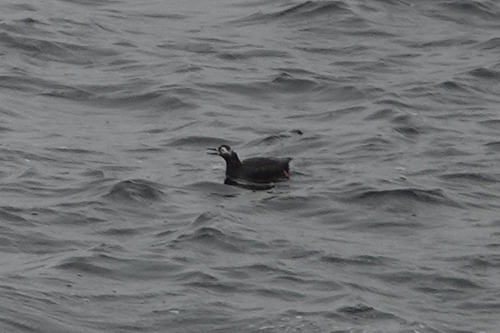 Spectacled Guillemot
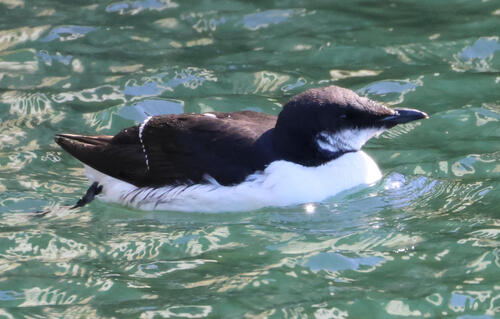 Brünnich's Guillemot
In short
The most reliable field mark to separate Spectacled Guillemot from Brünnich's Guillemot is the presence of bold white 'spectacles' on the face of the Spectacled Guillemot, which are never shown by Brünnich's. In all plumages, Spectacled Guillemot is sooty-black with red legs and a black bill, while Brünnich's Guillemot is larger, with a thicker, pointed bill and a white underpart contrasting with a black head and back. Juvenile and non-breeding plumages can cause confusion, but the unique facial pattern of Spectacled Guillemot remains distinctive. Bill structure and overall size also help, especially at close range or in mixed colonies.
Identification tips
- White spectacles: Only Spectacled Guillemot shows bold white spectacles around the eye in all plumages and ages; Brünnich's Guillemot never shows this feature. This is the single most reliable mark at any distance or season.
- Bill structure: Brünnich's Guillemot has a thick, pointed bill, often with a white gape stripe (especially in adults), while Spectacled Guillemot has a slimmer, black bill with no white gape or bill-stripe. However, first-year Brünnich's may lack a clear gape stripe, so rely on head pattern in young birds.
- Leg color: Spectacled Guillemot has red legs, which can be visible when perched or swimming. Brünnich's Guillemot's leg color is not specified in the sources, but does not show the striking red of Spectacled.
- Body size: Brünnich's Guillemot is much heavier and longer (up to 48 cm and 1,481 g) than Spectacled Guillemot (38 cm, 495 g). When seen together, Brünnich's looks bulkier and longer, but this is less helpful with lone birds or at long range.
- Plumage contrast: Spectacled Guillemot is sooty-black overall in breeding plumage, while Brünnich's is sharply black above and white below. In non-breeding plumage, Spectacled develops white underparts but retains the spectacles, while Brünnich's gets a white lower face but never spectacles.
- Head pattern in immatures: Juvenile and first-year Brünnich's can be tricky, as their bill is smaller and the white gape stripe may be faint or absent. Still, they never show spectacles; look for a plain dark head with a possible faint gape line.
- Tail shape: Brünnich's Guillemot has a small, rounded black tail. No distinctive tail shape is described for Spectacled, so this is not a strong separator.
- Flight jizz: Brünnich's Guillemot has a strong, direct flight with rapid wingbeats. Spectacled's flight is not described, but both are likely similar due to family traits. Size and head pattern are more reliable in flight than flight style.
- Colony context: In large, dense colonies, Brünnich's Guillemot may be present in huge numbers. Spectacled Guillemot's colony size is not described, but it is unlikely to form such vast aggregations.
- Underwing and upperwing pattern: No distinctive upperwing or underwing pattern is described for either species, so do not rely on this feature in flight.
- Vocalizations: Only Brünnich's Guillemot is described as vocal at colonies (harsh cackling); both are silent at sea. This is only useful if you are at a breeding site.
- Seasonal changes: Both species show some seasonal change, but only Spectacled Guillemot keeps the spectacles year-round. Brünnich's gets a white lower face in winter, but never spectacles or a white eye-stripe.
- Sex differences: Both species are sexually monomorphic in plumage, so sex is not a useful separator.
- Juvenile confusion: If faced with a juvenile or first-year bird, always check for spectacles first. If absent, and the bird is large and thick-billed, Brünnich's is likely, but beware that bill size is less reliable in young birds.
- Common pitfalls: The main pitfall is mistaking a non-breeding or juvenile Brünnich's for a Spectacled, especially if viewing conditions are poor. Always prioritize the presence or absence of spectacles, then check bill shape and overall size.
Size
Brünnich's Guillemot is significantly larger and heavier than Spectacled Guillemot. Spectacled Guillemot averages about 495 g in mass and is around 38 cm long. Brünnich's Guillemot is the largest living auk, measuring 40–48 cm in length with a mass ranging from 736–1,481 g (with Pacific birds being largest). This size difference is often visible when both species are seen together, but can be subtle at a distance or when seen singly.
Plumage
-
Juvenile/First-year: Spectacled Guillemot juveniles are separable from adults, but still show the distinctive white spectacles. Brünnich's Guillemot first-years have smaller bills and the white gape stripe is often obscure, making bill-based ID unreliable at this age. Head pattern is the best way to separate them: Brünnich's never shows spectacles, and its face pattern is always more conservative.
-
Adult breeding: Spectacled Guillemot is dull sooty-black overall with bold white spectacles; Brünnich's is black above and white below, with a black head and no spectacles. Brünnich's bill is thick and pointed, sometimes with a white gape stripe, but never a white eye-stripe.
-
Adult non-breeding: Spectacled Guillemot has white underparts tipped pale grey-brown, but the spectacles remain. Brünnich's Guillemot develops a white lower face in winter, but never a spectacle pattern; its underparts remain white, and the upperparts stay black. Transitional Spectacled Guillemots show white scaling on the underparts but keep the facial spectacles.
-
Flight views: No distinctive upperwing pattern is described for either species in the sources, so flight separation relies on body size, bill shape, and the presence/absence of spectacles.
Behaviour
Both species are strong divers and use their wings to swim underwater. Brünnich's Guillemot is noted for its strong, direct flight with rapid wingbeats due to its short wings, and often looks shorter in flight than Common Murre. Spectacled Guillemot's flight style is not detailed in the sources, but it is likely similar given their shared family. Brünnich's Guillemot forms vast breeding colonies, sometimes with over a million birds, while Spectacled Guillemot's colony size is not specified. Both species are silent at sea, but Brünnich's is noisy at colonies.
Habitat
No diagnostic habitat differences are provided in the sources for separating these two species in the field. Both are marine auks and can occur in similar coastal environments.
Voice
Brünnich's Guillemot produces harsh cackling calls at breeding colonies but is silent at sea. No vocalization information is provided for Spectacled Guillemot, so voice is not a reliable separation feature.
Spectacled Guillemot · Brünnich's Guillemot · My Tricky Birds