

Speckled Mousebird vs Village Weaver
Colius striatus versus Ploceus cucullatus
Play a quiz with Speckled Mousebird and Village Weaver
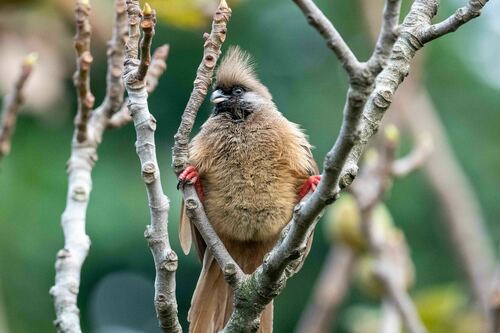 Speckled Mousebird
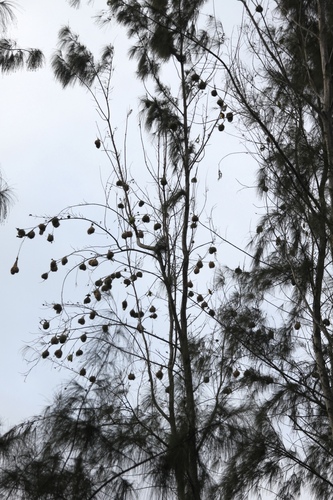 Village Weaver
In short
The most reliable field mark to separate Speckled Mousebird from Village Weaver is overall structure: mousebirds are long-tailed, slim, and crested, while weavers are short-tailed, stocky, and conical-billed. In all ages and seasons, Speckled Mousebird shows a drab, mousy-brown plumage with a long, graduated tail and a small, pointed crest, whereas Village Weaver is brighter, with yellow and black or olive tones, a much shorter tail, and a thick, seed-eater bill. Juvenile Village Weavers can appear dull, but never show the mousebird's elongated silhouette or crest. Both species may be seen in groups, but their flight and perching jizz are strikingly different.
Identification tips
- Tail length and shape: Speckled Mousebird always shows an extremely long, graduated tail (about half its total length), which is obvious both perched and in flight. Village Weaver has a short, square tail.
- Crest: Mousebirds have a small, pointed crest on the head, visible in all ages and postures. Village Weavers never show a crest.
- Bill shape: Mousebird has a short, slightly decurved bill with a black upper and pinkish lower mandible. Village Weaver has a thick, conical, seed-eater's bill, always black in adults.
- Overall shape/jizz: Mousebirds are slim, elongated, and often perch with the body horizontal and tail drooping. Weavers are stocky, upright, and compact.
- Plumage color: Mousebirds are uniformly dull, mousy brown above and below, with subtle speckling and no bright colors. Village Weavers (especially males) are bright yellow and black (breeding), or yellow/olive/grey (nonbreeding/female/juvenile), with strong contrast in the wings.
- Wing pattern in flight: Village Weavers always show contrasting yellow and black in the wings, even in juveniles. Mousebirds have plain brown wings.
- Head pattern: Breeding male Village Weavers have a black head (with chestnut or yellow nape/crown depending on region), never matched by mousebird. Mousebirds have a plain brown head with a crest, sometimes with subtle barring or throat color variation.
- Eye color: Village Weaver adults have dark reddish eyes; mousebird iris color varies by subspecies but is never a strong field mark.
- Group behavior: Mousebirds move in small, tight groups, often clambering through foliage and sunning. Weavers are more likely to be seen in large, noisy colonies, especially near nests.
- Nesting context: Village Weavers build large, woven, hanging nests in colonies. Mousebirds build untidy cup nests, usually less conspicuous.
- Vocalizations: Mousebirds are relatively quiet, with soft warbles and 'tisk-tisk' calls. Weavers are much more vocal, especially in colonies, with loud, chattering calls.
- Habitat context: If seen in dense shrubbery or thickets, mousebird is more likely; open lawns, parks, or trees with hanging nests suggest weaver.
- Juvenile confusion: Young Village Weavers are duller but still show yellow and black in the wings and never have a crest or long tail. Young mousebirds look like adults: brown, crested, long-tailed.
- Flight style: Mousebirds fly with loose, floppy wingbeats and a trailing tail; weavers have rapid, direct flight with a short tail.
- Seasonal variation: Only Village Weaver males show strong seasonal plumage change (breeding vs nonbreeding); mousebirds are always drab brown.
Size
Speckled Mousebird is significantly larger and more elongated, reaching about 35 cm in length (with the tail making up about half of this), and weighing around 57 g [wikipedia]. Village Weaver is much more compact, at 15–17 cm long and about 37.5 g [wikidata]. The mousebird's long tail makes it appear much bigger and more slender, especially in flight or when perched upright. The weaver is noticeably chunkier and shorter-tailed, with a more robust, finch-like build.
Plumage
- Juvenile/Immature: Juvenile Village Weavers resemble adult females, being brownish above with streaked olive upperparts, yellow and black wings, and pale yellow underparts. They never show the uniform, mousy-brown tones or long tail of the mousebird. Juvenile mousebirds are similar to adults: drab brown, long-tailed, and crested, with no strong patterning or bright colors.
- Adult (nonbreeding): Nonbreeding male Village Weavers have a yellow head with an olive crown, grey upperparts, and whitish underparts, but still retain yellow and black in the wings. Speckled Mousebird adults are always dull brown above and below, with a slight speckling and a dark crest, lacking any yellow or black wing markings.
- Adult (breeding): Breeding male Village Weavers are strikingly patterned: black head (with chestnut or yellow on nape/crown depending on region), black and yellow upperparts, and yellow underparts. Mousebirds remain drab brown, with a black upper mandible and pinkish lower mandible, and a prominent crest. No mousebird shows the weaver's black face or yellow plumage.
- Wings in flight: Village Weavers show contrasting yellow and black in the wings (all ages), while mousebirds have uniform brown wings with no strong pattern.
Behaviour
Speckled Mousebirds often move in small, tight groups, clambering acrobatically through foliage, sometimes hanging upside down. They are agile and social, often seen sunning with wings and tail spread. In flight, they appear loose and floppy, with the long tail trailing. Village Weavers are more likely to be seen in noisy, larger colonies, especially around their woven nests. Their flight is strong and direct, with rapid wingbeats and a short, square tail. Perched, weavers look upright and chunky, often in open areas or at feeders.
Habitat
Both species are widespread in sub-Saharan Africa and may overlap in gardens, villages, and woodland edges. However, Village Weavers are especially common in open or semi-open habitats, often near human habitation, and frequently nest colonially in trees in towns and villages. Speckled Mousebirds are more often seen in dense shrubbery, thickets, and gardens, moving through vegetation rather than out in the open.
Voice
Speckled Mousebird is not known for melodious song, but is noisy, giving a warbling 'tsu-tsu' call in flight and a 'tisk-tisk' alarm. Village Weaver is much more vocal, especially in colonies, with a variety of harsh, chattering calls and some song. The difference in vocal activity is especially obvious near weaver colonies.