

Spanish Sparrow vs Cape Verde Sparrow
Passer hispaniolensis versus Passer iagoensis
Play a quiz with Spanish Sparrow and Cape Verde Sparrow
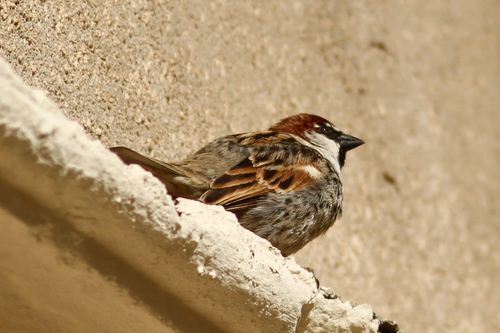 Spanish Sparrow
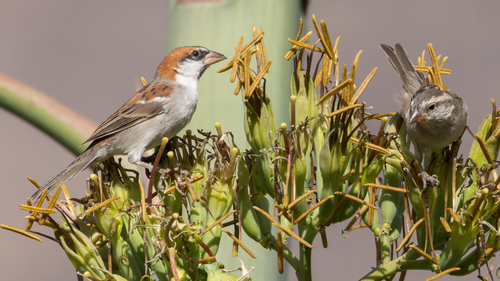 Cape Verde Sparrow
In short
The most reliable field mark between Spanish Sparrow and Cape Verde Sparrow is size: Spanish Sparrow is noticeably larger and bulkier, with a heavier bill, while Cape Verde Sparrow is distinctly smaller and more delicate. For adult males, Spanish Sparrow shows a chestnut crown and heavily streaked underparts, whereas Cape Verde Sparrow males have a blackish crown, bold chestnut and black head stripes, and a much paler, unstreaked underside. Females and immatures are trickier, but Cape Verde Sparrow females and juveniles have a strong, pale supercilium that is more pronounced than in Spanish Sparrow, and a generally greyer, less streaked underside. In flight or at a distance, size and head pattern are your best clues, as both species share similar sparrow-like structure and behavior.
Identification tips
- Size: Spanish Sparrow is noticeably larger and heavier than Cape Verde Sparrow. Use this especially when sparrows are seen together or with known reference species.
- Bill Structure: Spanish Sparrow has a longer, stouter bill, which can be apparent at close range. Cape Verde Sparrow's bill is proportionately smaller and more delicate.
- Adult Male Crown Color: Spanish Sparrow males have a rich chestnut crown; Cape Verde Sparrow males have a black or greyish-black crown and eyestripe, with a contrasting cinnamon above the eye.
- Adult Male Cheek and Underparts: Spanish Sparrow males show white cheeks and heavily black-streaked underparts. Cape Verde Sparrow males have pale grey cheeks and underparts, with only a small black bib on the throat and no heavy streaking below.
- Adult Male Head Pattern: Cape Verde Sparrow males have a bold, contrasting head pattern with blackish crown, cinnamon supercilium, and grey nape; Spanish Sparrow males lack the blackish crown and have a more uniform chestnut cap.
- Female and Juvenile Supercilium: Cape Verde Sparrow females and juveniles have a strong, pale supercilium (eyebrow), much more obvious than the subtle or absent supercilium of Spanish Sparrow females.
- Female and Juvenile Underparts: Spanish Sparrow females are more boldly streaked on the sides and back, while Cape Verde Sparrow females are greyer below and less streaked.
- Upperwing/Flight Pattern: No distinctive marks are described for either species, so rely on size and head pattern in flight.
- Plumage Seasonality: Spanish Sparrow males may appear paler-crowned in winter, but the chestnut vs. blackish crown distinction remains. Cape Verde Sparrow males may appear brighter below after fresh moult.
- Vocalizations: Calls are broadly similar; Spanish Sparrow's display call is louder and higher-pitched, while Cape Verde Sparrow's male call is "twangy" or "chew-weep." Use with caution unless very familiar.
- Habitat Context: Spanish Sparrow is found in the Mediterranean and adjacent regions, often in farmland and open woodland. Cape Verde Sparrow is restricted to Cape Verde islands, usually in open, rocky, or semi-arid habitats.
- Urban vs. Rural: Spanish Sparrow can occur in urban areas where House Sparrow is absent; Cape Verde Sparrow avoids dense settlements and is more common in wild or semi-wild areas.
- Hybridization: Spanish Sparrow can hybridize with House Sparrow in some regions, but not with Cape Verde Sparrow, which is isolated on the islands.
- Local Abundance: On Fogo (Cape Verde), Cape Verde Sparrow is the only sparrow and common everywhere; Spanish Sparrow is rare or absent on most Cape Verde islands.
- Pitfalls: Females and juveniles are the most challenging; always look for the strength of the supercilium and overall size. If in doubt, use location and habitat as supporting clues.
Size
Spanish Sparrow is the larger of the two, measuring 15–16 cm in length and weighing 22–36 g. Cape Verde Sparrow is smaller, at 12.5–13 cm long, with a wing length of 5.5–6.9 cm. This size difference is usually evident in direct comparison or when familiar with local sparrow species. Spanish Sparrow also has a slightly longer, stouter bill, which can be a subtle but helpful mark if seen well.
Plumage
- Juveniles and Females: Both species' females and immatures are brown and streaked above, but Cape Verde Sparrow females and young birds are best separated by their large, pale supercilium, which is more distinct than the subtle supercilium of Spanish Sparrow. Spanish Sparrow females are more boldly marked overall but lack the strong supercilium.
- Adult Males: Spanish Sparrow males have a chestnut crown, white cheeks, and heavily black-streaked underparts. Cape Verde Sparrow males have a black or greyish-black crown and eyestripe, a rich cinnamon (chestnut) above the eye, grey nape, and a small black bib on a pale grey, mostly unstreaked underside. The combination of a blackish crown and pale underparts is unique to Cape Verde Sparrow among these two.
- Upperwing Pattern: No distinctive age-specific upperwing or flight marks are described for either species, so separation in flight relies on size and head pattern.
- Seasonal Variation: Spanish Sparrow males may show paler crowns in winter (especially the eastern subspecies), but the chestnut crown vs. blackish crown distinction remains. Cape Verde Sparrow males may appear brighter below and more chestnut on the head in fresh plumage.
Behaviour
Both species are typical sparrows in behavior, foraging on the ground and perching conspicuously. Spanish Sparrow is slightly bulkier and may appear more robust in posture. Both species can be seen in flocks, but Cape Verde Sparrow is more likely to be found in open, rocky, or semi-arid habitats, while Spanish Sparrow prefers moister farmland and open woodland. In areas where they overlap (rarely), Spanish Sparrow may dominate in cultivated or wetter areas.
Habitat
Spanish Sparrow is found across the Mediterranean, southwest and central Asia, and is associated with farmland, open woodland, and sometimes urban areas (especially where House Sparrow is absent). Cape Verde Sparrow is endemic to the Cape Verde islands and occurs in a wide range of open habitats, such as lava plains, rocky hills, and gorges, but avoids dense settlements and richer cultivated areas where Spanish Sparrow or House Sparrow may be present. On Fogo, Cape Verde Sparrow is the sole sparrow and common in all habitats.
Voice
Both species have chirping calls similar to other sparrows. Spanish Sparrow's display call is a loud, high-pitched disyllabic chirp ("chweeng-chweeng"), while Cape Verde Sparrow's male call is described as "twangy" or "chew-weep" and the female's as a more sibilant "chisk." Both have similar alarm calls ("chur-chur-chur"). Differences are subtle and not usually diagnostic in the field unless you are very familiar with both species' repertoires.