

Southern Double-collared Sunbird vs Greater Double-collared Sunbird
Cinnyris chalybeus versus Cinnyris afer
Play a quiz with Southern Double-collared Sunbird and Greater Double-collared Sunbird
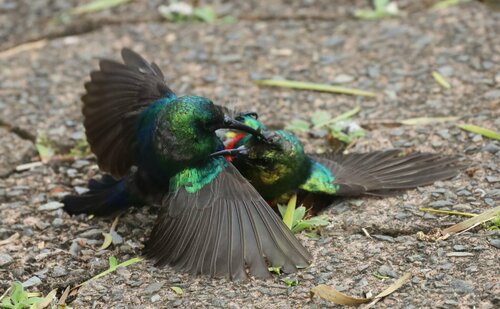 Southern Double-collared Sunbird
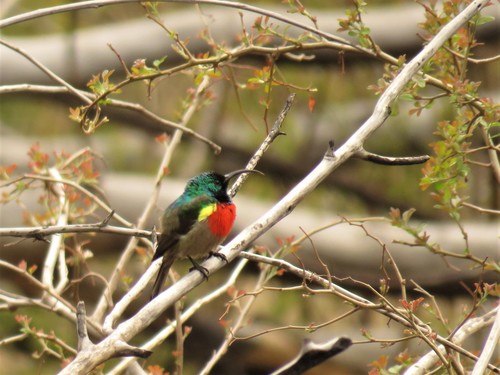 Greater Double-collared Sunbird
In short
The most reliable way to separate Southern Double-collared Sunbird from Greater Double-collared Sunbird is by size and the width of the red chest band in adult males: Southern is distinctly smaller and has a much narrower red band, while Greater is larger with a broader red chest band. Both species share a metallic green head and upperparts, a narrow blue band, and a decurved bill, but the bill is longer in Greater. Females and immatures are much harder to distinguish, but Southern tends to be browner above and greyer below, while Greater is paler grey overall. Structural differences and subtle plumage cues are key, especially outside adult male breeding plumage.
Identification tips
- Red chest band width (adult males): Southern has a noticeably narrower red chest band, while Greater's is broad and bold. This is the single most reliable field mark for adult males in good light.
- Overall size: Southern is smaller and more compact (12 cm, 8 g), while Greater is larger (14 cm) and bulkier. If seen together or with experience, this difference is clear.
- Bill length: Greater has a longer, more prominent decurved bill. In Southern, the bill is shorter and less striking.
- Underparts color (adult males): Southern shows whitish underparts below the red band; Greater's are pale grey. This can be subtle but is useful in good light.
- Female/juvenile color: Southern females/juveniles are brown above and yellowish-grey below, tending greyer below than Orange-breasted Sunbird and darker than Dusky Sunbird. Greater females are paler grey overall with darker wings. Use this cautiously, as overlap and light can obscure differences.
- Yellow shoulder tufts: Both species show yellow tufts when displaying, so this is not helpful for separation.
- Eye, bill, legs, and feet: All are dark in both species; not useful for separation.
- Flight style: Both have fast, direct flight on short wings; not a separator.
- Song and call: Southern gives a 'chee-chee' call and a high-pitched, tinkling song; Greater's call is 'chut-chut-chut' and its song is a richer jumble of tweets and twitters. These differences are subtle and best used as supporting evidence.
- Habitat and range: Both occur in southern Africa and can overlap. Southern is more likely to be resident, with some partial migration, but this is not a reliable field mark.
- Juvenile/immature plumage: No distinctive upperwing or flight marks are described for either species, so rely on structure and subtle color differences in non-adult males.
- Group size: Southern is more often seen in small groups, Greater in pairs, but this is not a strong separator.
- Context with other sunbirds: Southern female is greyer below than Orange-breasted Sunbird and darker than Dusky Sunbird, which may help in mixed flocks but not for separating from Greater.
- When marks fail: In poor light or with distant/female/immature birds, rely on size and bill length as the most consistent clues.
- Pitfalls: Immature and female birds are very similar; do not rely on chest band color or width in these ages. Always use a combination of size, structure, and subtle color cues.
Size
Southern Double-collared Sunbird is smaller (12 cm, 8 g) compared to Greater Double-collared Sunbird (14 cm, mass not specified but clearly larger in direct comparison). In the field, Southern appears more delicate and compact, while Greater looks bulkier and longer overall. The bill of Greater is also noticeably longer, which can be apparent even at a distance if the birds are side by side.
Plumage
Adult males are best separated by the width of the red chest band: Southern has a much narrower red band, while Greater's is broad and prominent. Both have a metallic green head, throat, and upper breast, separated from the red chest band by a narrow metallic blue line. The underparts of Southern are whitish, while Greater's are pale grey. Displaying males of both species show yellow shoulder tufts. Females and juveniles are more challenging: Southern females are brown above and yellowish-grey below, noticeably greyer than female Orange-breasted Sunbird and darker below than Dusky Sunbird, while Greater females are pale grey with darker wings. Juveniles resemble females in both species, so structural and subtle color differences are most helpful. There are no distinctive age-specific upperwing or flight marks described for either species.
Behaviour
Both species are usually seen singly or in small groups (Southern) or pairs (Greater). Their flight is fast and direct on short wings. Both take nectar primarily by perching, but can hover briefly like hummingbirds. There are no strong behavioral differences highlighted in the sources for field separation.
Habitat
Both species breed in southern Africa and can overlap in range. Southern Double-collared Sunbird is mainly resident, with some partial migration in the northeast of its range. No strong habitat separation is noted in the sources, so context is not a reliable separator.
Voice
Both species have high-pitched, tinkling songs and hard calls. Southern's call is described as a 'chee-chee' and its song as a high-pitched jumble of tinkling notes, rising and falling for 3–5 seconds. Greater's call is a 'chut-chut-chut', and its song is a high-pitched jumble of tweets and twitters, said to be richer than Southern's. In practice, these differences are subtle and may not be diagnostic unless you are very familiar with both.
Southern Double-collared Sunbird · Greater Double-collared Sunbird · My Tricky Birds