

South Polar Skua vs Horned Puffin
Stercorarius maccormicki versus Fratercula corniculata
Play a quiz with South Polar Skua and Horned Puffin
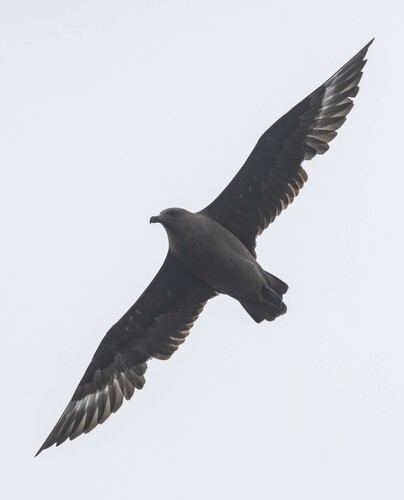 South Polar Skua
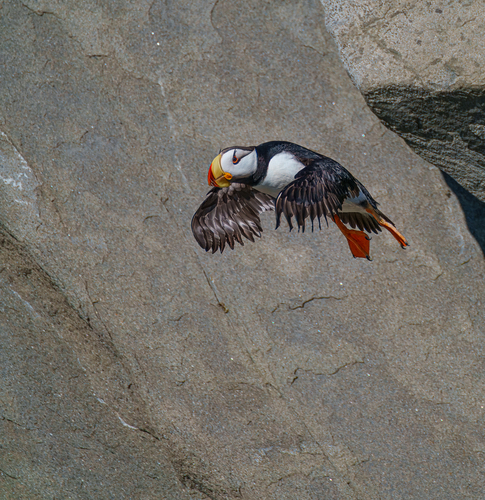 Horned Puffin
In short
The most reliable way to separate South Polar Skua from Horned Puffin is by overall structure and flight style: the skua is a massive, barrel-chested, broad-winged seabird with a powerful, direct flight, while the puffin is compact, short-necked, and flies with rapid wingbeats. In all plumages, the skua appears much larger and more imposing, with a heavy, hooked bill and broad white wing flashes visible in flight. Horned Puffin is instantly recognizable when seen well by its striking black-and-white face, colorful bill, and upright posture on land. Juvenile and dark-morph skuas can be trickier, but even then, the size, structure, and lack of any puffin-like facial pattern are decisive. These two species are so different in shape and behavior that confusion usually only arises at great distance or in poor viewing conditions.
Identification tips
- Size and bulk: South Polar Skua is much larger and bulkier than Horned Puffin; even distant birds show a massive, barrel-chested silhouette compared to the puffin's compact, short-necked shape. This is true for all ages and plumages.
- Flight style: Skuas fly with strong, direct wingbeats and glide on broad wings, while puffins have rapid, whirring wingbeats and a more fluttery, low flight. Puffins rarely soar; skuas often do.
- Bill shape and color: Skuas have a heavy, hooked bill (blue at the base in juveniles/dark morphs), never colorful. Puffins have a huge, laterally compressed bill that is bright red and yellow in adults (breeding), with a yellow wattle and black 'horn' above the eye.
- Facial pattern: Puffins always show a striking white face with a black cap and dark eyestripe, plus a fleshy black 'horn' in adults. Skuas never show any white on the face or bill, regardless of age or morph.
- Wing pattern in flight: Skuas (all ages) show broad white flashes in the primaries, visible from above and below. Puffins have entirely dark upperwings with no white, and white only on the underparts.
- Leg color: Puffins have bright orange legs and feet in breeding season, fading to pale in eclipse. Skuas have dark legs year-round.
- Posture on land: Puffins stand upright, almost penguin-like, and walk or climb with ease. Skuas are more horizontal and rarely stand upright.
- Juvenile confusion: Juvenile puffins have smoky-gray cheeks and a small, dark bill but still show a contrasting face. Juvenile/dark-morph skuas are cold brown with no facial pattern, and a blue bill base.
- Breeding vs non-breeding plumage: Puffins lose their bright bill colors and orange legs in eclipse but retain the white face and black cap. Skuas show less seasonal change, with only subtle differences between morphs.
- Behavior: Skuas are often seen chasing or harassing other seabirds, using brute force. Puffins are more likely to be seen diving for fish or gathering in noisy colonies.
- Habitat context: Puffins are usually seen near coastal cliffs or islands in the North Pacific, while skuas are more pelagic and Southern Ocean-based, though vagrants can occur.
- No overlap in range: If seen in the North Pacific near puffin colonies, the bird is almost certainly a puffin. Skuas are rare vagrants in these areas.
- No voice confusion: No similar calls are described, so vocalization is not a useful field mark here.
- On water: Puffins sit low in the water, often in groups, and show a white face and colorful bill. Skuas sit higher, appear bulkier, and have a plain brown or grayish head and body.
- Pitfalls: At great distance, a puffin's dark upperparts and white face can be misread as a pale-headed skua, but the bill shape, size, and structure are always different.
Size
South Polar Skua is more than twice as heavy as Horned Puffin (1349 g vs 637 g) and much longer (about 53 cm vs 20 cm). The skua has a massive, barrel-chested body and broad wings, giving it a bulky, powerful appearance both at rest and in flight. In contrast, Horned Puffin is compact, short-necked, and squat, with a much smaller body and proportionally shorter wings. Even at a distance, the skua's size and bulk are apparent, especially when seen alongside other seabirds.
Plumage
There is no overlap in age-specific wing pattern between these two: South Polar Skua (all ages) shows broad white flashes in the primaries, most visible in flight, while Horned Puffin lacks any white in the wing and is entirely dark above except for its white face. Juvenile and dark-morph skuas are overall cold brown with a blue bill base, lacking any facial markings or bright colors. Adult skuas (pale or intermediate morphs) show a contrasting pale head and darker body, but never any white face or bill coloration. Horned Puffin adults are unmistakable in breeding plumage, with a white face, black cap, and a large, colorful bill (red and yellow with a yellow wattle and black 'horn' above the eye). In eclipse (non-breeding) plumage, the puffin's bill dulls and the face becomes grayish, but the basic black-and-white head pattern remains. Juvenile puffins have smoky-gray cheeks and a small, dark bill, but still show a contrasting face unlike any skua. On the water or land, the puffin's orange legs and feet are obvious, while skuas have dark legs.
Behaviour
South Polar Skua is a powerful, direct flier, often seen harassing other seabirds for food with brute force rather than agility. It spends most of its time flying or loafing at sea, rarely coming to land except to breed. Horned Puffin is extremely agile underwater, using its wings to 'fly' beneath the surface while chasing fish. In flight, puffins have rapid, whirring wingbeats and a low, direct trajectory. On land, puffins walk upright and climb rocks with ease, often gathering in dense colonies. Skuas rarely walk upright and never show the upright, penguin-like stance of puffins.
Habitat
South Polar Skua is a circumpolar Southern Ocean species, but vagrants can appear in northern oceans. It is always associated with open sea or remote breeding grounds. Horned Puffin is strictly North Pacific, breeding on coastal cliffs and islands from Alaska to Siberia, and is often seen near colonies or at sea. Puffins are most often seen close to land during the breeding season, while skuas are more pelagic and rarely come close to shore except at nesting sites.