

South African Shelduck vs Australian Shelduck
Tadorna cana versus Tadorna tadornoides
Play a quiz with South African Shelduck and Australian Shelduck
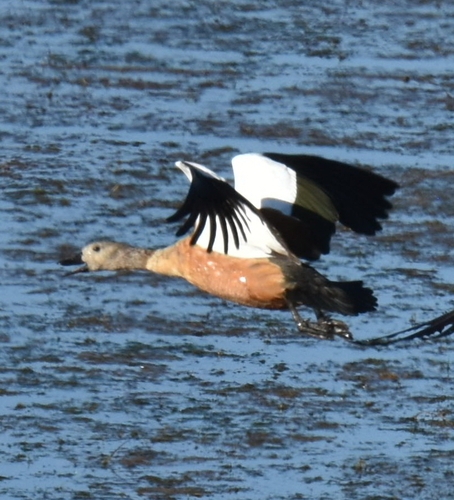 South African Shelduck
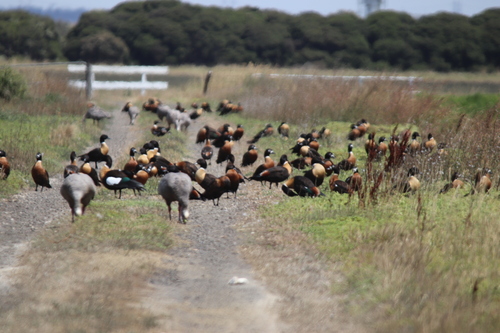 Australian Shelduck
In short
The most reliable way to separate South African Shelduck from Australian Shelduck is by head pattern and body color, especially in adult males: South African males have a grey head, while Australian males show a dark green head with a distinct white neck collar. Females of both species have white facial markings, but the pattern and extent differ, and juvenile plumages can be confusing. In flight, both show black, white, and green on the wings, but the overall body color and head pattern are still helpful. Size is broadly similar, but South African Shelduck is slightly heavier on average. Vocalizations differ, but may be hard to distinguish at distance.
Identification tips
- Adult male head color: South African Shelduck males have a plain grey head, while Australian Shelduck males have a dark green head with a clear white neck collar. This is the single best mark for adult males.
- Adult female face pattern: South African Shelduck females have a white face with a black crown, nape, and neck sides. Australian Shelduck females show white around the eyes but not a full white face, and are smaller overall.
- Juvenile confusion: Juvenile South African Shelduck females lack the adult's white head, showing only white eye circles, while juvenile Australian Shelduck females have much more white on the face except the crown. Juvenile males of both are duller, but Australian Shelduck males lack the white collar entirely.
- Chestnut breast: Australian Shelduck of both sexes has a striking chestnut-colored breast and black body, while South African Shelduck is generally more ruddy or orange-brown overall.
- Wing pattern in flight: Both species show black, white, and green on the wings, with a green speculum and some white visible in flight. This is not a reliable separator between the two, but helps rule out other ducks.
- Body size and shape: Both are large, robust, goose-like ducks. South African Shelduck is slightly heavier on average, but this is not a field mark.
- Neck collar: The white neck collar is a key feature of adult male Australian Shelduck and is absent in South African Shelduck males.
- Female head pattern variability: South African Shelduck females can become almost fully white-headed with age, while Australian Shelduck females retain white around the eyes but not the entire head.
- Vocalizations: If heard well, female South African Shelduck gives a sharp 'hark,' while Australian Shelduck female gives a high-pitched 'zeek, zeek.' Males of both give deep honks, so are less useful for separation.
- Geographic range: If seen in southern Africa, it is almost certainly South African Shelduck; in Australia, Australian Shelduck. However, beware of escapes in collections.
- Hybrid confusion in captivity: Both species can hybridize with other orange-plumaged shelducks in captivity, which may complicate identification in collections.
- Downy young: Australian Shelduck ducklings are white with a brown crown and brown stripes from crown to tail. South African Shelduck young are described as duller but not in detail; this is not a reliable field separator.
- Sexual dimorphism: Both species show some sexual dimorphism, but the head and neck pattern is the most reliable for separating males and females within each species, and between species.
- Plumage variability: South African Shelduck females show increasing white on the head with age, sometimes becoming almost fully white-headed, which can be confusing. Always check for the black crown and nape.
- Contextual clues: When in doubt, prioritize head and neck pattern, then overall body color, and use voice or range as supporting evidence.
Size
Both species are large, goose-like ducks, but South African Shelduck averages slightly heavier (about 1587.5g vs. 1425g for Australian Shelduck) [wikidata]. Length is similar, with South African Shelduck around 64 cm and Australian Shelduck ranging from 56–72 cm [wikipedia]. In the field, size alone is not a reliable separator, as there is overlap and both are robust, long-necked waterfowl.
Plumage
Juvenile and immature birds are the most challenging: both are duller than adults, but juvenile South African Shelducks lack the adult's strong head pattern, with young females missing the white head (except for eye circles), while juvenile Australian Shelduck males lack the white collar and are generally duller, and juvenile females have extensive white on the face except the crown. Adult males are more straightforward: South African Shelduck males have a grey head, while Australian Shelduck males have a dark green head and a striking white neck collar. Adult females of both show white facial markings, but South African females have a white face with a black crown, nape, and neck sides, whereas Australian females have white around the eyes and a smaller overall size. Both species show chestnut and black on the wings with a green speculum and some white in flight, but Australian Shelduck is noted for a more striking chestnut breast and black body overall. In flight, both can look similar, but head and neck patterns remain the best clues if visible.
Behaviour
Both species are typically seen in pairs or small groups, often grazing near water or swimming. Australian Shelducks are known to nest in tree holes or banks and their young may gather in large crèches, but this is not a field mark for separating adults. Both are strong fliers and may be seen flying in loose flocks. No strong behavioral differences are noted for field separation.
Habitat
South African Shelduck is native to southern Africa, breeding mainly in Namibia and South Africa, while Australian Shelduck is endemic to Australia. Both favor open wetlands, lakes, and grasslands near water. Habitat alone is not diagnostic unless you are outside the natural range of one species.
Voice
Both species' males give a deep honking call, but the female calls differ: South African Shelduck females give a louder, sharper 'hark,' while Australian Shelduck females have a high-pitched, penetrating 'zeek, zeek.' These differences are subtle and may be hard to use unless the birds are calling distinctly and at close range.
South African Shelduck · Australian Shelduck · My Tricky Birds