

Motmot

South African Shelduck vs African Pygmy-Goose

Tadorna cana versus Nettapus auritus

Play a quiz with South African Shelduck and African Pygmy-Goose
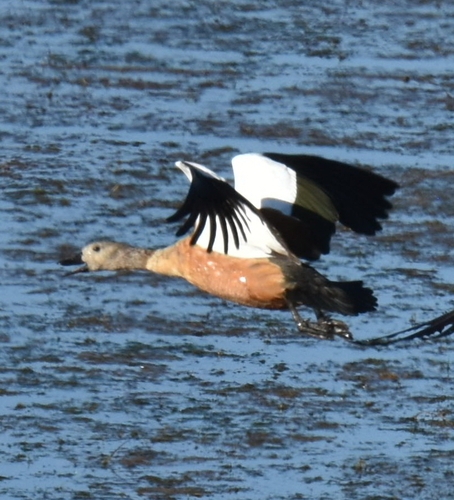
South African Shelduck (Tadorna cana) South African Shelduck
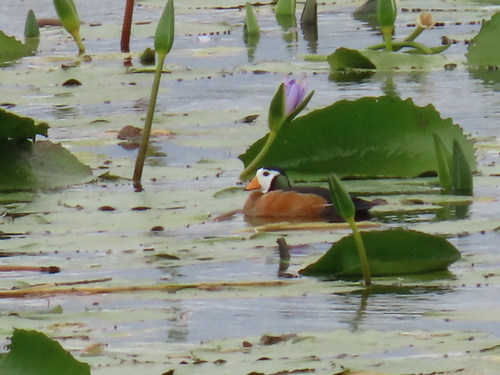
African Pygmy-Goose (Nettapus auritus) African Pygmy-Goose

Media

Loading…

In short

Size and structure are the most reliable field marks: South African Shelduck is a large, heavy-bodied duck with a long neck and upright stance, while African Pygmy-Goose is tiny, compact, and short-necked. In flight or on water, the shelduck’s size and bulk are unmistakable beside the pygmy-goose’s petite, almost teal-like jizz. Adult plumage is also distinctive: shelducks show a ruddy body with bold black, white, and green wing pattern, while pygmy-geese are intricately marked with metallic greens, chestnut flanks, and white faces (males) or gray faces (females). Juvenile and female plumages can be confusing, but even then, size and structure are decisive. Habitat overlap is possible, but pygmy-geese are more often seen among water lilies in smaller wetlands, while shelducks prefer open water and larger bodies.

Identification tips

  1. Size is decisive: South African Shelduck is more than five times heavier than African Pygmy-Goose. Even at a distance, the shelduck’s large, goose-like size and long neck stand out against the pygmy-goose’s tiny, teal-like build. This holds for all ages and sexes.
  2. Structure: Shelducks are upright, long-necked, and heavy-bodied, with a strong, broad bill. Pygmy-geese are compact, short-necked, and have a short, stubby bill that rises onto the forehead, giving a 'toy goose' look.
  3. Adult male head pattern: Shelduck males have a plain grey head; pygmy-goose males have a white face with black eye patches and metallic green ear patches, plus a black crown. The pygmy-goose’s face is much more patterned and colorful.
  4. Adult female head pattern: Shelduck females have a white face with a black crown and nape, but young females may show only white eye-circles. Pygmy-goose females have a gray face with a brown eye-stripe and brown cheek/nape patches, lacking the stark white of older shelduck females. Look for the overall face contrast and extent of white.
  5. Juvenile confusion: Juvenile shelducks are duller but still large and ruddy, with variable white on the face. Juvenile pygmy-geese are much paler-faced, with a black V-shaped crown and white flanks/rump. The pygmy-goose juvenile’s face pattern is unique among small ducks.
  6. Wing pattern in flight: Shelducks show a bold, blocky pattern of black, white, and green on the wings, visible in all ages. Pygmy-geese show a white bar on the secondaries but otherwise dark wings, and their small size and rapid wingbeats are distinctive.
  7. Body color: Shelducks have a rich ruddy (orange-brown) body; pygmy-geese have chestnut flanks, a white belly, and a metallic green back (males), or dark brown back (females).
  8. Bill color: Shelduck bills are dark and strong; pygmy-goose males have a yellow bill with a black tip, while females have a yellow lower mandible and mottled brown upper mandible with a dark tip.
  9. Tail: Shelduck tails are proportionally short and broad; pygmy-geese have a relatively longer, pointed tail for their size, with 16 black feathers.
  10. Habitat context: If among dense water lilies or floating vegetation, pygmy-goose is more likely; on open water or grazing shores, suspect shelduck.
  11. Behavior: Pygmy-geese are quick, agile, and often hidden among lilies; shelducks are slower, more exposed, and often graze or swim in the open.
  12. Vocalization: If you hear a deep honk or sharp 'hark,' it’s likely a shelduck. Pygmy-goose calls are less well known and not described here.
  13. Group size: Both can be in pairs or small groups, but large gatherings on open water are more typical of shelduck.
  14. Sexual variation: Shelduck females’ head pattern changes with age, from minimal white (young) to almost fully white-headed (old), so don’t rely solely on face color for sexing or aging.
  15. Confusion with other species: Shelducks in flight can resemble Egyptian Geese, but pygmy-geese are unlikely to be confused with anything except perhaps small teal, and only at a great distance.

Size

South African Shelduck is dramatically larger: about 64 cm in length and weighing around 1587.5 g [wikidata], making it goose-sized and imposing. African Pygmy-Goose is one of Africa’s smallest waterfowl, weighing only 260–285 g and measuring about 27–30 cm in length (wing length 142–165 mm) [wikipedia]. Even at a distance, the shelduck’s bulk, long neck, and heavy body contrast sharply with the pygmy-goose’s tiny, round-bodied, short-necked appearance. If seen together, the pygmy-goose looks almost like a duckling or teal beside the shelduck.

Plumage

Juvenile/immature plumages: Juvenile South African Shelducks are duller than adults, lacking the bold contrast and with less white on the female’s head (sometimes only eye-circles). Young female shelducks can be confused with duller waterfowl, but still show the ruddy body and developing wing pattern. Juvenile African Pygmy-Geese have a white face with black patterning, a dark gray eye patch, and a black V-shaped crown, with a white rump and flanks, and black back and tail. Their underparts are pale gray to white, and the wings are black. These juvenile patterns are quite different: pygmy-goose juveniles are much paler and more patterned on the face, while shelduck juveniles are overall duller but still structurally large and ruddy.

Adult males: South African Shelduck males have a grey head, ruddy body, and strikingly marked wings (black, white, green). African Pygmy-Goose males have a white face with black eye patches, metallic green ear patches, black crown, chestnut flanks, and a yellow bill with black tip. The shelduck’s wing pattern is bold and blocky; the pygmy-goose’s is intricate with metallic green and a white bar on the secondaries.

Adult females: Shelduck females have a white face with a black crown, nape, and neck sides; the extent of white increases with age and can become almost fully white-headed. Young females may lack most white except eye-circles. Pygmy-goose females have a gray face with a dark brown eye stripe, brown cheek and nape patches, and a dark brown crown and back of neck, with chestnut flanks and a white belly. The pygmy-goose female is much more patterned and less starkly white-faced than even young shelduck females.

In flight: Shelducks show a large, broad-winged profile with bold black, white, and green wing pattern. Pygmy-geese in flight are fast, compact, and show a white bar on the secondaries but otherwise dark wings, with a much smaller, rounder shape.

Behaviour

South African Shelducks are often seen in pairs or small groups, swimming or grazing on open ground, and are relatively approachable. They have a stately, upright posture and move with a slow, deliberate gait. African Pygmy-Geese are much more secretive and agile, usually in pairs or small groups among floating vegetation, especially water lilies. They are quick to flush and fly with rapid, whirring wingbeats, often landing back among lilies. Their feeding is mostly on seeds of water lilies, and they spend much time hidden among floating leaves.

Habitat

South African Shelduck favors open water bodies, lakes, dams, and large wetlands, often in more open country. African Pygmy-Goose prefers smaller, slow-flowing or stagnant water with abundant floating vegetation, especially water lilies, and is more likely in densely vegetated or partially shaded wetlands. While both can occur in southern Africa, pygmy-geese are more tied to lily-covered pools and quieter waters, whereas shelducks are more likely on open, exposed water.

Voice

South African Shelduck males give a deep honk or 'hoogh' call, while females have a sharper, louder 'hark.' African Pygmy-Goose vocalizations are not described in the provided notes, so are not reliably diagnostic here.

Submit a better description

Use the same sections as the comparison. Your text is published immediately.

Size and structure are the most reliable field marks: South African Shelduck is a large, heavy-bodied duck with a long neck and upright stance, while African Pygmy-Goose is tiny, compact, and short-necked. In flight or on water, the shelduck’s size and bulk are unmistakable beside the pygmy-goose’s petite, almost teal-like jizz. Adult plumage is also distinctive: shelducks show a ruddy body with bold black, white, and green wing pattern, while pygmy-geese are intricately marked with metallic greens, chestnut flanks, and white faces (males) or gray faces (females). Juvenile and female plumages can be confusing, but even then, size and structure are decisive. Habitat overlap is possible, but pygmy-geese are more often seen among water lilies in smaller wetlands, while shelducks prefer open water and larger bodies.

  1. Size is decisive: South African Shelduck is more than five times heavier than African Pygmy-Goose. Even at a distance, the shelduck’s large, goose-like size and long neck stand out against the pygmy-goose’s tiny, teal-like build. This holds for all ages and sexes.
  2. Structure: Shelducks are upright, long-necked, and heavy-bodied, with a strong, broad bill. Pygmy-geese are compact, short-necked, and have a short, stubby bill that rises onto the forehead, giving a 'toy goose' look.
  3. Adult male head pattern: Shelduck males have a plain grey head; pygmy-goose males have a white face with black eye patches and metallic green ear patches, plus a black crown. The pygmy-goose’s face is much more patterned and colorful.
  4. Adult female head pattern: Shelduck females have a white face with a black crown and nape, but young females may show only white eye-circles. Pygmy-goose females have a gray face with a brown eye-stripe and brown cheek/nape patches, lacking the stark white of older shelduck females. Look for the overall face contrast and extent of white.
  5. Juvenile confusion: Juvenile shelducks are duller but still large and ruddy, with variable white on the face. Juvenile pygmy-geese are much paler-faced, with a black V-shaped crown and white flanks/rump. The pygmy-goose juvenile’s face pattern is unique among small ducks.
  6. Wing pattern in flight: Shelducks show a bold, blocky pattern of black, white, and green on the wings, visible in all ages. Pygmy-geese show a white bar on the secondaries but otherwise dark wings, and their small size and rapid wingbeats are distinctive.
  7. Body color: Shelducks have a rich ruddy (orange-brown) body; pygmy-geese have chestnut flanks, a white belly, and a metallic green back (males), or dark brown back (females).
  8. Bill color: Shelduck bills are dark and strong; pygmy-goose males have a yellow bill with a black tip, while females have a yellow lower mandible and mottled brown upper mandible with a dark tip.
  9. Tail: Shelduck tails are proportionally short and broad; pygmy-geese have a relatively longer, pointed tail for their size, with 16 black feathers.
  10. Habitat context: If among dense water lilies or floating vegetation, pygmy-goose is more likely; on open water or grazing shores, suspect shelduck.
  11. Behavior: Pygmy-geese are quick, agile, and often hidden among lilies; shelducks are slower, more exposed, and often graze or swim in the open.
  12. Vocalization: If you hear a deep honk or sharp 'hark,' it’s likely a shelduck. Pygmy-goose calls are less well known and not described here.
  13. Group size: Both can be in pairs or small groups, but large gatherings on open water are more typical of shelduck.
  14. Sexual variation: Shelduck females’ head pattern changes with age, from minimal white (young) to almost fully white-headed (old), so don’t rely solely on face color for sexing or aging.
  15. Confusion with other species: Shelducks in flight can resemble Egyptian Geese, but pygmy-geese are unlikely to be confused with anything except perhaps small teal, and only at a great distance.

South African Shelduck is dramatically larger: about 64 cm in length and weighing around 1587.5 g [wikidata], making it goose-sized and imposing. African Pygmy-Goose is one of Africa’s smallest waterfowl, weighing only 260–285 g and measuring about 27–30 cm in length (wing length 142–165 mm) [wikipedia]. Even at a distance, the shelduck’s bulk, long neck, and heavy body contrast sharply with the pygmy-goose’s tiny, round-bodied, short-necked appearance. If seen together, the pygmy-goose looks almost like a duckling or teal beside the shelduck.

Juvenile/immature plumages: Juvenile South African Shelducks are duller than adults, lacking the bold contrast and with less white on the female’s head (sometimes only eye-circles). Young female shelducks can be confused with duller waterfowl, but still show the ruddy body and developing wing pattern. Juvenile African Pygmy-Geese have a white face with black patterning, a dark gray eye patch, and a black V-shaped crown, with a white rump and flanks, and black back and tail. Their underparts are pale gray to white, and the wings are black. These juvenile patterns are quite different: pygmy-goose juveniles are much paler and more patterned on the face, while shelduck juveniles are overall duller but still structurally large and ruddy.

Adult males: South African Shelduck males have a grey head, ruddy body, and strikingly marked wings (black, white, green). African Pygmy-Goose males have a white face with black eye patches, metallic green ear patches, black crown, chestnut flanks, and a yellow bill with black tip. The shelduck’s wing pattern is bold and blocky; the pygmy-goose’s is intricate with metallic green and a white bar on the secondaries.

Adult females: Shelduck females have a white face with a black crown, nape, and neck sides; the extent of white increases with age and can become almost fully white-headed. Young females may lack most white except eye-circles. Pygmy-goose females have a gray face with a dark brown eye stripe, brown cheek and nape patches, and a dark brown crown and back of neck, with chestnut flanks and a white belly. The pygmy-goose female is much more patterned and less starkly white-faced than even young shelduck females.

In flight: Shelducks show a large, broad-winged profile with bold black, white, and green wing pattern. Pygmy-geese in flight are fast, compact, and show a white bar on the secondaries but otherwise dark wings, with a much smaller, rounder shape.

South African Shelducks are often seen in pairs or small groups, swimming or grazing on open ground, and are relatively approachable. They have a stately, upright posture and move with a slow, deliberate gait. African Pygmy-Geese are much more secretive and agile, usually in pairs or small groups among floating vegetation, especially water lilies. They are quick to flush and fly with rapid, whirring wingbeats, often landing back among lilies. Their feeding is mostly on seeds of water lilies, and they spend much time hidden among floating leaves.

South African Shelduck favors open water bodies, lakes, dams, and large wetlands, often in more open country. African Pygmy-Goose prefers smaller, slow-flowing or stagnant water with abundant floating vegetation, especially water lilies, and is more likely in densely vegetated or partially shaded wetlands. While both can occur in southern Africa, pygmy-geese are more tied to lily-covered pools and quieter waters, whereas shelducks are more likely on open, exposed water.

South African Shelduck males give a deep honk or 'hoogh' call, while females have a sharper, louder 'hark.' African Pygmy-Goose vocalizations are not described in the provided notes, so are not reliably diagnostic here.

Discard your changes?

You have unsaved edits. If you leave now, those changes will be lost.

South African Shelduck · African Pygmy-Goose · My Tricky Birds