
Sora vs Bananaquit
Porzana carolina versus Coereba flaveola
Play a quiz with Sora and Bananaquit
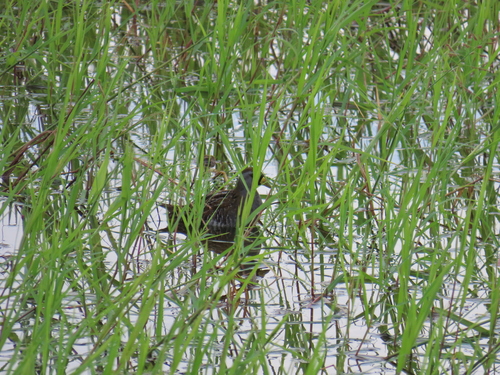 Sora
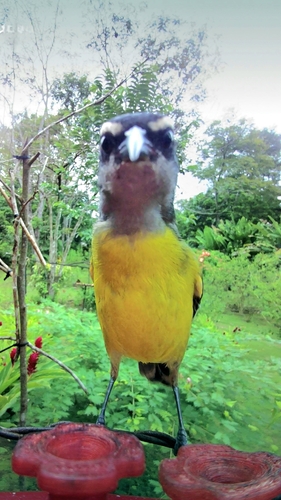 Bananaquit
In short
The most reliable field mark to separate Sora from Bananaquit is overall structure and bill shape: Sora is a small, chunky rail with a short, thick yellow bill, while Bananaquit is a much smaller, slender songbird with a thin, strongly curved bill. Sora shows blue-grey underparts, black-and-white barred flanks, and a black face and throat in adults; Bananaquit is boldly marked with a white eyestripe, black crown, and bright yellow underparts. Juvenile Soras lack the adult's black face and have a buffy breast, but still show a short, thick bill and rail-like shape. These species never overlap in typical habitat: Sora is found in marshes and wetlands, Bananaquit in gardens, parks, and open woodland. Even at a distance, Sora's rail jizz and Bananaquit's warbler-like behavior are clear distinctions.
Identification tips
- Bill shape and size: Sora has a short, thick, yellow bill (rail-like); Bananaquit has a slender, strongly curved bill (nectarivore type). This is visible even at a distance and works for all ages.
- Body size and structure: Sora is much larger, chunky, and short-tailed; Bananaquit is tiny, slim, and more upright. Compare to nearby birds if possible.
- Face pattern: Adult Sora shows a black face and throat with blue-grey cheeks; Bananaquit has a bold white eyestripe and black crown, with no black throat patch. Juvenile Sora lacks the black face but never shows a white eyestripe.
- Underparts color: Sora has blue-grey underparts with black-and-white barred flanks; Bananaquit is bright yellow below, with a white vent. No Sora ever shows yellow underparts.
- Flank pattern: Sora (all ages) has black-and-white barring on the flanks; Bananaquit's flanks are plain yellow.
- Upperparts: Sora is brown above with dark markings; Bananaquit is dark grey to black above, never brown.
- Juvenile confusion: Juvenile Sora lacks black face, has a whitish face and buff breast, but still has rail structure and barred flanks. Juvenile Bananaquit is duller but always shows yellow below and a white eyestripe.
- Legs and feet: Not described in the notes, but Sora's legs are adapted for walking in marshes, Bananaquit's for perching.
- Behavior: Sora walks or swims low in marsh vegetation, rarely perches high; Bananaquit is active, perches in the open, and visits flowers or feeders.
- Habitat context: Sora is only in wetlands or marshes; Bananaquit is in gardens, parks, and forest edges, never in marshes.
- Vocalizations: Sora's loud 'whinny' or 'ker-whee' is unique; Bananaquit does not give rail-like calls.
- Flight style: Not described in detail, but Sora's flight is typically short and weak, low over marsh; Bananaquit is agile and quick in flight between perches.
- Sex differences: Both species are similar between sexes; do not rely on sex for separation.
- Seasonal variation: Sora's plumage is similar year-round; Bananaquit's color varies slightly by subspecies, but always with yellow underparts and white eyestripe.
- Pitfalls: Do not mistake a juvenile Sora's pale face for Bananaquit—check for bill shape, structure, and habitat. Bananaquit's yellow below and white eyestripe are never matched by Sora.
Size
Sora is substantially larger and heavier: adults measure 19–30 cm in length and weigh 49–112 g, with a wingspan of 35–40 cm [wikipedia]. Bananaquit is much smaller, at 10–13 cm long and only 5.5–19 g in weight [wikipedia]. Sora is a chunky, short-tailed marsh bird; Bananaquit is a tiny, slim, active songbird. Even a juvenile Sora dwarfs a Bananaquit.
Plumage
No age-specific upperwing or flight marks are described for either species, but overall plumage is highly diagnostic.
- Adult Sora: dark-marked brown upperparts, blue-grey face and underparts, black-and-white barring on flanks, short thick yellow bill, black face markings at base of bill and throat.
- Juvenile Sora: lacks black facial markings, has a whitish face and buff breast, but still shows brown upperparts and barred flanks.
- Bananaquit (all ages): dark grey to black upperparts, black crown and sides of head, prominent white eyestripe, yellow chest, belly, and rump, white vent, slender curved bill. Juveniles are duller, with partially yellow eyebrows and throat, but always have the white eyestripe and yellow underparts.
Sora never shows a white eyestripe or yellow underparts; Bananaquit never shows blue-grey or brown body, black throat, or barred flanks.
Behaviour
Sora is secretive, usually walking or swimming low in dense marsh vegetation, sometimes venturing into the open near water. It rarely perches above ground. Bananaquit is active, often seen flitting through shrubs, gardens, or trees, perching in the open, and frequently visiting flowers or feeders. Bananaquit never wades or swims. Sora is more often heard than seen, while Bananaquit is conspicuous and tame in human environments.
Habitat
Sora is strictly a marsh and wetland species, found in freshwater or brackish reedbeds and sedge marshes across North America [wikipedia]. Bananaquit is a bird of open and semi-open habitats—gardens, parks, forest edges, and scrub—across the Caribbean, Central, and South America, and is absent from dense forests and high mountains. Sora is never found in gardens or dry habitats, Bananaquit never in marshes.
Voice
Sora gives a distinctive, loud, descending 'whinny' or a slow whistled 'ker-whee' [wikipedia]. Bananaquit's vocalizations are not described in the notes, but it does not give rail-like calls. Sora's calls are unique and, if heard, immediately rule out Bananaquit.