

Motmot

Sooty Shearwater vs Manx Shearwater

Ardenna grisea versus Puffinus puffinus

Play a quiz with Sooty Shearwater and Manx Shearwater
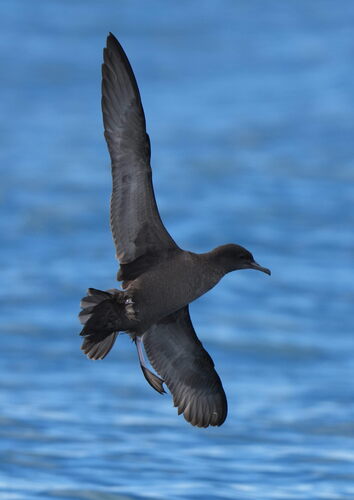
Sooty Shearwater (Ardenna grisea) Sooty Shearwater
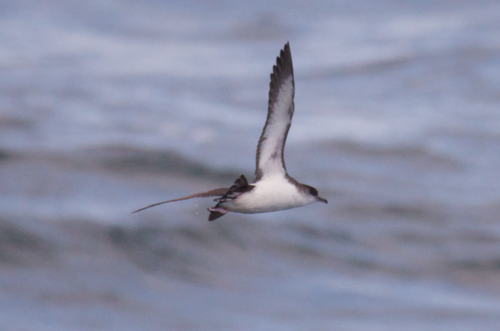
Manx Shearwater (Puffinus puffinus) Manx Shearwater

Media

Loading…

In short

The most reliable field mark for separating Sooty Shearwater from Manx Shearwater is overall plumage: Sooty is uniformly dark chocolate-brown to sooty-black with a silvery underwing stripe, while Manx is sharply black above and white below, creating a striking contrast in flight. Sooty Shearwater can appear all-dark in poor light, but in good conditions, the pale underwing stripe is visible; Manx Shearwater never shows this, always displaying white underparts. Both species fly with stiff, straight wings low over the sea, but Sooty looks larger and more albatross-like, while Manx appears more compact. If you see a shearwater with white underparts, it is not a Sooty; if it is all-dark with a silvery underwing, it is not a Manx.

Identification tips

  1. Underparts color is the fastest check: Sooty Shearwater is all dark below (including belly and underwing coverts) except for a silvery stripe on the underwing; Manx Shearwater is white below, including the belly and underwing coverts. This works for all ages and seasons.
  2. Underwing pattern: Look for the silvery central stripe on Sooty's underwing in good light; Manx never shows this, instead flashing entirely white underwings.
  3. Upperparts: Sooty is uniformly dark brown to sooty-black above; Manx is black above, but this is not diagnostic alone—focus on the contrast with the underparts.
  4. Flight silhouette: Sooty appears longer-winged, more robust, and sometimes albatross-like, with stiff, straight wings; Manx is more compact and often shows a flying cross shape with wings at right angles.
  5. Size: Sooty is significantly larger and longer-winged than Manx, but beware overlap and perspective effects at sea.
  6. Behavior in flocks: Sooty may be seen in huge, dense flocks during migration; Manx usually in smaller groups or singly.
  7. Lighting pitfalls: In poor light, Sooty can look entirely black, but Manx will always show a white belly if seen well. Always try to get a view of the underparts.
  8. Geographic context: In the North Atlantic, any large, all-dark shearwater is almost certainly Sooty; Manx is the only common black-and-white shearwater in this region.
  9. Seasonal context: Manx breeds in the north Atlantic and is common there in summer; Sooty is a passage migrant or vagrant in the same area, mostly seen during migration.
  10. Bill and head structure: Not described as diagnostic in these notes; focus on plumage and flight style.
  11. Voice: Not useful at sea—both are silent away from breeding colonies.
  12. Perched views: Rare at sea, but if seen on land, Sooty will still appear all-dark, Manx will show white underparts.
  13. Juvenile confusion: No age-specific wing or body patterns described that would cause confusion; the same field marks apply to all ages.
  14. Common pitfalls: Do not rely on size alone; always confirm underparts color and underwing pattern. In poor light or distant views, try to see the bird banking to reveal the underwing.
  15. When in doubt: If you cannot see the underparts, do not guess based on flight style or size alone—wait for a better view.

Size

Sooty Shearwater is noticeably larger than Manx Shearwater. Sooty measures 40–51 cm in length with a 94–110 cm wingspan (no mass given), while Manx is 30–38 cm long with a 76–89 cm wingspan and an average adult mass of 521 g [wikipedia][wikidata]. In the field, Sooty appears longer-winged and more robust, with a heavier, more powerful flight style. Manx is more compact and lighter-bodied, which can be apparent when both species are seen together, but size alone is rarely diagnostic at distance.

Plumage

Juvenile and adult Sooty Shearwaters are uniformly dark brown to sooty-black above and below, with a distinctive silvery stripe running along the center of the underwing, visible in good light (all ages) [wikipedia]. In poor conditions, Sooty may look entirely black. Manx Shearwater of all ages shows a classic black-and-white contrast: black upperparts and white underparts, including the underwing coverts, so the bird flashes white below in flight. Manx never shows a silvery underwing stripe or all-dark underparts. There are no age-specific upperwing patterns described for either species that would cause confusion; the key difference is the presence (Sooty) or absence (Manx) of all-dark underparts and the silvery underwing stripe.

Behaviour

Both species exhibit the characteristic 'shearing' flight, gliding low over the sea on stiff wings with minimal flapping and wingtips nearly touching the water [wikipedia]. Sooty Shearwater's flight is described as more powerful and direct, with wings held stiff and straight, giving a small albatross impression. Manx Shearwater also shears, but appears more compact and often shows a flying cross shape, with wings held at right angles to the body. Both are usually silent at sea. Sooty is more likely to be seen in massive flocks during migration, while Manx is often seen singly or in smaller groups.

Habitat

Both species are pelagic and spend most of their lives at sea, only coming to land to breed. Sooty Shearwater breeds in the southern hemisphere (New Zealand, Australia, South Atlantic islands) and migrates into both the Pacific and Atlantic, sometimes in huge numbers [wikipedia]. Manx Shearwater breeds in the north Atlantic (UK, Ireland, Iceland, etc.) and winters in the South Atlantic off South America and Africa. Manx is much more likely near northern European coasts in summer, while Sooty is a passage migrant or vagrant there. In the North Atlantic, Sooty is the only all-dark large shearwater, while Manx is the only common black-and-white shearwater.

Voice

Both species are mostly silent at sea. Sooty Shearwater is vocal at night on breeding grounds, producing loud coos and croaks, but these are not heard at sea. Manx Shearwater also calls at night at colonies but is silent in flight over the ocean. Vocalizations are not useful for field separation at sea.

Submit a better description

Use the same sections as the comparison. Your text is published immediately.

The most reliable field mark for separating Sooty Shearwater from Manx Shearwater is overall plumage: Sooty is uniformly dark chocolate-brown to sooty-black with a silvery underwing stripe, while Manx is sharply black above and white below, creating a striking contrast in flight. Sooty Shearwater can appear all-dark in poor light, but in good conditions, the pale underwing stripe is visible; Manx Shearwater never shows this, always displaying white underparts. Both species fly with stiff, straight wings low over the sea, but Sooty looks larger and more albatross-like, while Manx appears more compact. If you see a shearwater with white underparts, it is not a Sooty; if it is all-dark with a silvery underwing, it is not a Manx.

  1. Underparts color is the fastest check: Sooty Shearwater is all dark below (including belly and underwing coverts) except for a silvery stripe on the underwing; Manx Shearwater is white below, including the belly and underwing coverts. This works for all ages and seasons.
  2. Underwing pattern: Look for the silvery central stripe on Sooty's underwing in good light; Manx never shows this, instead flashing entirely white underwings.
  3. Upperparts: Sooty is uniformly dark brown to sooty-black above; Manx is black above, but this is not diagnostic alone—focus on the contrast with the underparts.
  4. Flight silhouette: Sooty appears longer-winged, more robust, and sometimes albatross-like, with stiff, straight wings; Manx is more compact and often shows a flying cross shape with wings at right angles.
  5. Size: Sooty is significantly larger and longer-winged than Manx, but beware overlap and perspective effects at sea.
  6. Behavior in flocks: Sooty may be seen in huge, dense flocks during migration; Manx usually in smaller groups or singly.
  7. Lighting pitfalls: In poor light, Sooty can look entirely black, but Manx will always show a white belly if seen well. Always try to get a view of the underparts.
  8. Geographic context: In the North Atlantic, any large, all-dark shearwater is almost certainly Sooty; Manx is the only common black-and-white shearwater in this region.
  9. Seasonal context: Manx breeds in the north Atlantic and is common there in summer; Sooty is a passage migrant or vagrant in the same area, mostly seen during migration.
  10. Bill and head structure: Not described as diagnostic in these notes; focus on plumage and flight style.
  11. Voice: Not useful at sea—both are silent away from breeding colonies.
  12. Perched views: Rare at sea, but if seen on land, Sooty will still appear all-dark, Manx will show white underparts.
  13. Juvenile confusion: No age-specific wing or body patterns described that would cause confusion; the same field marks apply to all ages.
  14. Common pitfalls: Do not rely on size alone; always confirm underparts color and underwing pattern. In poor light or distant views, try to see the bird banking to reveal the underwing.
  15. When in doubt: If you cannot see the underparts, do not guess based on flight style or size alone—wait for a better view.

Sooty Shearwater is noticeably larger than Manx Shearwater. Sooty measures 40–51 cm in length with a 94–110 cm wingspan (no mass given), while Manx is 30–38 cm long with a 76–89 cm wingspan and an average adult mass of 521 g [wikipedia][wikidata]. In the field, Sooty appears longer-winged and more robust, with a heavier, more powerful flight style. Manx is more compact and lighter-bodied, which can be apparent when both species are seen together, but size alone is rarely diagnostic at distance.

Juvenile and adult Sooty Shearwaters are uniformly dark brown to sooty-black above and below, with a distinctive silvery stripe running along the center of the underwing, visible in good light (all ages) [wikipedia]. In poor conditions, Sooty may look entirely black. Manx Shearwater of all ages shows a classic black-and-white contrast: black upperparts and white underparts, including the underwing coverts, so the bird flashes white below in flight. Manx never shows a silvery underwing stripe or all-dark underparts. There are no age-specific upperwing patterns described for either species that would cause confusion; the key difference is the presence (Sooty) or absence (Manx) of all-dark underparts and the silvery underwing stripe.

Both species exhibit the characteristic 'shearing' flight, gliding low over the sea on stiff wings with minimal flapping and wingtips nearly touching the water [wikipedia]. Sooty Shearwater's flight is described as more powerful and direct, with wings held stiff and straight, giving a small albatross impression. Manx Shearwater also shears, but appears more compact and often shows a flying cross shape, with wings held at right angles to the body. Both are usually silent at sea. Sooty is more likely to be seen in massive flocks during migration, while Manx is often seen singly or in smaller groups.

Both species are pelagic and spend most of their lives at sea, only coming to land to breed. Sooty Shearwater breeds in the southern hemisphere (New Zealand, Australia, South Atlantic islands) and migrates into both the Pacific and Atlantic, sometimes in huge numbers [wikipedia]. Manx Shearwater breeds in the north Atlantic (UK, Ireland, Iceland, etc.) and winters in the South Atlantic off South America and Africa. Manx is much more likely near northern European coasts in summer, while Sooty is a passage migrant or vagrant there. In the North Atlantic, Sooty is the only all-dark large shearwater, while Manx is the only common black-and-white shearwater.

Both species are mostly silent at sea. Sooty Shearwater is vocal at night on breeding grounds, producing loud coos and croaks, but these are not heard at sea. Manx Shearwater also calls at night at colonies but is silent in flight over the ocean. Vocalizations are not useful for field separation at sea.

Discard your changes?

You have unsaved edits. If you leave now, those changes will be lost.

Sooty Shearwater · Manx Shearwater · My Tricky Birds