

Social Flycatcher vs White-ringed Flycatcher
Myiozetetes similis versus Conopias albovittatus
Play a quiz with Social Flycatcher and White-ringed Flycatcher
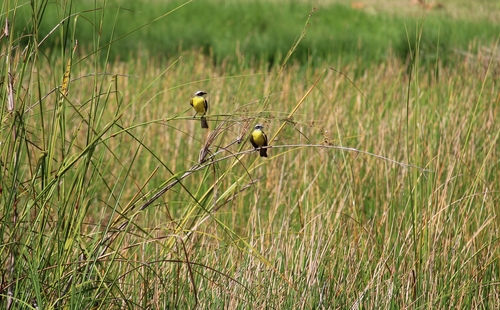 Social Flycatcher
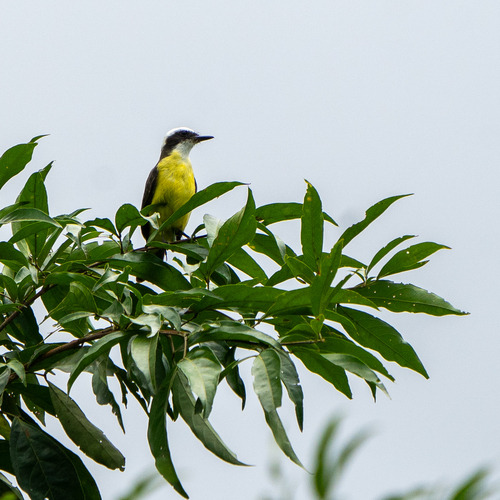 White-ringed Flycatcher
In short
The most reliable field mark to separate Social Flycatcher from White-ringed Flycatcher is the pattern and extent of the white supercilium: Social Flycatcher shows a broad white eyebrow that extends well behind the eye but does not wrap around the nape, while White-ringed Flycatcher has a striking white supercilium that widens behind the eye and nearly encircles the nape. Juvenile birds can be separated by the color of the wing and tail feather edges—Social Flycatcher juveniles have rufous, while White-ringed Flycatcher juveniles show cinnamon and yellowish tones. Structurally, Social Flycatcher is slightly larger and has a shorter, stubbier bill compared to the longer bill of White-ringed. Both species share bright yellow underparts and olive upperparts, but subtle differences in head pattern and wing edging are key. Both are often confused due to similar size and overall color, but careful attention to the supercilium and crown patch (when visible) will resolve most field identifications.
Identification tips
- Supercilium pattern: Social Flycatcher shows a wide white eyebrow that extends well behind the eye but does not wrap around the nape. White-ringed Flycatcher's white supercilium is broader behind the eye and nearly encircles the nape, forming a partial 'ring'—a key field mark in perched birds.
- Head color and crown patch: Social Flycatcher has a dark gray to brownish gray head with a mostly hidden red to orange crown patch (rarely visible except at close range or when raised). White-ringed has a black to sooty brown crown and face, with a hidden lemon- to canary-yellow crown patch (also rarely visible). The crown patch color is not usually a reliable field mark unless the bird is agitated or displaying.
- Juvenile wing and tail edges: Juvenile Social Flycatchers have broad rufous edges on wing and tail feathers, while juvenile White-ringed Flycatchers have cinnamon edges on the wing coverts and rump, and broader yellowish edges on the tertials. This is most reliable in fresh juveniles.
- Bill structure: Social Flycatcher has a short, stubby black bill. White-ringed Flycatcher has a longer, more slender black bill. Bill shape is best judged in profile and with good views.
- Wing bars: Social Flycatcher may show two faint wing bars formed by pale grayish white edges to the coverts, but these are often subtle. White-ringed's wing coverts have pale grayish brown or olive edges, but the effect is less of a bar and more of a diffuse edging.
- Upperparts color: Social Flycatcher is olive-green to brownish olive above, with a slightly grayer hindneck. White-ringed is more grayish olive to olive-brown, sometimes appearing darker or more uniform.
- Underparts: Both species have bright yellow bellies and white throats, but White-ringed's yellow is often described as more 'canary' or intense, especially in fresh plumage. This difference is subtle and not always reliable.
- Tail color: Both have grayish brown tails with pale olive or gray-brown edges. Juvenile tail edges are rufous in Social Flycatcher, cinnamon in White-ringed.
- Iris color: Social Flycatcher has a brown iris, while White-ringed's is blackish. This is only visible at close range.
- Leg color: Both species have black or blackish legs and feet—this is not a useful separation.
- Perched vs. in flight: Most field marks are visible when perched; in flight, look for the extent and color of wing edging in juveniles, and overall size and shape.
- Habitat and range: If seen in open country, edge, or urban areas in Central or South America, Social Flycatcher is much more likely. In humid lowland forest edge, especially in Costa Rica, Panama, or northwest South America, check for White-ringed.
- Group behavior: Social Flycatcher is often seen in small groups or pairs, sometimes quite conspicuous. White-ringed is more often solitary or in pairs.
- Subspecies variation: Social Flycatcher subspecies can differ in size and brightness of underparts, but these differences are subtle and not likely to cause confusion with White-ringed.
- Pitfalls: Both species are easily confused with other large yellow-bellied flycatchers (e.g., Great Kiskadee, Rusty-margined Flycatcher), so always check supercilium shape and head color carefully.
Size
Social Flycatcher is marginally larger, measuring 16–18.5 cm in length and weighing 24–27 g, while White-ringed Flycatcher is 15–16.5 cm and about 24 g. The difference is subtle and not always apparent in the field, but Social Flycatcher may appear slightly bulkier, especially in direct comparison. Bill structure differs: Social Flycatcher has a shorter, stubbier bill, while White-ringed's is longer and more slender. Both sexes are similar in size within each species, but Social Flycatcher subspecies grandis is notably larger than other forms.
Plumage
Juvenile plumage provides the clearest separation: Social Flycatcher juveniles have little or no red on the crown and show broad rufous edges on wing and tail feathers, while White-ringed Flycatcher juveniles lack any yellow on the crown and instead have cinnamon edges on the wing coverts and rump, plus broader yellowish edges on the tertials. In adults, Social Flycatcher has a dark gray to brownish gray head with a mostly hidden red to orange crown patch, a wide white supercilium extending past the eye (but not around the nape), olive to brownish olive upperparts, and faint wing bars. White-ringed Flycatcher adults have a black to sooty brown crown and face with a concealed lemon- to canary-yellow crown patch, a white supercilium that widens and wraps almost around the nape, and upperparts that are more grayish olive to olive-brown. Their wings are dusky and browner than the back, with pale edges that can appear yellowish on the secondaries and tertials. Both species have bright yellow underparts and white throats, but White-ringed's underparts are often described as canary-yellow and may appear slightly brighter.
Behaviour
Both species are typical tyrant flycatchers in behavior, often perching conspicuously and sallying for insects. There are no strongly diagnostic behavioral differences in the notes, but Social Flycatcher is often described as more gregarious and likely to be seen in small groups, while White-ringed Flycatcher is less frequently noted as social. Both may be seen in similar open or edge habitats, and both are active and vocal when present.
Habitat
Social Flycatcher has a much broader range, occurring from Mexico through Central America and into most of South America (except Chile, Guyana, Suriname, and Uruguay), and can be found in a wide variety of semi-open habitats, edges, and even urban areas. White-ringed Flycatcher is more restricted, found from Honduras to Ecuador, mainly in humid lowland forests and edges. In areas of overlap (Central America, northwest South America), Social Flycatcher is generally much more common and widespread, while White-ringed is more localized and tied to forested habitats.
Social Flycatcher · White-ringed Flycatcher · My Tricky Birds