

Snow Goose vs White Ibis
Anser caerulescens versus Eudocimus albus
Play a quiz with Snow Goose and White Ibis
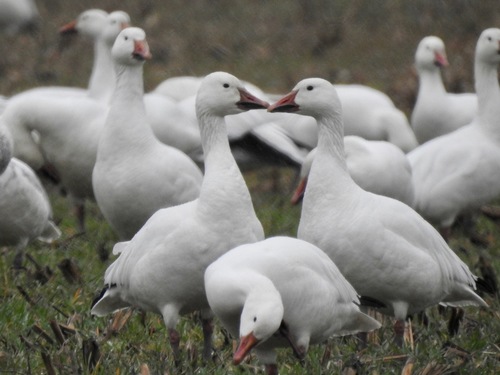 Snow Goose
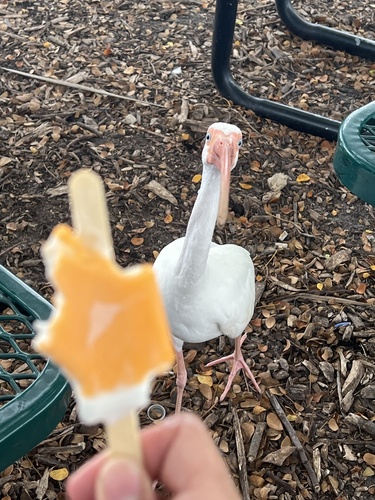 White Ibis
In short
The most reliable field mark to separate Snow Goose from White Ibis is structure: Snow Goose is a bulky, heavy-bodied goose with a short neck and a stout, straight pink bill, while White Ibis is a slimmer, long-legged wader with a long, downcurved red-orange bill. In flight, both show black wingtips contrasting with white wings, but the Snow Goose's black is limited to the primaries and is visible in both morphs, while White Ibis's black wingtips are usually only seen from below or in flight. Immature birds can be confusing: juvenile Snow Geese (especially blue morph) are drab gray with little white, but always have a goose-like shape and pinkish bill; juvenile White Ibis are brown with white underparts and a pale, decurved bill. Habitat and behavior also help: Snow Goose is almost always in flocks on open fields or water, while White Ibis is seen probing in marshes, mudflats, or lawns, often in loose groups.
Identification tips
- Bill shape and color: Snow Goose has a stout, straight pink bill with a black 'grin patch'; White Ibis has a long, slender, downcurved red-orange bill. This is the fastest way to separate them at any age.
- Legs: Both have reddish or pinkish legs as adults, but White Ibis's are longer and more slender, often visible well beyond the tail in flight or when wading.
- Body structure: Snow Goose is compact, heavy-bodied, and short-necked; White Ibis is slim, long-legged, and long-necked, with a more delicate build.
- Flight silhouette: Snow Goose flies with neck retracted and feet barely visible past the tail; White Ibis flies with neck and legs fully outstretched, giving a stretched, heron-like profile.
- Wing pattern in flight: Both show black wingtips contrasting with white wings, but Snow Goose's black is bold and visible from above and below, while White Ibis's black is mostly visible from below and is less extensive.
- Juvenile confusion: Immature Snow Geese (especially blue morph) are grayish with little white, but always have a goose-like shape and short, straight bill. Juvenile White Ibis are brown above with white underparts and a pale, decurved bill.
- Resting posture: Snow Goose sits upright or waddles on land; White Ibis often stands or walks with head down, probing with its bill.
- Head color: Adult Snow Goose (white morph) has a pure white head; blue morph has a white head and neck on a dark body. Adult White Ibis has a white head with pinkish facial skin, and in breeding season, the bill and legs become deep pink or reddish.
- Bill 'grin patch': Only Snow Goose shows a dark 'grin patch' along the cutting edge of the bill, visible at close range.
- Habitat: Snow Goose is found in open fields, lakes, and agricultural land; White Ibis is found in marshes, mudflats, and shallow water, rarely far from wet habitats.
- Group behavior: Snow Geese form dense, noisy flocks; White Ibis are more loosely grouped and quieter.
- Vocalizations: Loud honking from a flock points to Snow Goose; silence or soft grunts suggest White Ibis.
- Feeding behavior: Grazing or dabbling on land or water is typical of Snow Goose; probing in mud or shallow water with a downcurved bill is typical of White Ibis.
- Geographic context: In the southeastern US, both can occur, but White Ibis is much more likely in marshes and urban wetlands, while Snow Goose is more likely in open agricultural areas during migration or winter.
- Seasonal marks: White Ibis bill and legs become brighter in breeding season, but this is subtle compared to the structural differences.
Size
Snow Goose is much heavier and bulkier, with an average adult mass of 2630g compared to White Ibis's 900g. The goose stands taller and appears more robust, with a thick neck and body, while White Ibis is more slender, with long legs and a proportionally smaller body. In direct comparison, Snow Goose looks almost twice as massive and much more compact, while White Ibis is lanky and delicate by contrast.
Plumage
- Juvenile/immature birds: Juvenile Snow Geese (especially blue morph) are slate-gray overall with little or no white on the head, neck, or belly, and have duller pinkish bills and legs. Juvenile White Ibis are mostly brown above with white underparts and rump, and their bill is pale and already decurved, legs grayish turning orange.
- Adults: Adult Snow Goose (white morph) is pure white with black primaries (wingtips), visible at rest and in flight; blue morph adults have bluish-gray body with white head and neck. Adult White Ibis is all white with black wingtips only visible in flight (not at rest), and a red-orange decurved bill and legs.
- In flight: Both species show black wingtips contrasting with white wings, but Snow Goose's black is bold and obvious from above and below, while White Ibis's black is usually only visible from below or at the trailing edge. Snow Goose has a more compact, 'goose-like' wing shape, while White Ibis has longer, narrower wings and flies with neck and legs outstretched.
Behaviour
Snow Geese are highly gregarious, usually seen in large, dense flocks on open fields, lakes, or agricultural land, feeding on grain or grazing. They walk with a waddling gait and rarely probe. White Ibis are also social but often forage in looser groups, walking with a deliberate, probing motion in shallow water, mud, or wet grass, using their long bills to search for prey. In flight, Snow Geese form tight V formations or large swirling flocks, while White Ibis fly in loose lines or Vs, often with undulating or gliding flight and necks outstretched.
Habitat
Snow Goose is found in open habitats: agricultural fields, lakes, and marshes, especially during migration and winter. They avoid wooded or densely vegetated wetlands. White Ibis is a classic wader, frequenting marshes, mudflats, shallow ponds, and even lawns or golf courses near water, especially in the southeastern US and Gulf Coast. Seeing a bird probing in mud or shallow water strongly favors White Ibis; a bird grazing or loafing in a dry field or on open water is almost certainly a Snow Goose.
Voice
Snow Goose is very vocal, with loud, nasal honking calls often heard from flocks even at a distance. White Ibis is generally quiet, rarely vocalizing except for low grunts or croaks at the nest or in flight, and is not likely to be heard at a distance.