

Snow Goose vs Ross's Goose
Anser caerulescens versus Anser rossii
Play a quiz with Snow Goose and Ross's Goose
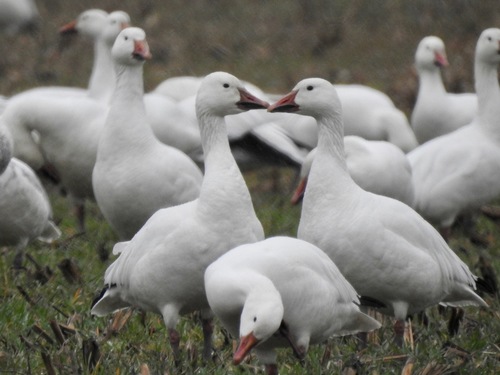 Snow Goose
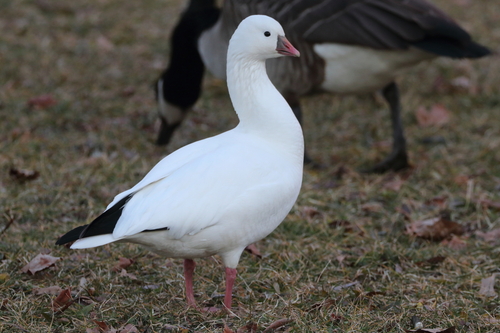 Ross's Goose
In short
The most reliable field mark to separate Snow Goose from Ross's Goose is size and bill structure: Ross's Goose is about 40% smaller and has a noticeably shorter neck and a stubbier, triangular bill without the Snow Goose's prominent black 'grin patch.' In flight, adult Ross's Geese have all-white secondaries, while juvenile Ross's show dark-centered secondaries—a useful mark for young birds. Both species are white with black wingtips in their typical morph, but Snow Goose can also be seen in a dark 'blue' morph, which is extremely rare in Ross's. Careful attention to bill shape, head profile, and overall bulk is essential, especially when birds are seen together or in mixed flocks.
Identification tips
- Size and structure: Ross's Goose is about 40% smaller than Snow Goose. Look for a compact, short-necked, and small-headed bird in Ross's, versus a larger, longer-necked, and more robust Snow Goose. This is most reliable when both species are present for comparison.
- Bill shape and 'grin patch': Snow Goose has a longer, sloping bill with a prominent black 'grin patch' (the dark edge of the bill). Ross's Goose has a short, triangular bill with a bluish base and no obvious 'grin patch.' This is diagnostic at close range.
- Head profile: Ross's Goose has a rounded head, while Snow Goose's head is more wedge-shaped.
- Juvenile secondary feathers: Juvenile Ross's Geese have dark-centered secondaries, visible in flight or when the wing is spread. Adult Ross's have all-white secondaries. Snow Goose juveniles do not show this pattern; their wings are more uniformly pale with black primaries.
- Blue morphs: Blue-morph Snow Geese are common, showing a bluish-gray body with white head and neck. Blue-morph Ross's Geese are extremely rare (<0.01% of adults), so a blue-morph bird is almost certainly a Snow Goose.
- Leg and bill color: Both species have pinkish legs and bills as adults, but Ross's may show a bluish base to the bill and warty structures (especially in older birds). Immature birds of both species have duller colors.
- Neck length: In all postures, Ross's Goose shows a much shorter neck relative to body size than Snow Goose. This is especially apparent when birds are alert or stretching their necks.
- Flock composition: In large flocks, especially in migration or winter, Snow Goose is overwhelmingly more common. A small, short-necked white goose among Snow Geese is likely a Ross's.
- Sex differences: Female Ross's Geese average about 6% smaller than males, but this is not a useful field mark unless birds are side by side.
- No subspecies in Ross's: Ross's Goose shows no geographic variation, while Snow Goose has two subspecies (lesser and greater) that overlap in size, but both are larger than Ross's.
- Head staining: Both species can show rusty staining on the head from feeding in iron-rich soils, so this is not a reliable separator.
- Behavior in flight: Ross's Geese appear more agile and compact in flight, while Snow Geese look heavier and longer-necked. This impression is subtle but can help with experience.
- Plumage confusion: Do not rely solely on overall whiteness or black wingtips, as both species share these features in the white morph. Use structure and bill shape for confirmation.
- Vocalization: Calls are not reliably separable in the field based on the available notes.
- Habitat overlap: Both species use similar habitats during migration and winter, so context is not a reliable separator except that Snow Goose is much more abundant.
Size
Snow Goose is substantially larger, with an average mass of about 2630 g compared to Ross's Goose at 1589.5 g. Snow Goose stands 64–79 cm tall (25–31 in), while Ross's Goose is 57–64 cm (22.6–25.2 in). Wingspan is also greater in Snow Goose (135–165 cm vs. 113–116 cm for Ross's). In the field, this translates to a much bulkier, longer-necked impression for Snow Goose, especially when both species are present together. Ross's Goose is the smallest white goose in North America, and this difference is often obvious in direct comparison.
Plumage
- Juvenile/immature birds: Juvenile Ross's Geese have dark-centered secondary feathers, which can be seen in flight or at rest, while adult Ross's have all-white secondaries. This is a key mark for separating young Ross's from Snow Goose, whose juveniles do not show this pattern. Immature blue-morph Snow Geese are drab or slate-gray with little to no white on the head, neck, or belly, while blue-morph Ross's is vanishingly rare.
- Adults: Both species are white with black wingtips in their typical morph. Snow Goose white morph is pure white with black primaries; blue morph (common in Snow, rare in Ross's) is mostly bluish-gray with white only on the head, neck, and tail tip. Both have pinkish bills and legs (brighter in adults), but Snow Goose's bill is longer with a black 'grin patch.'
- Head and bill: Ross's Goose has a rounded head and short, triangular bill with a bluish base and warty structures (more obvious with age), while Snow Goose has a longer, sloping bill with a distinct black 'grin patch.'
- Legs: Both have rose-red legs as adults, but Ross's start olive-gray as goslings.
Behaviour
Both species are highly gregarious and often feed in large flocks, especially outside the breeding season. Snow Goose flocks are usually larger and more numerous, and Ross's Geese frequently associate with Snow Geese, sometimes making up a small percentage of mixed flocks. In flight, Ross's Geese appear more compact and agile due to their smaller size and shorter necks, while Snow Geese look heavier and longer-necked. Both species are very vocal, but their calls are not reliably separable at a distance.
Habitat
Both species breed in the Arctic and migrate through similar habitats, often stopping in agricultural fields, wetlands, and tundra. Snow Goose is much more abundant and widespread, while Ross's Goose has a more restricted breeding range in the central Arctic. In winter, both can be found in similar habitats, but Snow Goose is far more likely to be encountered in large numbers.
Voice
Both species are described as very vocal, and their calls can carry for long distances. However, the notes do not provide diagnostic differences in voice between Snow Goose and Ross's Goose, so vocalizations are not a reliable field mark for separation.