

Motmot

ハクガン 対 ヒメハクガン

Anser caerulescens 対 Anser rossii

ハクガンとヒメハクガンのクイズ
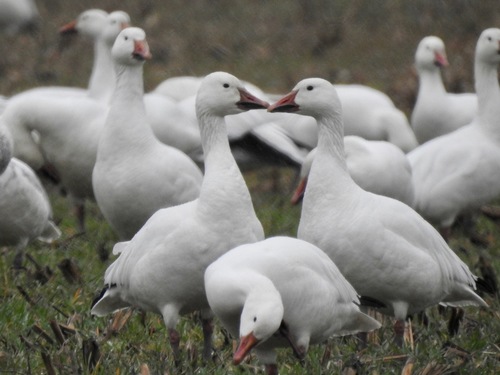
ハクガン (Anser caerulescens) ハクガン
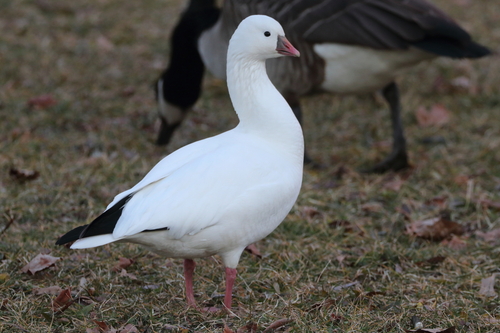
ヒメハクガン (Anser rossii) ヒメハクガン

メディア

読み込み中…

要点

ハクガンとヒメハクガンを区別する最も信頼できるフィールドマークは、サイズとくちばしの構造です:ヒメハクガンは約40%小さく、明らかに短い首と、ハクガンの目立つ黒い「グリンパッチ」がない、より太くて三角形のくちばしを持っています。飛行中、成鳥のヒメハクガンは全て白い二次羽を持ち、幼鳥のヒメハクガンは暗い中心の二次羽を示します—これは若い鳥にとって有用なマークです。両種は典型的な形態で黒い翼先を持つ白色ですが、ハクガンは非常に稀な暗い「青」形態でも見られることがあります。特に鳥が一緒に見られたり混合群れにいるときは、くちばしの形、頭のプロファイル、全体的な体格に注意を払うことが重要です。

識別のコツ

  1. Size and structure: ヒメハクガンはハクガンより約40%小さいです。ヒメハクガンではコンパクトで短い首と小さな頭の鳥を探し、対してハクガンはより大きく、長い首とより頑丈です。これは両種が比較のために存在する時に最も信頼できます。
  2. Bill shape and 'grin patch': ハクガンは目立つ黒い「グリンパッチ」(くちばしの暗い縁)を持つ、長く傾斜のあるくちばしを持っています。ヒメハクガンは短い三角形のくちばしを持ち、青みがかった基部と明らかな「グリンパッチ」がありません。これは近距離での診断に役立ちます。
  3. Head profile: ヒメハクガンは丸い頭を持ち、ハクガンの頭はよりくさび形です。
  4. Juvenile secondary feathers: 幼鳥のヒメハクガンは暗い中心の二次羽を持ち、飛行中または翼を広げた時に見えます。成鳥のヒメハクガンは全て白い二次羽を持っています。ハクガンの幼鳥はこのパターンを示さず、彼らの翼は黒い初列羽を持つより均一に淡いです。
  5. Blue morphs: 青形態のハクガンは一般的で、白い頭と首を持つ青灰色の体を示します。青形態のヒメハクガンは非常に稀です(成鳥の<0.01%)、したがって青形態の鳥はほぼ確実にハクガンです。
  6. Leg and bill color: 両種は成鳥としてピンクがかった脚とくちばしを持っていますが、ヒメハクガンはくちばしの青みがかった基部とイボ状の構造を示すことがあります(特に古い鳥で)。未熟な鳥は色が鈍いです。
  7. Neck length: すべての姿勢において、ヒメハクガンはハクガンに比べて体のサイズに対してはるかに短い首を示します。これは特に鳥が警戒している時や首を伸ばしている時に明らかです。
  8. Flock composition: 大きな群れでは、特に移動中や冬に、ハクガンは圧倒的に一般的です。ハクガンの中に小さく短い首の白いガチョウがいる場合、それはおそらくヒメハクガンです。
  9. Sex differences: メスのヒメハクガンはオスより平均して約6%小さいですが、これは鳥が並んでいない限り有用なフィールドマークではありません。
  10. No subspecies in Ross's: ヒメハクガンは地理的変異を示さず、ハクガンにはサイズが重なる二つの亜種(小型と大型)があり、どちらもヒメハクガンより大きいです。
  11. Head staining: 両種は鉄分の豊富な土壌で餌を食べることから頭に錆色の染みを示すことがありますので、これは信頼できる区別ではありません。
  12. Behavior in flight: ヒメハクガンは飛行中により敏捷でコンパクトに見え、ハクガンはより重く長い首に見えます。この印象は微妙ですが、経験に役立つことがあります。
  13. Plumage confusion: 全体的な白さや黒い翼先のみに頼らないでください。両種は白い形態でこれらの特徴を共有しています。確認のために構造とくちばしの形を使用してください。
  14. Vocalization: 鳴き声は利用可能な音符に基づいてフィールドで信頼できる区別はできません。
  15. Habitat overlap: 両種は移動中や冬に似た生息地を使用しますので、文脈は信頼できる区別ではありませんが、ハクガンははるかに一般的です。

大きさ

ハクガンはかなり大きく、平均体重は約2630 gで、ヒメハクガンは1589.5 gです。ハクガンは64–79 cm(25–31 in)の高さで、ヒメハクガンは57–64 cm(22.6–25.2 in)です。翼幅もハクガンの方が大きいです(135–165 cm対113–116 cmのヒメハクガン)。フィールドでは、これはハクガンにとってはるかに大きく、長い首の印象に変わります、特に両種が一緒に存在する時に。ヒメハクガンは北アメリカで最も小さな白いガチョウであり、この違いは直接比較でしばしば明らかです。

羽色

行動

両種は非常に群れを成し、特に繁殖シーズン外で大きな群れで餌を食べることがよくあります。ハクガンの群れは通常より大きく、より多く、ヒメハクガンはしばしばハクガンと関連し、時には混合群れの小さな割合を占めます。飛行中、ヒメハクガンはその小さなサイズと短い首のためによりコンパクトで敏捷に見え、ハクガンはより重く長い首に見えます。両種は非常に声が大きいですが、彼らの鳴き声は距離で信頼できる区別はできません。

生息環境

両種は北極で繁殖し、似たような生息地を通って移動し、農業用地、湿地、ツンドラに立ち寄ることがよくあります。ハクガンははるかに一般的で広範囲に分布していますが、ヒメハクガンは中央北極でより制限された繁殖範囲を持っています。冬には、両者は似たような生息地に見られますが、ハクガンは大きな数で遭遇する可能性がはるかに高いです。

声

両種は非常に声が大きいとされており、彼らの鳴き声は長距離にわたって届くことがあります。しかし、音符はハクガンとヒメハクガンの間の声の診断的な違いを提供しないため、鳴き声は区別のための信頼できるフィールドマークではありません。

より良い説明を送る

比較と同じ項目を使ってください。文章はすぐに公開されます。

The most reliable field mark to separate Snow Goose from Ross's Goose is size and bill structure: Ross's Goose is about 40% smaller and has a noticeably shorter neck and a stubbier, triangular bill without the Snow Goose's prominent black 'grin patch.' In flight, adult Ross's Geese have all-white secondaries, while juvenile Ross's show dark-centered secondaries—a useful mark for young birds. Both species are white with black wingtips in their typical morph, but Snow Goose can also be seen in a dark 'blue' morph, which is extremely rare in Ross's. Careful attention to bill shape, head profile, and overall bulk is essential, especially when birds are seen together or in mixed flocks.

  1. Size and structure: Ross's Goose is about 40% smaller than Snow Goose. Look for a compact, short-necked, and small-headed bird in Ross's, versus a larger, longer-necked, and more robust Snow Goose. This is most reliable when both species are present for comparison.
  2. Bill shape and 'grin patch': Snow Goose has a longer, sloping bill with a prominent black 'grin patch' (the dark edge of the bill). Ross's Goose has a short, triangular bill with a bluish base and no obvious 'grin patch.' This is diagnostic at close range.
  3. Head profile: Ross's Goose has a rounded head, while Snow Goose's head is more wedge-shaped.
  4. Juvenile secondary feathers: Juvenile Ross's Geese have dark-centered secondaries, visible in flight or when the wing is spread. Adult Ross's have all-white secondaries. Snow Goose juveniles do not show this pattern; their wings are more uniformly pale with black primaries.
  5. Blue morphs: Blue-morph Snow Geese are common, showing a bluish-gray body with white head and neck. Blue-morph Ross's Geese are extremely rare (<0.01% of adults), so a blue-morph bird is almost certainly a Snow Goose.
  6. Leg and bill color: Both species have pinkish legs and bills as adults, but Ross's may show a bluish base to the bill and warty structures (especially in older birds). Immature birds of both species have duller colors.
  7. Neck length: In all postures, Ross's Goose shows a much shorter neck relative to body size than Snow Goose. This is especially apparent when birds are alert or stretching their necks.
  8. Flock composition: In large flocks, especially in migration or winter, Snow Goose is overwhelmingly more common. A small, short-necked white goose among Snow Geese is likely a Ross's.
  9. Sex differences: Female Ross's Geese average about 6% smaller than males, but this is not a useful field mark unless birds are side by side.
  10. No subspecies in Ross's: Ross's Goose shows no geographic variation, while Snow Goose has two subspecies (lesser and greater) that overlap in size, but both are larger than Ross's.
  11. Head staining: Both species can show rusty staining on the head from feeding in iron-rich soils, so this is not a reliable separator.
  12. Behavior in flight: Ross's Geese appear more agile and compact in flight, while Snow Geese look heavier and longer-necked. This impression is subtle but can help with experience.
  13. Plumage confusion: Do not rely solely on overall whiteness or black wingtips, as both species share these features in the white morph. Use structure and bill shape for confirmation.
  14. Vocalization: Calls are not reliably separable in the field based on the available notes.
  15. Habitat overlap: Both species use similar habitats during migration and winter, so context is not a reliable separator except that Snow Goose is much more abundant.

Snow Goose is substantially larger, with an average mass of about 2630 g compared to Ross's Goose at 1589.5 g. Snow Goose stands 64–79 cm tall (25–31 in), while Ross's Goose is 57–64 cm (22.6–25.2 in). Wingspan is also greater in Snow Goose (135–165 cm vs. 113–116 cm for Ross's). In the field, this translates to a much bulkier, longer-necked impression for Snow Goose, especially when both species are present together. Ross's Goose is the smallest white goose in North America, and this difference is often obvious in direct comparison.

  • Juvenile/immature birds: Juvenile Ross's Geese have dark-centered secondary feathers, which can be seen in flight or at rest, while adult Ross's have all-white secondaries. This is a key mark for separating young Ross's from Snow Goose, whose juveniles do not show this pattern. Immature blue-morph Snow Geese are drab or slate-gray with little to no white on the head, neck, or belly, while blue-morph Ross's is vanishingly rare.
  • Adults: Both species are white with black wingtips in their typical morph. Snow Goose white morph is pure white with black primaries; blue morph (common in Snow, rare in Ross's) is mostly bluish-gray with white only on the head, neck, and tail tip. Both have pinkish bills and legs (brighter in adults), but Snow Goose's bill is longer with a black 'grin patch.'
  • Head and bill: Ross's Goose has a rounded head and short, triangular bill with a bluish base and warty structures (more obvious with age), while Snow Goose has a longer, sloping bill with a distinct black 'grin patch.'
  • Legs: Both have rose-red legs as adults, but Ross's start olive-gray as goslings.

Both species are highly gregarious and often feed in large flocks, especially outside the breeding season. Snow Goose flocks are usually larger and more numerous, and Ross's Geese frequently associate with Snow Geese, sometimes making up a small percentage of mixed flocks. In flight, Ross's Geese appear more compact and agile due to their smaller size and shorter necks, while Snow Geese look heavier and longer-necked. Both species are very vocal, but their calls are not reliably separable at a distance.

Both species breed in the Arctic and migrate through similar habitats, often stopping in agricultural fields, wetlands, and tundra. Snow Goose is much more abundant and widespread, while Ross's Goose has a more restricted breeding range in the central Arctic. In winter, both can be found in similar habitats, but Snow Goose is far more likely to be encountered in large numbers.

Both species are described as very vocal, and their calls can carry for long distances. However, the notes do not provide diagnostic differences in voice between Snow Goose and Ross's Goose, so vocalizations are not a reliable field mark for separation.

変更を破棄しますか?

保存していない編集があります。今離れると失われます。

ハクガン · ヒメハクガン · 苦手な鳥