

Motmot

Snow Goose vs Greylag Goose

Anser caerulescens versus Anser anser

Play a quiz with Snow Goose and Greylag Goose
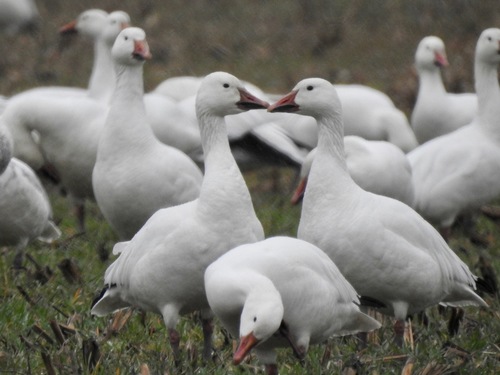
Snow Goose (Anser caerulescens) Snow Goose
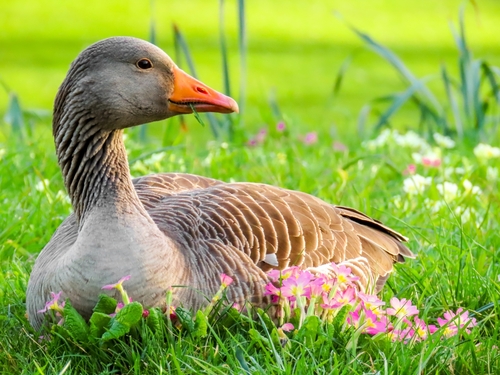
Greylag Goose (Anser anser) Greylag Goose

Media

Loading…

In short

The most reliable field mark to separate Snow Goose from Greylag Goose is overall plumage: adult Snow Geese are either pure white with black wingtips (white morph) or have a blue-gray body with a white head (blue morph), while Greylag Geese are always gray-brown with a paler belly and never show a pure white or blue-gray morph. In flight, Snow Goose (all ages) shows a striking black-and-white wing pattern (white morph) or a dark, contrasting upperwing (blue morph), while Greylag Goose has pale gray forewings and rump, with no black wingtips. Bill and leg color also differ: Snow Goose has a pink bill with a black 'grin patch' and pinkish legs, while Greylag Goose has an orange bill and pink legs. Juvenile Snow Geese can be confusingly gray, but lack the orange bill and gray-brown, barred upperparts of Greylag. Size is not a safe separator, but Greylag is bulkier on average.

Identification tips

  1. Plumage morphs: Snow Goose comes in two morphs: white (entirely white with black wingtips) and blue (blue-gray body with white head and tail tip). Greylag Goose never shows these morphs—always gray-brown and barred.
  2. Flight pattern (all ages): Snow Goose (white morph) in flight shows a sharp black-and-white contrast on the upperwing; blue morph is dark with white head. Greylag Goose has pale gray forewing and rump, with no black wingtips.
  3. Juvenile confusion: Juvenile Snow Geese (especially blue morph) are grayish, but lack the barred, mottled look of Greylag and never have an orange bill. Juvenile Greylags are gray-brown, lack black belly spots, and have grayish legs.
  4. Bill color and shape: Snow Goose has a pink bill with a prominent black 'grin patch' (dark edge along the cutting edge); Greylag Goose has an orange bill, usually stouter, and lacks the black edge.
  5. Leg color: Both can have pinkish legs, but Greylag's are consistently pink; Snow Goose's are rose-red in adults, duller in immatures.
  6. Head and neck: Snow Goose (white morph) has a pure white head; blue morph has a white head on a blue-gray body. Greylag Goose has a gray-brown head, often slightly darker than the body, and a distinctive 'concertina' pattern of neck feathering in adults.
  7. Belly and breast: Greylag Goose has a paler breast and belly with variable black spotting (adults); Snow Goose (white morph) is white below, blue morph may have a white belly patch but never the same pattern as Greylag.
  8. Upperwing coverts: Greylag shows light-colored coverts contrasting with darker flight feathers; Snow Goose (white morph) shows white coverts and black primaries.
  9. Tail: Snow Goose has a white tail with a dark terminal band (blue morph); Greylag's tail is grayish with white edges and rump.
  10. Voice: Snow Goose gives loud, high-pitched honks; Greylag's call is lower, cackling, and more domestic goose-like.
  11. Size and structure: Greylag is bulkier and longer on average, but overlap exists—do not rely on size alone.
  12. Habitat: Snow Goose is North American, often in huge flocks in open fields; Greylag is Eurasian, in wetlands and grasslands, but both can appear in agricultural areas.
  13. Rusty head stains: Snow Goose may show rusty staining on the head from feeding in iron-rich soils; Greylag does not.
  14. Hybrid/domestic confusion: Do not confuse white domestic geese (derived from Greylag) with wild Snow Goose; check for bill color and 'grin patch.'
  15. Seasonal context: In North America, a gray-brown Anser with orange bill is almost always a feral Greylag or domestic; in Eurasia, a white goose with black wingtips is almost certainly a vagrant Snow Goose.

Size

Greylag Goose is the heavier and slightly longer species, with an average adult mass of about 3465g and length up to 91 cm, compared to Snow Goose's 2630g and up to 79 cm. However, there is overlap, especially with larger Snow Goose subspecies. In the field, Greylag often appears bulkier and more robust, while Snow Goose is more streamlined. Size alone is unreliable for quick separation, especially at distance or in mixed flocks.

Plumage

Immature Snow Geese (especially blue morph) can be drab gray or slate with little white on the head, neck, or belly, but still lack the barred and mottled pattern of Greylag Goose. Adult Snow Geese are either pure white with black primaries (white morph) or have a blue-gray body with a white head (blue morph); both morphs have black wingtips in flight. Greylag Goose, adult and immature, is always gray-brown with a paler belly and variable black spotting, and never shows a pure white or blue-gray phase. Its upperwing in flight is pale gray on the forewing and rump, with light coverts contrasting with darker flight feathers, but never shows the sharp black-and-white contrast of Snow Goose. Juvenile Greylags lack black belly speckling and have grayish legs, but still show the overall gray-brown, barred look. Snow Goose always has a pink bill with a black 'grin patch', while Greylag's bill is orange and lacks the black edge.

Behaviour

Both species are social and often seen in flocks, but Snow Goose flocks can be extremely large and noisy, especially during migration and on wintering grounds. Greylag flocks are usually smaller and may be more sedate. Both feed on open ground, but Snow Geese are more likely to be seen in agricultural fields in winter, while Greylag may be found in a wider range of wetland and grassland habitats. Both species are wary and alert, but Greylag may appear more ponderous and less agile in flight.

Habitat

Snow Goose is native to North America and is most often found in large flocks in open fields, marshes, and agricultural land, especially in winter. Greylag Goose is Palearctic, found across Europe and Asia, and prefers wetlands, lakes, and adjacent grasslands. In areas where both are present (e.g., feral or vagrant populations), context can help, but habitat overlap is possible in wintering or migration periods.

Voice

Snow Goose is very vocal, with loud, high-pitched honks that can carry over a mile. Greylag Goose has a lower, cackling call ('aahng-ung-ung'), reminiscent of domestic geese, and flocks can sound like baying hounds. The calls are distinct, but both can be noisy in flocks. Voice is a useful separator if heard well.

Submit a better description

Use the same sections as the comparison. Your text is published immediately.

The most reliable field mark to separate Snow Goose from Greylag Goose is overall plumage: adult Snow Geese are either pure white with black wingtips (white morph) or have a blue-gray body with a white head (blue morph), while Greylag Geese are always gray-brown with a paler belly and never show a pure white or blue-gray morph. In flight, Snow Goose (all ages) shows a striking black-and-white wing pattern (white morph) or a dark, contrasting upperwing (blue morph), while Greylag Goose has pale gray forewings and rump, with no black wingtips. Bill and leg color also differ: Snow Goose has a pink bill with a black 'grin patch' and pinkish legs, while Greylag Goose has an orange bill and pink legs. Juvenile Snow Geese can be confusingly gray, but lack the orange bill and gray-brown, barred upperparts of Greylag. Size is not a safe separator, but Greylag is bulkier on average.

  1. Plumage morphs: Snow Goose comes in two morphs: white (entirely white with black wingtips) and blue (blue-gray body with white head and tail tip). Greylag Goose never shows these morphs—always gray-brown and barred.
  2. Flight pattern (all ages): Snow Goose (white morph) in flight shows a sharp black-and-white contrast on the upperwing; blue morph is dark with white head. Greylag Goose has pale gray forewing and rump, with no black wingtips.
  3. Juvenile confusion: Juvenile Snow Geese (especially blue morph) are grayish, but lack the barred, mottled look of Greylag and never have an orange bill. Juvenile Greylags are gray-brown, lack black belly spots, and have grayish legs.
  4. Bill color and shape: Snow Goose has a pink bill with a prominent black 'grin patch' (dark edge along the cutting edge); Greylag Goose has an orange bill, usually stouter, and lacks the black edge.
  5. Leg color: Both can have pinkish legs, but Greylag's are consistently pink; Snow Goose's are rose-red in adults, duller in immatures.
  6. Head and neck: Snow Goose (white morph) has a pure white head; blue morph has a white head on a blue-gray body. Greylag Goose has a gray-brown head, often slightly darker than the body, and a distinctive 'concertina' pattern of neck feathering in adults.
  7. Belly and breast: Greylag Goose has a paler breast and belly with variable black spotting (adults); Snow Goose (white morph) is white below, blue morph may have a white belly patch but never the same pattern as Greylag.
  8. Upperwing coverts: Greylag shows light-colored coverts contrasting with darker flight feathers; Snow Goose (white morph) shows white coverts and black primaries.
  9. Tail: Snow Goose has a white tail with a dark terminal band (blue morph); Greylag's tail is grayish with white edges and rump.
  10. Voice: Snow Goose gives loud, high-pitched honks; Greylag's call is lower, cackling, and more domestic goose-like.
  11. Size and structure: Greylag is bulkier and longer on average, but overlap exists—do not rely on size alone.
  12. Habitat: Snow Goose is North American, often in huge flocks in open fields; Greylag is Eurasian, in wetlands and grasslands, but both can appear in agricultural areas.
  13. Rusty head stains: Snow Goose may show rusty staining on the head from feeding in iron-rich soils; Greylag does not.
  14. Hybrid/domestic confusion: Do not confuse white domestic geese (derived from Greylag) with wild Snow Goose; check for bill color and 'grin patch.'
  15. Seasonal context: In North America, a gray-brown Anser with orange bill is almost always a feral Greylag or domestic; in Eurasia, a white goose with black wingtips is almost certainly a vagrant Snow Goose.

Greylag Goose is the heavier and slightly longer species, with an average adult mass of about 3465g and length up to 91 cm, compared to Snow Goose's 2630g and up to 79 cm. However, there is overlap, especially with larger Snow Goose subspecies. In the field, Greylag often appears bulkier and more robust, while Snow Goose is more streamlined. Size alone is unreliable for quick separation, especially at distance or in mixed flocks.

Immature Snow Geese (especially blue morph) can be drab gray or slate with little white on the head, neck, or belly, but still lack the barred and mottled pattern of Greylag Goose. Adult Snow Geese are either pure white with black primaries (white morph) or have a blue-gray body with a white head (blue morph); both morphs have black wingtips in flight. Greylag Goose, adult and immature, is always gray-brown with a paler belly and variable black spotting, and never shows a pure white or blue-gray phase. Its upperwing in flight is pale gray on the forewing and rump, with light coverts contrasting with darker flight feathers, but never shows the sharp black-and-white contrast of Snow Goose. Juvenile Greylags lack black belly speckling and have grayish legs, but still show the overall gray-brown, barred look. Snow Goose always has a pink bill with a black 'grin patch', while Greylag's bill is orange and lacks the black edge.

Both species are social and often seen in flocks, but Snow Goose flocks can be extremely large and noisy, especially during migration and on wintering grounds. Greylag flocks are usually smaller and may be more sedate. Both feed on open ground, but Snow Geese are more likely to be seen in agricultural fields in winter, while Greylag may be found in a wider range of wetland and grassland habitats. Both species are wary and alert, but Greylag may appear more ponderous and less agile in flight.

Snow Goose is native to North America and is most often found in large flocks in open fields, marshes, and agricultural land, especially in winter. Greylag Goose is Palearctic, found across Europe and Asia, and prefers wetlands, lakes, and adjacent grasslands. In areas where both are present (e.g., feral or vagrant populations), context can help, but habitat overlap is possible in wintering or migration periods.

Snow Goose is very vocal, with loud, high-pitched honks that can carry over a mile. Greylag Goose has a lower, cackling call ('aahng-ung-ung'), reminiscent of domestic geese, and flocks can sound like baying hounds. The calls are distinct, but both can be noisy in flocks. Voice is a useful separator if heard well.

Discard your changes?

You have unsaved edits. If you leave now, those changes will be lost.

Snow Goose · Greylag Goose · My Tricky Birds